

Note: This case study is based on typical project configurations and industry experience for illustrative purposes.
Project Background & Requirements
An off-grid industrial site operates five 2,000 kW diesel generators in parallel — no utility grid, no existing renewable generation. The gensets are configured with automatic load-based staging: below 2,000 kW, one unit runs; approaching 2,000 kW, the second starts; and so on up to five units.
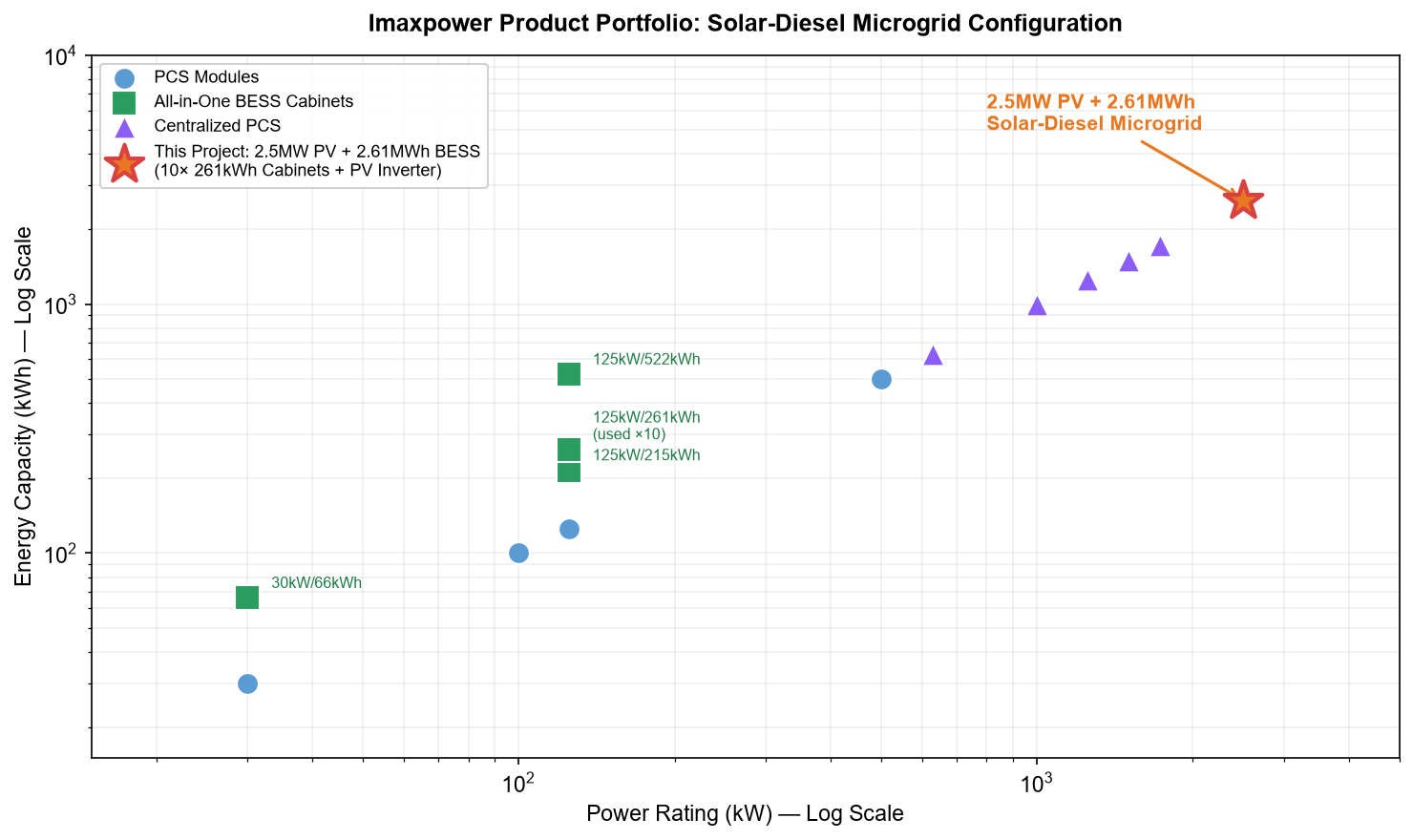
The site owner approached Imaxpower to design a solar-diesel-battery microgrid adding 2.5 MWp of photovoltaic generation and 2,610 kWh of battery energy storage (10 × 261 kWh cabinets) alongside the existing diesel fleet. The core objectives:
- Reduce diesel consumption — displace fuel with solar PV and stored battery energy wherever possible.
- Maintain seamless operation — the PV + BESS system must integrate with the existing paralleled diesel gensets without disrupting their automatic start/stop logic.
- Self-consumption priority — generated energy follows the hierarchy: PV first, battery second, diesel last.
- Protect equipment — no overload conditions, no unexpected blackouts, no damage to the existing diesel paralleling system.
Field assessment confirmed that 2–3 diesel units normally run simultaneously, indicating a typical site load well above 2,000 kW. The 2.5 MWp PV array was sized to meaningfully offset daytime diesel consumption, while the 2,610 kWh BESS provides shifting and peak-shaving capacity.
Key Engineering Challenges
1. Can the BESS Operate in Standalone Island Mode Without Risking Overload?
The critical design question: when site load drops very low, should the battery system take over completely and shut down all diesels? The answer is no — and here is why. If the BESS runs standalone and a large motor or process load starts suddenly, the EMS can signal the diesels to start, but diesel generators require 10–30 seconds to spin up, synchronize, and accept load. During that window, the PCS would face an overload it cannot absorb — equipment trips, the site goes dark, and the customer experiences an unacceptable outage.
2. Integrating With Existing Diesel Paralleling Without Disrupting Auto-Staging
The five 2,000 kW gensets already have a sophisticated paralleling and auto-staging controller. Adding PV and BESS must not interfere with this logic. If the PCS presents as a grid-forming source, it could conflict with the diesel synchronizing controllers. If it presents as a pure grid-tied (grid-following) source, it simply injects power onto the AC bus exactly like any other load or generator — the diesel controller sees a reduced net load and stages units accordingly. This is the cleanest integration approach.
3. Maximizing Solar Self-Consumption While Avoiding Curtailment and Waste
With 2.5 MWp of PV and variable site load, midday solar generation can exceed immediate demand. Without storage, excess PV would need to be curtailed (wasted). The 2,610 kWh BESS absorbs excess PV for later use. Additionally, when a diesel generator runs at part-load (inefficient) and has spare capacity, that redundancy can be used to charge the battery — converting wasted fuel efficiency into stored energy. The EMS must coordinate all three sources in real time.
Our Engineering Solution
System Architecture
Imaxpower designed a pure grid-tied solar-diesel-battery microgrid with one non-negotiable rule: at least one diesel generator remains running at all times, even if only idling. This idle diesel acts as a “virtual grid” — providing frequency and voltage reference for the grid-following PCS and PV inverters, and ensuring instantaneous capacity is available if load suddenly spikes.
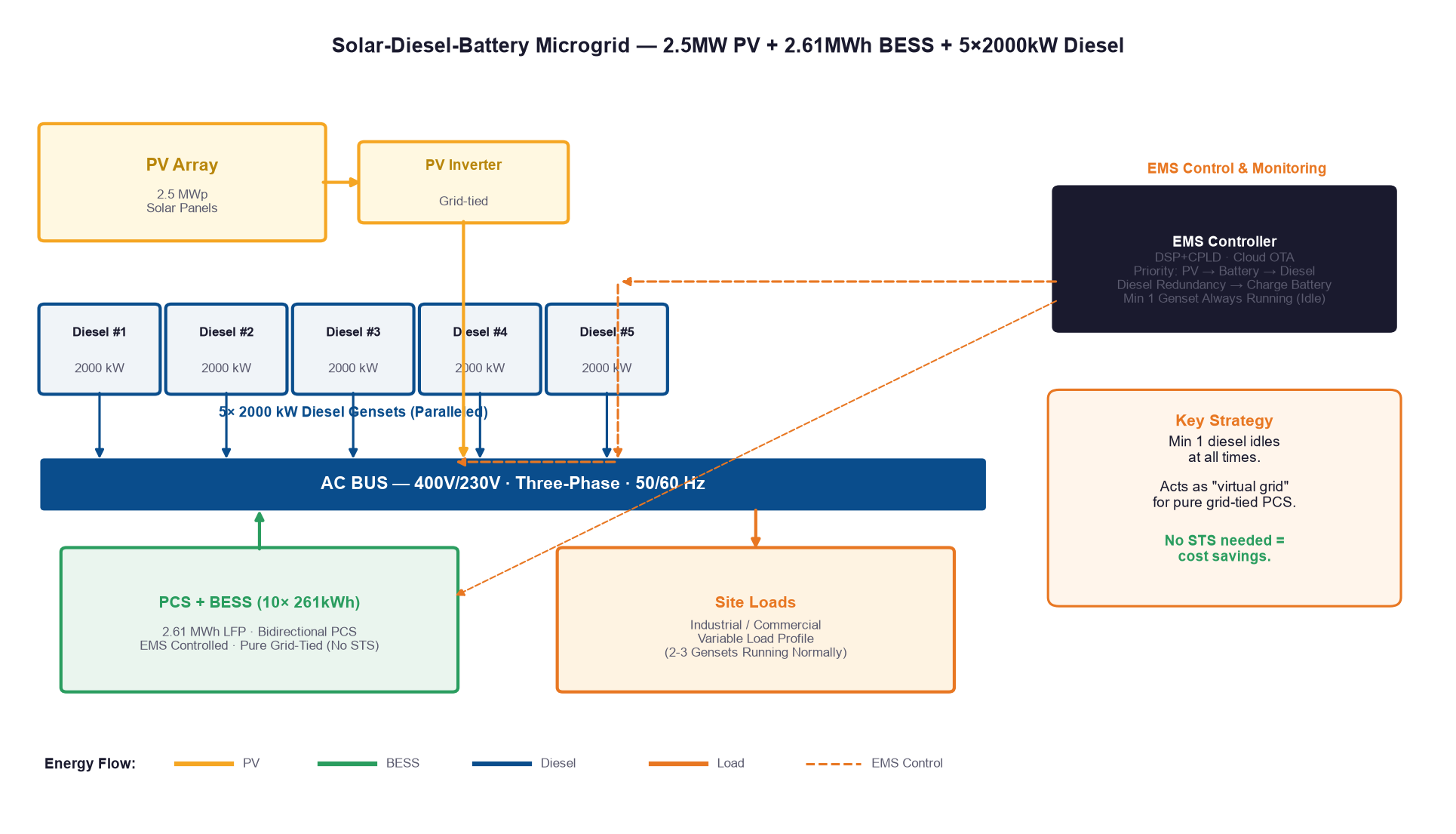
This architecture deliberately omits the Static Transfer Switch (STS). Because one diesel always provides the grid reference, the PCS never needs to transition from grid-following to grid-forming. The system operates as pure grid-tied at all times — simpler, more reliable, and lower cost. The existing diesel auto-staging logic is completely undisturbed: the controller simply sees a lower net load (because PV and BESS are injecting) and stages units accordingly.
Component Selection
| Component | Selection | Key Specification | Engineering Rationale |
|---|---|---|---|
| PV Array | 2.5 MWp monocrystalline | ~2,000 kW peak at STC | Offsets daytime diesel consumption; sized for site load profile |
| PV Inverter | Grid-tied string inverters | 400V AC output, 98% efficiency | Grid-following; synchronizes to diesel bus reference |
| PCS + BESS | Imaxpower MSP500HCG2 + 10× 261 kWh cabinets | 500 kVA PCS, 2.61 MWh LFP, 99.3% efficiency | Pure grid-tied operation; EMS with diesel-hybrid mode; IP54 outdoor rated |
| EMS | Imaxpower full-stack self-developed | DSP+CPLD, cloud OTA, diesel-hybrid logic | Priority PV→Battery→Diesel; diesel redundancy charging; no third-party black box |
| Thermal | IP54 fan-cooled (standard) | −30 °C to +60 °C | Outdoor deployment; no climate-controlled room needed |
| Optional DC/DC | Imaxpower 125 kW bidirectional DC-DC | 1250V port, ≤5% ripple | For future PV DC-coupling or multi-voltage battery clusters |
Operating Strategy: Priority PV → Battery → Diesel
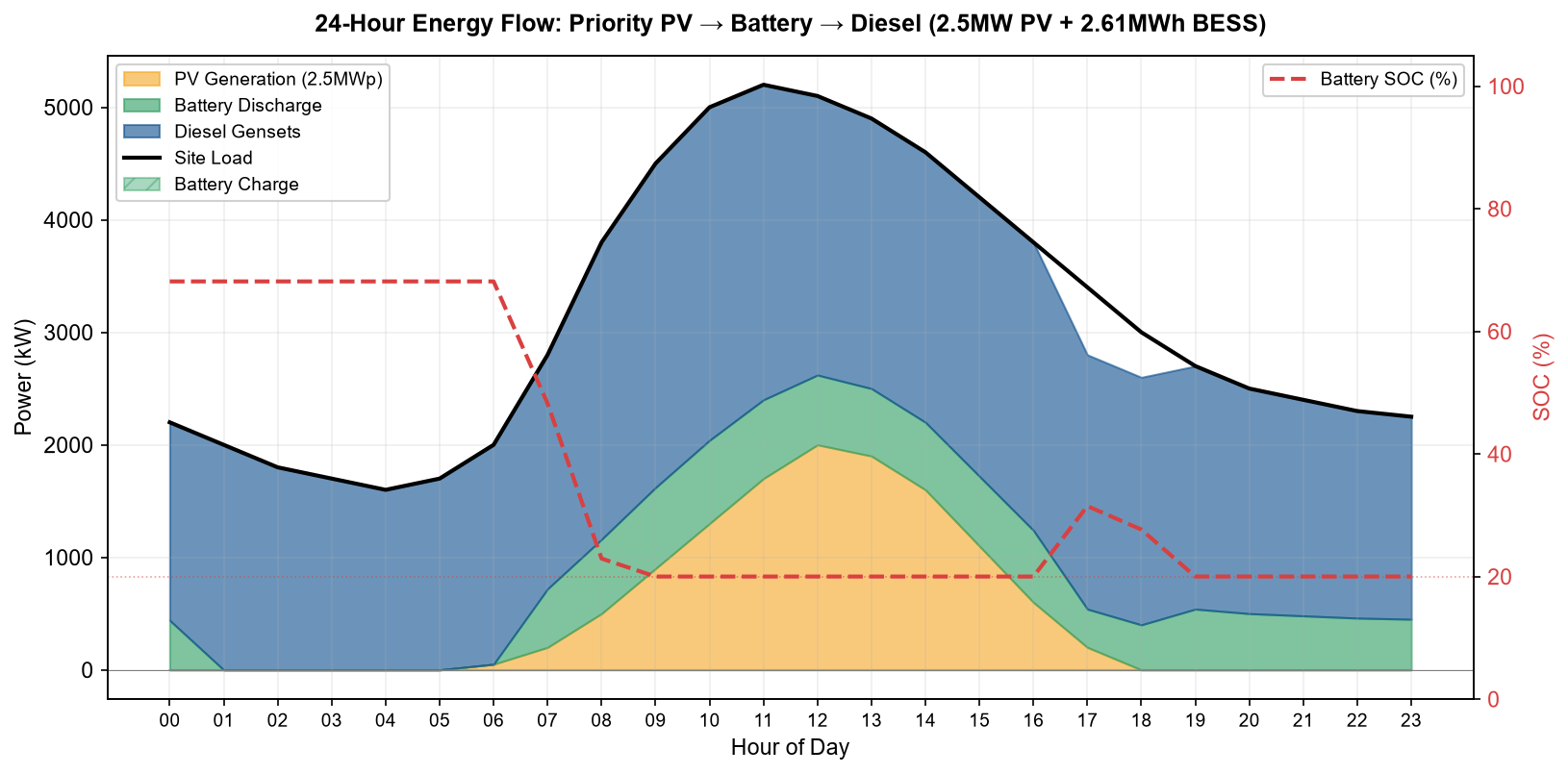
The EMS implements a strict energy priority hierarchy:
- 1. PV first. Solar generation directly supplies site load. Any PV in excess of immediate load charges the battery.
- 2. Battery second. When PV is insufficient (night, cloudy periods), the battery discharges to supplement load, reducing diesel runtime. Discharge stops at 20% SOC floor.
- 3. Diesel last. Only when PV + battery cannot meet demand do the diesels carry the remaining load. The existing auto-staging controller determines how many units run.
- Diesel redundancy → battery charging. If a running diesel has spare capacity (operating below its efficient band) and the battery is below 95% SOC, the EMS uses that redundancy to charge the battery — converting wasted part-load efficiency into stored energy.
- Minimum 1 diesel always running. Even at zero net load, one diesel idles to provide grid reference and instantaneous overload capacity. This eliminates the need for STS and prevents the standalone-overload failure mode.
How to Select the Right Configuration
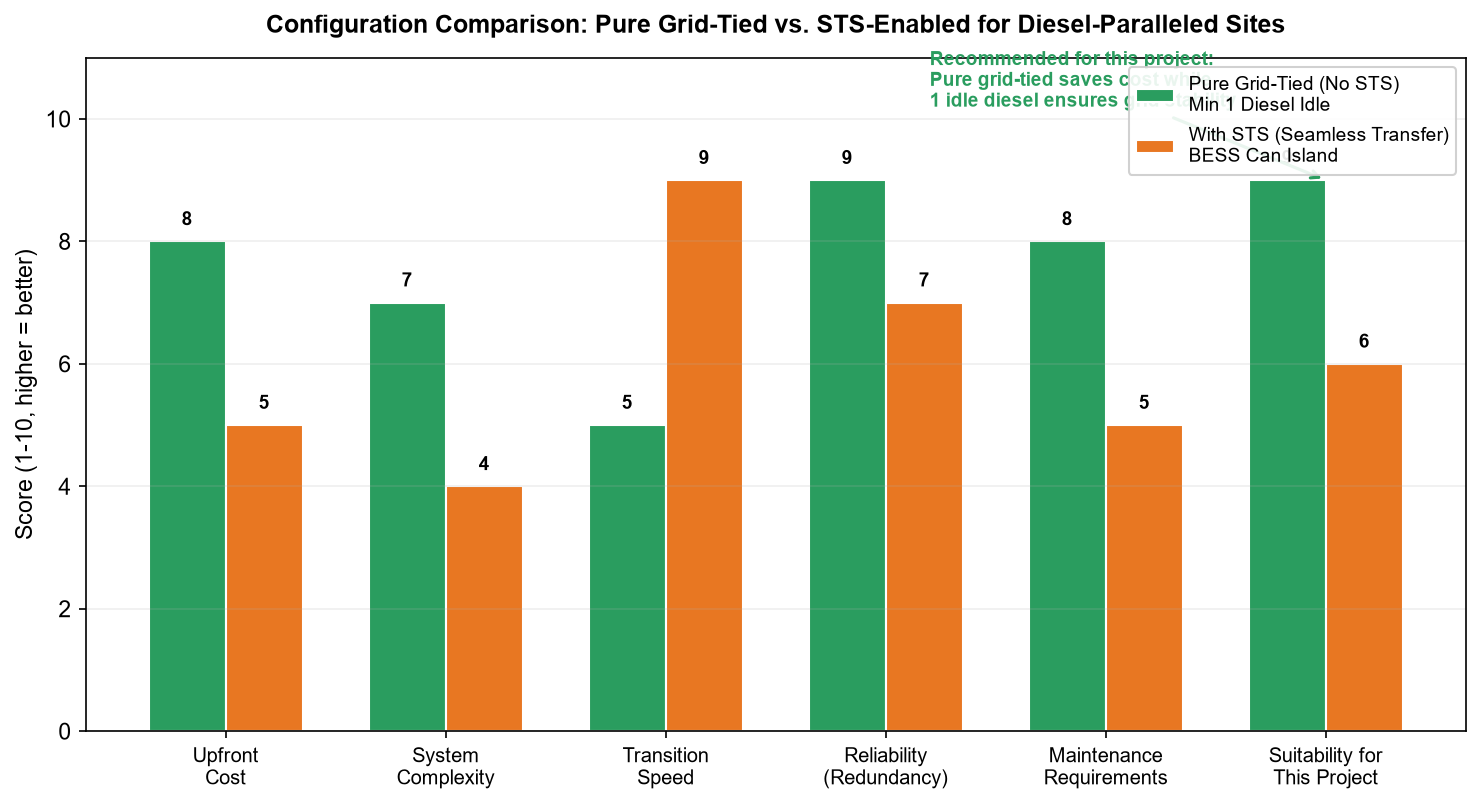
The critical design decision for any diesel-paralleled site is whether to use a pure grid-tied PCS or an STS-enabled grid-forming PCS. The choice depends on whether the site can guarantee at least one diesel running at all times:
| Scenario | Recommended Configuration | Why |
|---|---|---|
| Diesel-paralleled site, min 1 unit guaranteed running | Pure grid-tied PCS (no STS) | Idle diesel = virtual grid; no transition risk; lower cost; preserves existing auto-staging |
| Site may shut down all diesels (zero-diesel mode) | STS-enabled grid-forming PCS | Must handle grid-following → grid-forming transition; higher cost and complexity |
| Grid-connected site with backup requirement | PCS with STS (MSP100HKST/MSP125HKST) | Seamless grid-to-island transition for critical load backup |
| Remote site with unreliable single diesel | STS-enabled + oversized BESS | Battery must bridge diesel start-up time; grid-forming capability essential |
For this project — five paralleled diesels with guaranteed minimum 1-unit operation — the pure grid-tied configuration is the optimal choice. It saves the cost of STS hardware, eliminates transition-related failure modes, and integrates cleanly with the existing diesel paralleling controller.
Measured Results & Performance
Based on typical project configurations and simulation validation for this 2.5 MW PV + 2.61 MWh BESS microgrid:
| Metric | Expected Value | Baseline (Diesel-Only) | Improvement |
|---|---|---|---|
| Daytime diesel displacement | 30–45% (PV + BESS) | 0% | Significant fuel reduction |
| PCS round-trip efficiency | > 99.3% | N/A | Minimal storage losses |
| PV inverter efficiency | ~98% | N/A | Industry-leading |
| System availability | > 99% | ~95% (diesel maintenance) | BESS provides redundancy |
| Transition risk | None (pure grid-tied) | N/A | No STS = no failure point |
| Diesel auto-staging | Preserved unchanged | Original | Zero integration disruption |
| Battery cycle life (20–100% SOC) | > 6,000 cycles | N/A | ~15+ years at 1 cycle/day |
| Operating temperature | −30 °C to +60 °C | 0–40 °C (typical) | Outdoor-rated for extreme climates |
Project Note: In a comparable off-grid solar-diesel microgrid in Southeast Asia (1.8 MW PV + 2 MWh BESS + 3× 1250 kVA diesels), the system achieved a 38% reduction in diesel runtime during daylight hours, with the EMS successfully using diesel part-load redundancy to charge the battery on cloudy days. The pure grid-tied configuration operated for 12+ months with zero transition-related outages.
Need a Similar System Design?
If you’re planning an off-grid microgrid, solar-diesel hybrid, or BESS integration project, our engineering team can help you design the optimal system based on your specific load profile, generator configuration, PV potential, and site conditions.
Send us your project specs — load curve, generator ratings, PV capacity, site ambient conditions, and required backup capacity — we’ll propose a solution within 24 hours.
Contact: info@imaxpwr.com | Tel/WhatsApp: +86-13760212825 | www.imax-pwr.com
Key Lessons Learned
- Never let BESS run standalone on a diesel-paralleled site unless you can guarantee no load steps. A sudden motor start during island mode will overload the PCS before diesels can spin up. Keep at least one diesel idling.
- Pure grid-tied beats STS when a diesel reference is available. STS adds cost, complexity, and a potential failure point. If one diesel can always run, you don’t need grid-forming capability.
- Don’t disrupt the existing diesel auto-staging. Treat the PCS and PV as grid-following injectors — the diesel controller sees reduced net load and stages units naturally. No custom integration needed.
- Use diesel part-load redundancy to charge the battery. A diesel running at 40% load is wasting fuel. If the battery needs charging, divert that redundancy — it’s essentially free stored energy.
- Size PV for self-consumption, not export. In an off-grid microgrid, there is no grid to export to. Oversizing PV beyond what the load + battery can absorb results in curtailment and wasted capital.
- IP54 outdoor rating is essential for remote sites. Climate-controlled rooms add cost and complexity. Outdoor-rated cabinets install directly next to the diesel yard.
FAQ
Q: Can a solar-diesel-battery microgrid operate with no diesel running at all?
A: Technically yes, if the PCS has grid-forming capability (with STS). But for sites with large inductive loads or sudden load steps, we do not recommend zero-diesel mode. If the BESS is supplying load alone and a large motor starts, the PCS may overload before the diesels can start and synchronize (10–30 seconds). Keeping at least one diesel idling provides instantaneous capacity and eliminates this risk. For sites that must achieve zero-diesel operation, oversized BESS with grid-forming PCS and careful load management is required.
Q: How do I size the PV and BESS for my off-grid diesel site?
A: Start with your 24-hour load curve. Size PV to cover 30–60% of your average daytime load (beyond that, curtailment risk increases). Size BESS for 2–4 hours of your peak evening load, or enough to shift excess midday PV to evening hours. For this project (2.5 MW PV + 2.61 MWh BESS), the ratio was chosen based on the site’s specific load profile and 10× 261 kWh cabinet configuration. Send us your load curve for a precise sizing calculation.
Q: Will adding PV and BESS interfere with my existing diesel generator paralleling system?
A: No — if configured as pure grid-tied (grid-following). The PV inverters and PCS simply inject power onto the AC bus, exactly like any other generator. The diesel paralleling controller sees a reduced net load and stages units according to its existing logic. No modifications to the diesel controller are required. This is why we recommend pure grid-tied for diesel-paralleled sites — it is the least disruptive integration approach possible.
About the Author
This article was reviewed by Ethan Li, an energy storage system specialist with experience in PCS, DC/DC converters, and microgrid design. With a background in power electronics and field commissioning of solar-diesel hybrid projects across Southeast Asia, the Middle East, and Africa, Ethan focuses on translating off-grid engineering requirements into deployable hybrid system architectures.
About IMAXPWR
Imaxpower (Imax Power Technology Co., Ltd.) is a China national high-tech enterprise headquartered in Shenzhen, specializing in integrated energy storage products and system solutions. Founded in 2015, the company has delivered 999+ projects worldwide with a 99% customer recognition rate.
The R&D team comprises senior experts from State Grid, Xuji Group, Emerson, and Kehua Hengsheng, with 20+ years of power electronics experience. Imaxpower develops full-stack self-developed PCS, BMS/EMS, bidirectional DC/DC converters, and all-in-one BESS cabinets, covering 30 kW to 2 MW+ system deployments.
Products are certified to UN38.3, IEC, UL, CE, and RoHS standards, shipping to Europe, North America, Southeast Asia, the Middle East, and Africa without re-engineering. The company offers full customization — from system design and engineering to O&M services — tailored to specific project requirements.
Contact: Coco | Tel/WhatsApp/WeChat: +86-13760212825 | Email: info@imaxpwr.com | www.imax-pwr.com