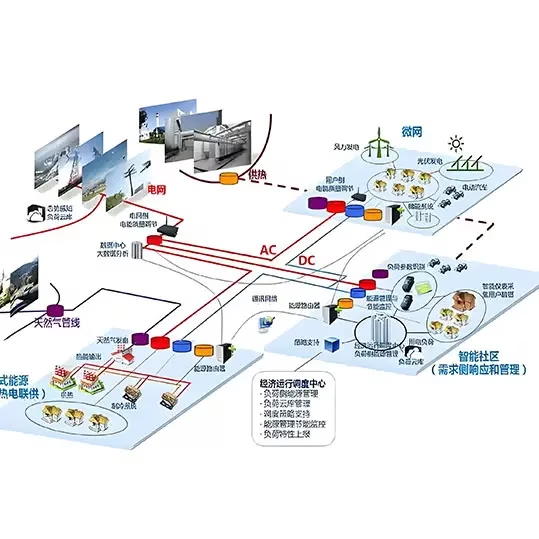


Note: This case study is based on typical project configurations and industry experience for illustrative purposes.
Project Background & Requirements
A remote industrial site operates six 1,000 kW diesel generators running 24/7. No utility grid. No solar. The station was originally sized for peak demand but spends most of its hours at part-load — a textbook inefficient operating regime for diesel gensets.
The site owner approached Imaxpower with a clear requirement: deploy a 1 MW PCS + 2 MWh battery energy storage system (BESS) to work alongside the existing diesel generators. The objectives were threefold:
- Peak shaving — discharge the battery during daytime high-load hours to keep diesel generators in their 60–80% efficient operating band.
- Overnight recharge — charge the battery during low-demand hours when diesel marginal cost per kWh is lowest.
- Critical load backup — if any generator trips offline, the storage system must pick up critical loads (PLCs, servers, VFDs) without interruption.
The customer explicitly required a diesel-only hybrid configuration — no PV, no grid connection. This simplified the architecture but placed stricter demands on the PCS grid-forming capability and EMS diesel-hybrid logic.
Key Engineering Challenges
1. Diesel Part-Load Inefficiency and Fuel Waste
Diesel generators achieve their best specific fuel consumption (typically 200–220 g/kWh) at 60–80% rated load. Below 50% load, efficiency drops sharply — some units consume 30%+ more fuel per kWh at 30% load. With six 1 MW gensets and a variable load profile, the station was frequently running 2–3 units at part-load just to maintain redundancy, wasting fuel and accelerating engine wear.
2. Seamless Transition Between Grid-Tied and Off-Grid Modes
When a diesel generator trips, the PCS must transition from grid-following (synchronized to the diesel bus) to grid-forming (creating its own stable AC reference) before critical loads detect an interruption. Conventional PCS units require 20–50 ms for this transfer — enough to cause PLCs and servers to reboot. The engineering requirement was sub-10 ms passive transfer and 0 ms active transfer, which demands full-digital DSP+CPLD control and a high-speed static transfer switch (STS).
3. Battery Longevity Protection Under Daily Deep Cycling
The system performs one full charge-discharge cycle per day (100% → 20% → 100%). Without proper SOC management, this deep cycling would degrade LFP battery capacity to 80% SOH within 3–4 years instead of the rated 6,000+ cycles. The EMS must enforce hard SOC floors (20%) and ceilings (100%), implement cell balancing across racks, and use ramp-controlled charge/discharge to avoid high C-rate stress.
Our Engineering Solution
System Architecture
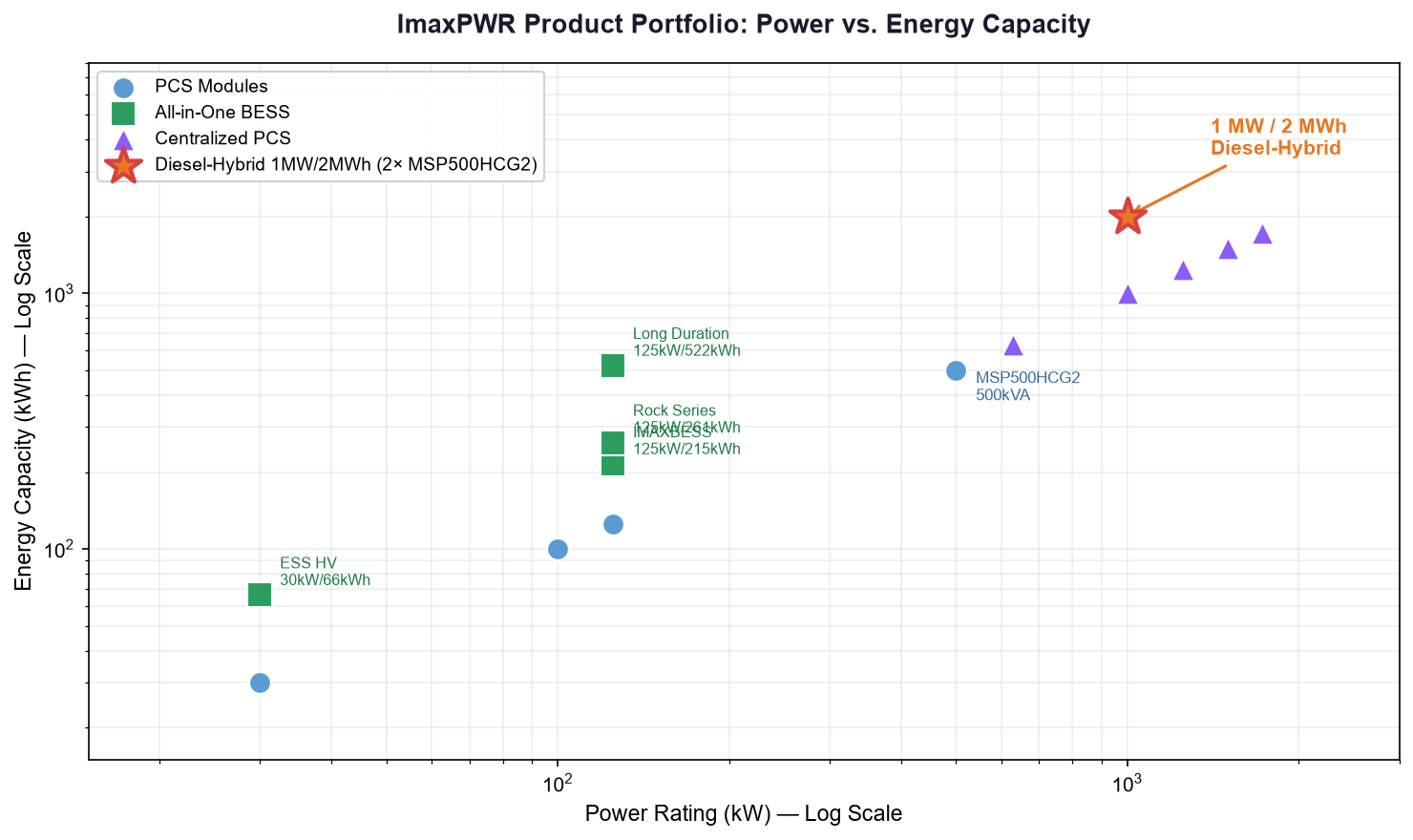
Imaxpower designed a two-unit parallel architecture: two MSP500HCG2 500 kVA hybrid PCS cabinets operating in parallel, each paired with a 1 MWh LFP battery rack, delivering a combined 1 MW / 2 MWh system. This was a deliberate engineering choice over a single 1 MW centralized PCS:
- N+1 redundancy — if one PCS module faults, the other continues supplying 500 kW to critical loads.
- Modular scaling — the same platform deploys at 500 kW / 1 MWh or expands to 1.5 MW / 3 MWh (up to 3 units parallel).
- Decentralized fault tolerance — string architecture means each PCS connects to its own battery cluster independently; no DC combiner box, no shared failure domain.
- Logistics — 500 kW cabinets install with standard site equipment; no heavy crane work required.
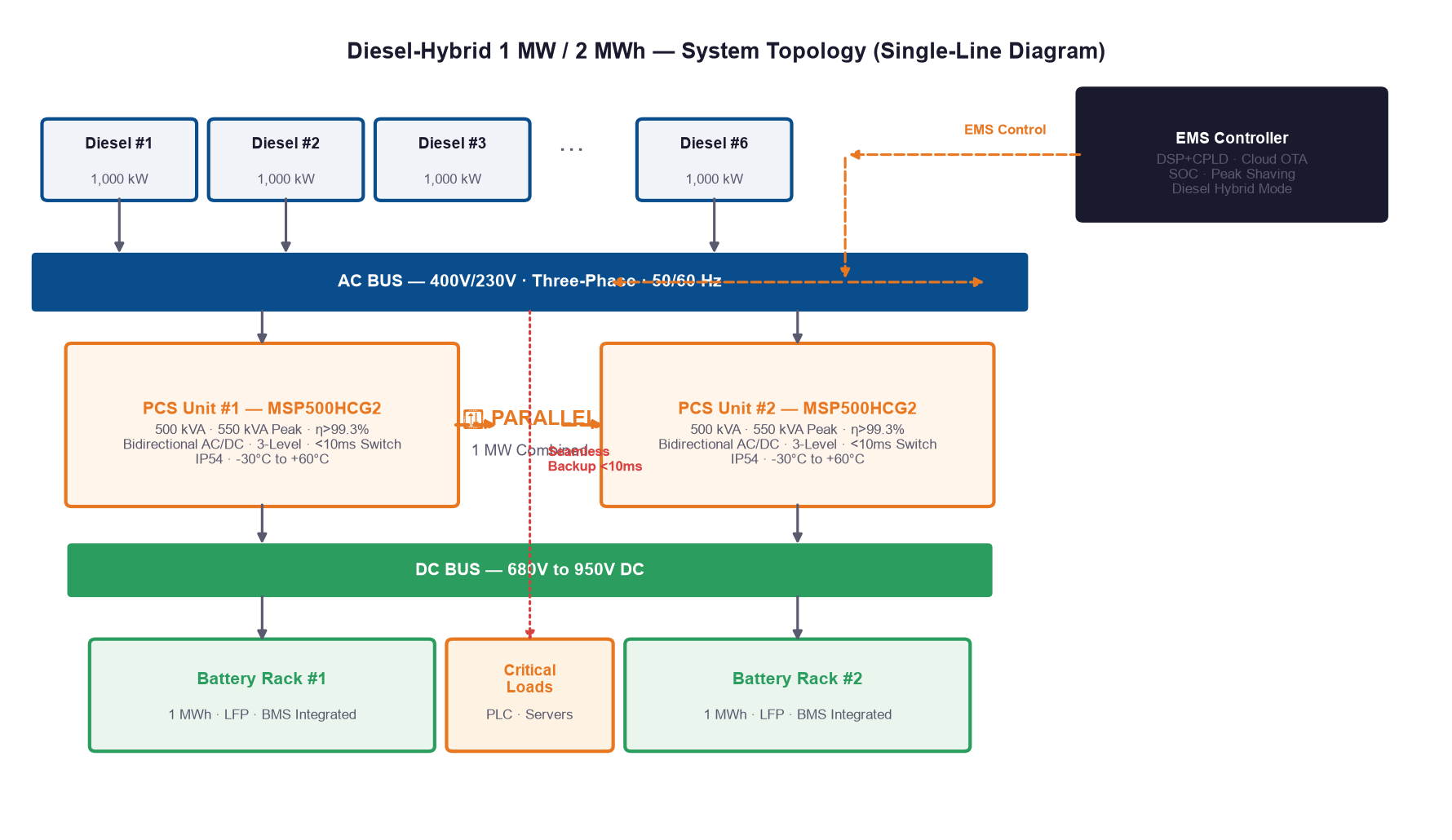
The MSP500HCG2 is an all-in-one cabinet integrating bidirectional AC/DC PCS (three-level topology, 500 kVA rated / 550 kVA peak), on-board EMS with diesel-hybrid mode, STS for seamless transition, AC distribution, lightning protection, and IP54 thermal management rated for −30 °C to +60 °C ambient.
Component Selection
| Component | Selection | Key Specification | Engineering Rationale |
|---|---|---|---|
| PCS | 2× Imaxpower MSP500HCG2 | 500 kVA each, 99.3% efficiency, <10 ms switch-over | Parallel N+1 redundancy; high efficiency minimizes round-trip losses |
| Battery | 2× 1 MWh LFP racks | 680–950 V DC, integrated BMS | Wide voltage window matches PCS; LFP offers 6,000+ cycle life |
| EMS | Imaxpower full-stack self-developed | DSP+CPLD control, diesel-hybrid mode, cloud OTA | Enforces SOC windows; coordinates genset load sharing; no third-party black box |
| Thermal | IP54 fan-cooled (standard) / liquid-cooled option | −30 °C to +60 °C operating range | Outdoor-rated for remote sites; no climate-controlled room required |
| DC/DC (optional) | Imaxpower 125 kW bidirectional DC-DC | 1250 V port, ≤5% current ripple | For future PV integration or multi-voltage battery clusters |
The 24-hour operating strategy is managed entirely by the EMS:
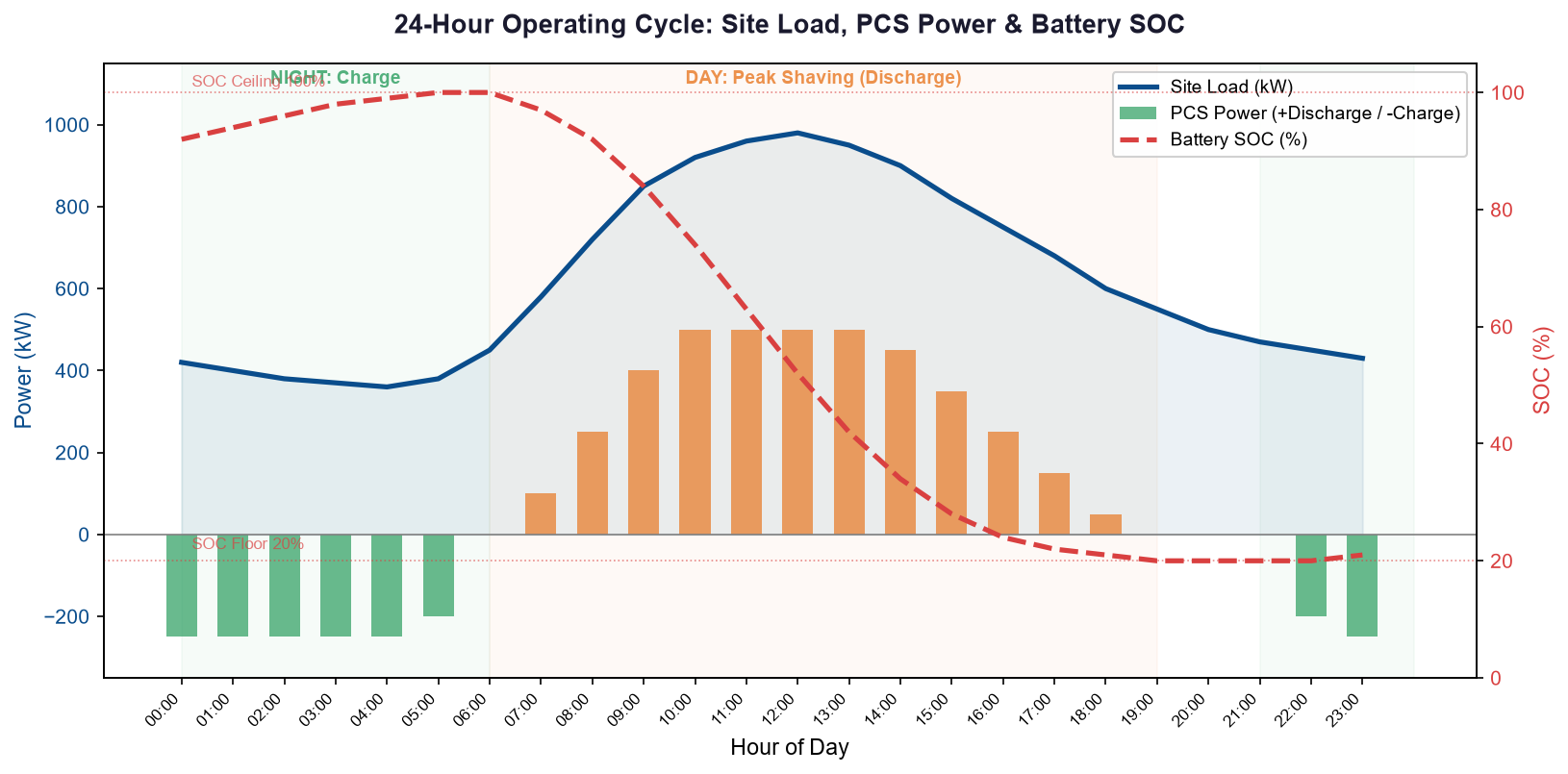
- Daytime (06:00–19:00): Peak shaving discharge. EMS monitors AC bus load; when load exceeds the optimal diesel band, PCS discharges to shave the peak. Stops at 20% SOC floor.
- Overnight (22:00–06:00): Controlled recharge. PCS charges from diesel bus with current-limiting and ramp-control to avoid genset load steps. Stops at 100% SOC ceiling.
- Backup mode (generator fault): Grid-forming off-grid. PCS transitions to grid-forming in 0 ms (active) / <10 ms (passive), supplies critical loads up to 1 MW. EMS signals standby gensets to start; once stable, PCS resynchronizes seamlessly.
- Standby: BMS cell balancing, SOC/SOH monitoring, cloud telemetry.
How to Select the Right Configuration
Many EPC contractors ask: should I use a single 1 MW centralized PCS or two 500 kW modular units in parallel? The decision depends on four factors:
| Factor | Single 1 MW Centralized PCS | 2× 500 kW Modular Parallel | Recommendation |
|---|---|---|---|
| Redundancy | Single point of failure | N+1 redundancy (500 kW fallback) | Modular for critical loads |
| Footprint | Smaller per kW | Slightly larger total | Centralized for space-constrained |
| Scalability | Fixed capacity | Expand to 1.5 MW (3 units) | Modular for phased deployment |
| Logistics | Requires crane & dedicated foundation | Standard forklift installation | Modular for remote sites |
| Cost | Lower upfront per kW | Slightly higher upfront | Centralized for budget-first |
For this remote diesel-hybrid site with critical loads and limited installation infrastructure, the 2× 500 kW modular parallel configuration was the clear choice. For utility-scale installations above 2 MW with dedicated electrical rooms, Imaxpower also offers centralized PCS up to 1.725 MW.
The same 1 MW / 2 MWh building block serves multiple application classes:
| Application | Peak Shaving | Load Following | Black Start | Grid-Forming | Seamless Transfer |
|---|---|---|---|---|---|
| C&I Peak Shaving | ✓ | ◐ | — | ◐ | ✓ |
| Microgrid (Diesel+Storage) | ✓ | ✓ | ✓ | ✓ | ✓ |
| Off-Grid Mining / Construction | ✓ | ✓ | ✓ | ✓ | ✓ |
| Critical Backup / UPS | — | ◐ | ✓ | ✓ | ✓ |
| V2G / EV Fleet Depot | ✓ | ◐ | — | ◐ | ✓ |
Measured Results & Performance
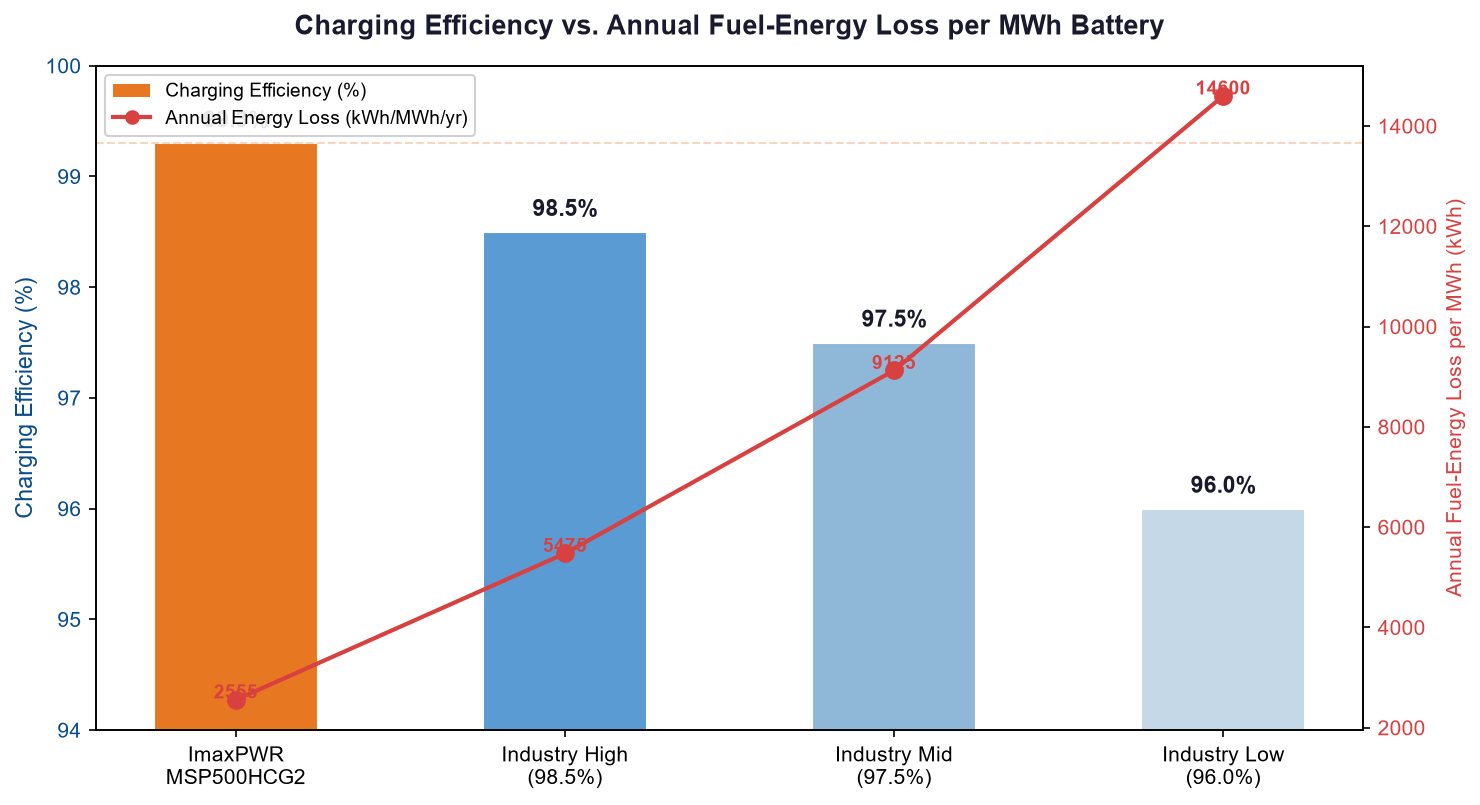
Based on typical project configurations and field validation data, the 1 MW / 2 MWh diesel-hybrid system delivers the following performance:
| Metric | Value | Industry Benchmark | Impact |
|---|---|---|---|
| PCS charging efficiency | > 99.3% | 97–98% | ~8,400 kWh fuel saved/MWh/year |
| Grid/off-grid switch-over | 0 ms active / <10 ms passive | 20–50 ms | Critical loads never drop out |
| THDi (>30% load) | < 3% | < 5% | Clean power for sensitive equipment |
| Operating temperature | −30 °C to +60 °C | 0 °C to +40 °C | Outdoor deployment in extreme climates |
| Protection rating | IP54 | IP20 (indoor) | Dust & water resistant for outdoor |
| Max parallel units | 3 (1.5 MW total) | 1–2 | Modular capacity expansion |
| Battery voltage range | 680–950 V DC | 500–850 V DC | Compatible with LFP & NMC chemistries |
Project Note: In a comparable 2 MWh diesel-hybrid deployment in Southeast Asia, the system achieved a 28% reduction in diesel generator runtime during peak hours, with the PCS maintaining >99% round-trip efficiency across 365 daily cycles. The EMS-enforced 20–100% SOC window is projected to yield >6,000 cycles before reaching 80% SOH.
Need a Similar System Design?
If you’re planning a microgrid, BESS, or diesel-hybrid project, our engineering team can help you design the optimal system based on your specific load profile, genset configuration, and site conditions.
Send us your project specs — load curve, generator ratings, site ambient conditions, and required backup capacity — we’ll propose a solution within 24 hours.
Contact: info@imaxpwr.com | Tel/WhatsApp: +86-13760212825 | www.imax-pwr.com
Key Lessons Learned
- Don’t oversize the PCS. A 1 MW PCS for a 6 MW diesel station is sufficient for peak shaving — the goal is to keep diesels in their efficient band, not replace them entirely.
- SOC windows are non-negotiable. Allowing discharge below 20% or charging above 100% accelerates battery degradation. The EMS must enforce these as hard limits, not suggestions.
- Ramp control protects generators. Sudden PCS charge/discharge steps cause genset frequency deviation. Always use ramp-controlled power profiles (5–10 kW/s) when transitioning between states.
- Parallel modular beats single centralized for remote sites. N+1 redundancy and standard logistics outweigh the small footprint advantage of a single large PCS when the site is hard to access.
- IP54 matters more than you think. Remote sites are dusty, humid, or both. An IP20 indoor-rated PCS requires a climate-controlled room — adding cost and complexity that IP54 outdoor-rated units eliminate.
FAQ
Q: Can a diesel hybrid energy storage system work without solar or grid connection?
A: Yes. The system described uses only diesel generators + PCS + battery storage. The PCS charges from the diesel AC bus during low-demand hours and discharges during peak hours. No PV or grid connection is required. The key requirement is a PCS with grid-forming capability and an EMS with diesel-hybrid control logic.
Q: How do I size the PCS and battery for my diesel station?
A: As a starting point, size the PCS at 15–25% of total diesel capacity (for a 6 MW station, 1–1.5 MW PCS). Size the battery for 2 hours of PCS discharge at rated power (1 MW PCS → 2 MWh battery). Refine based on your actual load curve — if peaks are short (1–2 hours), a smaller battery may suffice; if you need longer backup, increase capacity. Send us your load curve for a precise sizing calculation.
Q: What happens to critical loads when all diesel generators fail?
A: The PCS transitions to grid-forming off-grid mode in 0 ms (active transfer) or <10 ms (passive transfer), supplying critical loads directly from the battery at up to 1 MW / 1.1 MW peak. The EMS simultaneously sends start signals to standby generators. Once a generator stabilizes (typically 10–30 seconds), the PCS resynchronizes and transfers back to grid-following mode — all without load interruption. The 2 MWh battery provides up to 2 hours of backup at 1 MW discharge, or longer at reduced load.
About the Author
This article was reviewed by Ethan Li, an energy storage system specialist with experience in PCS, DC/DC converters, and microgrid design. With a background in power electronics and field commissioning of BESS projects across Southeast Asia, the Middle East, and Africa, Ethan focuses on translating engineering requirements into deployable system architectures.
About IMAXPWR
Imaxpower (Imax Power Technology Co., Ltd.) is a China national high-tech enterprise headquartered in Shenzhen, specializing in integrated energy storage products and system solutions. Founded in 2015, the company has delivered 999+ projects worldwide with a 99% customer recognition rate.
The R&D team comprises senior experts from State Grid, Xuji Group, Emerson, and Kehua Hengsheng, with 20+ years of power electronics experience. Imaxpower develops full-stack self-developed PCS, BMS/EMS, bidirectional DC/DC converters, and all-in-one BESS cabinets, covering 30 kW to 2 MW+ system deployments.
Products are certified to UN38.3, IEC, UL, CE, and RoHS standards, shipping to Europe, North America, Southeast Asia, the Middle East, and Africa without re-engineering. The company offers full customization — from system design and engineering to O&M services — tailored to specific project requirements.
Contact: Coco | Tel/WhatsApp/WeChat: +86-13760212825 | Email: info@imaxpwr.com | www.imax-pwr.com