


Abstract
Choosing an MPPT charge controller is a procurement decision with a measurable effect on project payback, not a commodity purchase. This guide gives buyers a five-spec checklist — conversion and tracking efficiency, MPPT voltage window, protection and environmental rating, scalability and communication, and total cost of ownership — and explains what each number really means before you compare quotes. Solar PV grew faster than any other power technology in 2025, with annual capacity additions surpassing 600 GW for the first time, according to the IEA Global Energy Review 2026, while BloombergNEF reports lithium-ion battery pack prices fell to a record USD 108/kWh in 2025. When PV and battery hardware both move this fast, the controller that connects them decides how much of that low-cost energy actually reaches the load.
1. Why the MPPT Charge Controller Is a Payback Decision
The MPPT charge controller sits between the PV array and the battery or DC bus. Its two jobs are to extract maximum power from the array — tracking the maximum power point as irradiance and temperature change — and to regulate the voltage and current delivered to the battery bank. In a DC-coupled solar-plus-storage system, every kilowatt-hour of PV generation passes through this device, so its efficiency is multiplied across the full lifetime of the asset. A 1% efficiency difference on a 120 kW array operating 5 equivalent sun-hours per day is roughly 2,190 kWh per year — enough to change a project IRR by fractions of a point that matter at tender stage.
The market context explains why this decision is getting more attention. According to the IEA Global Energy Review 2026, solar PV capacity additions in 2025 rose by around 12% and surpassed 600 GW for the first time, bringing cumulative installed capacity to roughly 2,800 GW and making PV the largest installed power technology globally. On the storage side, battery storage was the fastest-growing power technology in 2025, with additions rising about 40% to almost 110 GW. The buyers we meet across Southeast Asia, Africa, the Middle East, and Latin America are no longer asking whether to add storage — they are asking how to couple PV and battery at the lowest lifetime cost, which is exactly the question the controller answers.
2. Spec 1 — Efficiency: What the Datasheet Does and Does Not Tell You
Manufacturers quote two different numbers, and conflating them is the most common buying mistake.Conversion efficiency is the DC-to-DC conversion loss at a stated operating point.MPPT tracking efficiency is how accurately the algorithm keeps the array at its maximum power point under changing conditions. PerIEC 61683:1999, efficiency of power conditioners in photovoltaic systems is calculated from direct measurement of input and output power, so a single-point peak number is legitimate but should not be treated as an annual average. Real-world yield depends on the whole efficiency curve from 10% to 100% load, plus tracking behavior in partly cloudy conditions.
What to check on the datasheet: peak conversion efficiency, efficiency at 50% load (where DC-coupled systems operate much of the time), no-load and standby loss, and MPPT tracking speed. As a reference point, the ImaxPWR BIPV60K2/BIPV120K4/BIPV320K6 wall-mounted hybrid MPPT controller family achieves a rated max efficiency of 99.4%, and the M120KPV1/M120KPV4 120 kW non-isolated DC/DC MPPT module is specified at 99.3% peak efficiency with standby power below 10 W. The BIDC75050F 20 kW isolated bidirectional DC/DC module carries an integrated MPPT function rated above 99.5% tracking efficiency at powers above 5 kW. These numbers are comparable across vendors only when the load point is stated — ask for the efficiency curve, not the headline.
3. Spec 2 — MPPT Voltage Window and String Design
The MPPT operating voltage range must contain the array’s normal operating band, not just its nameplate voltage. Three figures matter: the MPPT voltage range, the full-load MPPT voltage range, and the maximum PV array voltage (which must respect both the controller’s rating and the battery’s maximum withstand voltage). If the array sits outside the window at high temperature, the controller stops tracking and clips power.
Check the numbers against your site. For 900 V-class systems, an MPPT window of 200–900 V with a full-load window of 560–900 V gives comfortable string sizing headroom across ambient temperature swings. For 1500 V-class utility-scale sites, the window shifts up — the BIPV320K6, for example, covers 500–1460 V MPPT with a full-load range of 900–1266 V and a maximum PV array voltage of 1500 V. Also check the number of independent MPPT inputs and the maximum current per tracker, because PV strings facing different azimuths and tilts need separate trackers to avoid losing energy to the lowest common denominator. The BIPV family offers 2/4/6 independent MPPT inputs with 6/12/24 PV branch connections, while the M120KPV1/M120KPV4 supports 1 or 4 PV input channels at up to 200 A total.
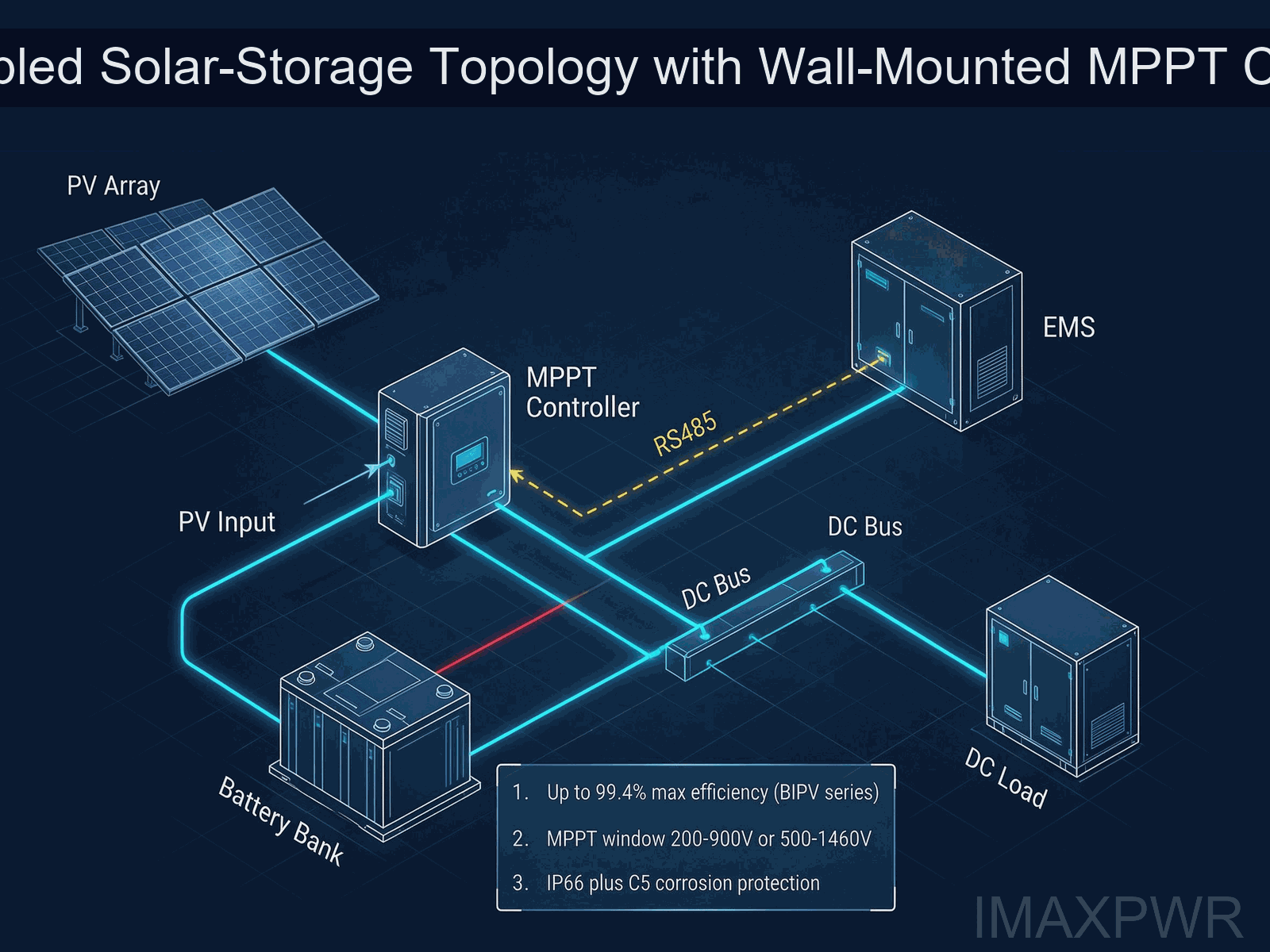
Figure 1 — DC-coupled solar-storage topology: PV strings feed the MPPT controller directly; battery and DC loads share the DC bus.
4. Spec 3 — Protection and Environmental Rating
A controller mounted outdoors in a coastal or high-humidity site fails on corrosion long before it fails on electronics, so the enclosure rating is a first-order economic spec. Look for the ingress protection (IP) rating, corrosion class, and the operating temperature range together. An IP66-rated unit with C5 corrosion protection, such as the BIPV series, is designed for outdoor, coastal, and high-salt-spray environments; an IP5X rating with an isolated air duct, as on the M120KPV module, suits installation inside cabinets where dust ingress is the main risk.
Beyond the enclosure, verify the protection functions that prevent field failures: output short-circuit protection, PV reverse-connection protection, over-temperature derating, and input surge protection. On the safety side, power conversion equipment for PV systems is covered byIEC 62109-1:2010 for general requirements, with Part 2 addressing inverters specifically; grid-interactive equipment sold into North American projects should also be evaluated toUL 1741. Ask the vendor for the standards applied to the exact model you are buying — a certification on the product family is not a certification on every variant.
5. Spec 4 — Scalability, Parallel Operation, and Communication
A controller that cannot grow with the site creates a forced replacement cost in year two. Three questions decide scalability: how many units can operate in parallel, whether parallel units share current, and what protocols the controller speaks. On the M120KPV module, up to 15 units can run in parallel with independent control for scalable power on larger solar and storage farms; the BIDC75050F supports up to 16 modules in parallel. On communication, RS485 is the practical minimum for commercial projects, and CAN support matters when the controller must talk directly to a battery BMS. If the project has an EMS, check that the controller exposes the registers the EMS needs — otherwise the system cannot implement anti-reflux, peak shaving, or demand management, which are usually the point of adding storage in the first place.
6. Spec 5 — Cost Structure and Total Cost of Ownership
The largest cost item in a DC-coupled solar-storage system is often not the controller itself but the components the controller eliminates. A dedicated MPPT charge controller that connects PV strings directly to the battery DC bus removes the need for a separate PV inverter and a DC/AC combiner box, cutting initial investment while improving round-trip efficiency, because the energy path is PV → controller → battery with no double conversion. Compare this with an AC-coupled architecture, where PV goes DC → AC through an inverter and then AC → DC through the storage PCS to charge the battery — each conversion leg costs a few points of efficiency.
Budget the full lifetime cost, not the purchase price: efficiency losses over 25 years, spare-part availability, the vendor’s response time for technical support, and whether the O&M team can service the unit without factory tools. A wall-mounted controller that installs in under an hour and communicates over RS485 has a meaningfully lower installed cost than a cabinet-scale solution on a small commercial site. When comparing quotes, normalize to cost per watt of MPPT capacity and cost per installed watt, including mounting, cabling, and commissioning time.
7. Price Drivers and Supply — Reading the 2025 Market Correctly
Buyers searching for “MPPT converter price” or asking about immediate stock availability are really asking one question: what should this cost, and can I get it when the project needs it. Three forces are currently shaping both. First, falling battery prices are pulling down the cost of the whole DC-coupled package —BloombergNEF’s December 2025 survey puts the average lithium-ion battery pack at USD 108/kWh, down 8% year on year and 93% below 2010 levels, which makes the storage-side economics more attractive and shortens payback for the coupling hardware too. Second, module supply for high-power DC/DC and MPPT products remains concentrated among specialist manufacturers, so lead time, not unit price, is often the binding constraint on project schedule. Third, the components a controller eliminates — PV inverters and combiner boxes — are a large share of a DC-coupled system’s bill of materials, so the highest-value controller is the one that lets you buy fewer boxes, not the cheapest box itself.
For procurement planning, order early for large projects, request the efficiency curve and protection list in writing, and validate that the vendor can support the voltage class (900 V or 1500 V) and the regional grid codes before committing. For an immediate requirement, ask the manufacturer directly about current lead times and stock — most reputable suppliers can quote both a price and a ship date on the same call.
8. Comparison: Three Ways to Couple PV and Battery
The selection decision is really a topology decision. The table below compares the three mainstream approaches on the dimensions that drive project economics.
| Dimension | DC-Coupled MPPT Controller | AC-Coupled PV Inverter + PCS | Hybrid Inverter with Built-in MPPT |
|---|---|---|---|
| PV-to-battery path | PV → controller → battery (single DC stage) | PV → inverter → AC bus → PCS → battery (two stages) | PV → MPPT → battery via internal DC link |
| Typical peak efficiency | Up to 99.4% (BIPV series) | ~97-98% per leg, lower round-trip | ~98% class, single unit |
| Additional components | None — eliminates inverter and combiner | PV inverter + AC/DC combiner + PCS | Single unit, may need combiner |
| Weak-grid behavior | Independent of grid frequency; suits off-grid DC bus | Depends on inverter grid support | Grid-tie/off-grid switching in one unit |
| Initial investment | Lower — fewer power stages and boxes | Higher — duplicated power electronics | Medium — one box, limited PV capacity |
| Best-fit scenario | C&I solar-storage, off-grid and weak-grid sites, coastal areas | Existing PV inverter parks, retrofit storage | Small commercial and residential, single-phase to 50 kW |
The rule of thumb that has held across our projects: for new-build solar-plus-storage above roughly 30 kW in weak-grid or off-grid regions, a dedicated DC-coupled MPPT controller earns back its modest price premium through avoided components and higher round-trip efficiency; for retrofit of an existing PV inverter park, AC coupling is usually the pragmatic choice; for compact single-box residential systems, a hybrid inverter with integrated MPPT wins on simplicity.

Figure 2 — Selection comparison: DC-coupled MPPT controller vs AC-coupled vs hybrid inverter.
9. Who Should — and Should Not — Buy a Dedicated MPPT Charge Controller
Buy a dedicated controller when: the project is a commercial or industrial solar-storage system where DC coupling cuts components; the site is off-grid or weak-grid and the DC bus is the system backbone; the location is coastal or high-salt-spray and enclosure rating is a reliability requirement; or the PV array is large (60–320 kW per controller) and multi-orientation strings need independent tracking.
Do not buy a dedicated controller when: the project is a small residential retrofit that already has a hybrid inverter with adequate MPPT capacity; the site only needs grid-tied export and has no storage; or the team has no experience commissioning DC-coupled equipment and the local support network covers only AC products. In those cases a dedicated controller adds complexity without adding value.
10. Industry Trends to Watch
Three trends will change how buyers specify MPPT controllers over the next few years. First, 1500 V DC-coupled architectures are moving from utility-scale into large C&I projects, so controllers with 1500 V-class MPPT windows and battery-matched output voltages (up to 1460 V MPPT / 1500 V array limits) become a procurement standard rather than a niche. Second, the off-grid market remains structurally large: based on theIRENA Off-grid Renewable Energy Statistics 2025, off-grid renewable power capacity reached 11.1 GW at the end of 2024, serving 86 million people, with Africa alone accounting for over three-quarters of beneficiaries — and theWorld Bank, IEA, and IRENA Tracking SDG 7 report (June 2026) still counts 655 million people without electricity. Third, integrated hybrid boxes are absorbing more functions, but the efficiency and flexibility ceiling of a dedicated DC-coupled stage keeps it relevant for systems above 30–60 kW. Buyers should treat the controller as the one component that is genuinely cheap to over-specify and expensive to under-specify.
11. Author’s Perspective
From a sourcing standpoint, the MPPT charge controller is the component where a modest budget increase buys the most project protection. In my experience across PV-storage tenders for C&I and off-grid customers, the projects that underperform are rarely those with the cheapest controller — they are the ones where the controller’s MPPT window did not match the string design, or where an IP20 indoor unit was installed outdoors and failed on corrosion within three years. Efficiency claims deserve skepticism without a load point, and price comparisons deserve normalization to installed cost. If I were writing a short procurement rule: verify the full-load MPPT range against your string voltage at 25°C and at 60°C, demand the protection list in writing, and ask for the vendor’s documented lead time before signing. A controller that matches the site pays for itself in avoided losses; a mismatched one costs the project in every year of its life.
12. Frequently Asked Questions (FAQ)
Q1: Does an MPPT charge controller support multiple PV strings on different roof orientations?
Yes, if it has multiple independent MPPT inputs. The ImaxPWR BIPV family provides 2/4/6 independent MPPT trackers supporting 6/12/24 PV branch connections, so strings facing different azimuths and tilts each track their own maximum power point instead of being dragged down to the weakest string.
Q2: Can a wall-mounted MPPT controller survive coastal and high-salt-spray environments?
Choose a unit with a real enclosure rating for that environment. The BIPV series carries IP66 protection plus C5 corrosion resistance and a -30°C to +55°C operating range, which is specified for outdoor, coastal, and high-salt-spray sites; indoor module solutions such as the M120KPV use an IP5X isolated air duct design for cabinet installation.
Q3: Do I still need a PV inverter and a combiner box if I use a DC-coupled MPPT controller?
No. The DC-coupled design eliminates the traditional PV inverter and AC/DC combiner box; PV strings connect directly to the controller, which feeds the battery or DC bus. That is the main source of the initial-investment saving compared with AC-coupled architectures.
Q4: What voltage window should I specify for a 1500 V-class solar-storage project?
Specify the MPPT window and the maximum PV array voltage together. For example, the BIPV320K6 covers a 500-1460 V MPPT range with a 900-1266 V full-load range and a 1500 V maximum array voltage, matched to battery output voltages up to 1500 V.
Q5: How do I compare efficiency claims from different MPPT controller vendors?
Ask for the efficiency curve at 10-100% load and the MPPT tracking efficiency, not only the peak number. Per IEC 61683:1999, efficiency is derived from direct input and output power measurement at stated operating points, so always request the load point and input voltage alongside any quoted percentage.
Q6: What drives the price of an MPPT charge controller?
The main cost drivers are power rating and voltage class, enclosure and corrosion rating, the number of independent MPPT inputs, protection electronics, and certification scope. Battery price declines — BloombergNEF reports pack prices at USD 108/kWh in 2025 — are improving the economics of the whole DC-coupled package, while lead time is often the practical constraint for large projects.
Q7: How long is typical lead time if I need stock immediately?
Lead times vary by model and voltage class. The practical approach is to contact the manufacturer directly with the model and quantity — reputable suppliers will quote both price and ship date together, and can advise whether a stocked variant covers your requirement.
Q8: Can MPPT controllers be paralleled for larger systems?
Yes, within the vendor’s limits. The M120KPV1/M120KPV4 supports up to 15 units in parallel with independent control, and the BIDC75050F supports up to 16 modules in parallel, allowing system power to scale without changing the architecture.
Related Reading:BIPV60K2/BIPV120K4/BIPV320K6 Wall-Mounted Hybrid MPPT Controller ·M120KPV1/M120KPV4 120 kW DC/DC MPPT Module ·HI30KW 30 kW Hybrid Converter (PCS+MPPT+DC/DC+EMS+STS) ·IM60KFCM3 50 kW Hybrid ESS Inverter ·AC/DC Coupled vs DC Coupled vs Hybrid BESS Engineering Guide ·8 C&I Energy Storage Architectures Guide ·ImaxPWR Product Center
About the Author
Ethan Li, energy storage systems engineer at ImaxPWR Power Co., Ltd., with years of experience in PCS, DC/DC converters, BESS, and microgrid design. He has participated in multiple domestic and international energy storage projects in solution design and technical support.
ImaxPWR is a National High-Tech Enterprise and a source manufacturer of integrated energy storage products and system solutions. This article was reviewed by Ethan Li.
About ImaxPWR
ImaxPWR Power Co., Ltd. (Brand: ImaxPWR) is a National High-Tech Enterprise and source manufacturer, covering bidirectional converters, DC/DC, energy management, and energy storage cabinet integration, providing design, delivery, and O&M services. Products are CE, UL, and ROHS certified. The wall-mounted hybrid MPPT controller family and the 120 kW DC/DC MPPT module are manufactured in-house for DC-coupled solar-storage systems from 60 kW to 320 kW per controller.
Planning a solar-plus-storage project and comparing MPPT controller quotes?
Send us your array voltage, battery configuration, and site conditions — we will confirm the MPPT window match, current lead time, and stock availability for your required quantity.
Contact: COCO
Tel / WhatsApp: +86-13760212825
Email: info@imaxpwr.com
Website:https://imax-pwr.com
© 2026 ImaxPWR Power Co., Ltd. · This article is for engineering practice and product selection purposes. Data sourced from industry public materials, international standards, and engineering practice.