

Energy Storage vs UPS: A Practical Selection Guide for Commercial & Industrial Projects
Introduction: The Engineering Challenge
When a plant manager submits a request that simply says “we need battery backup” — with no load list, no one-line diagram, no runtime specification — the engineering team faces a fundamental design question: UPS or BESS?
In modern commercial and industrial facilities, power outages are no longer the only concern. Rising utility prices, demand response programs, and increasingly volatile grid conditions are forcing engineers to rethink how they manage both emergency backup and daily electricity consumption. While both Uninterruptible Power Supplies (UPS) and Battery Energy Storage Systems (BESS) use batteries to store energy, they are designed for fundamentally different purposes. Selecting the wrong technology leads to overcapitalization on one hand, or critical load failure on the other.
This article provides a practical engineering framework for deciding: when to specify UPS, when to specify BESS, and when the project requires both.
Core Functional Difference: What Each System Is Built For
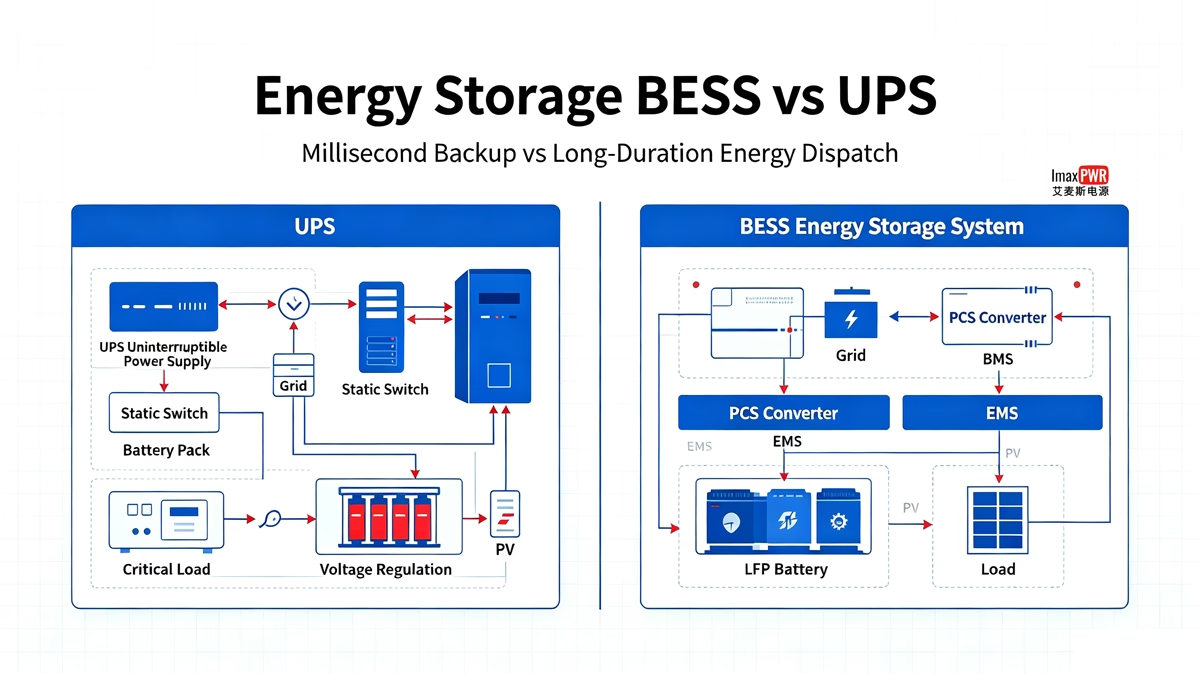
A UPS and a BESS have nearly the same building blocks — batteries, power conversion, and controls — but they differ fundamentally in usage and mission.
UPS Mission: Provide instantaneous, conditioned standby emergency power to specific mission-critical loads during a grid failure. The defining characteristic is near-zero millisecond transfer time — when grid power fails, the UPS immediately supplies power without interruption.
BESS Mission: Store energy — generated from renewable sources or the grid — for use on demand. A BESS acts as a strategic energy management system that optimizes electricity usage, supports renewable integration, and reduces operating costs. Transfer time is typically measured in seconds, not milliseconds.
In short: UPS protects equipment from the power event itself; BESS manages energy before, during, and after the event.
Engineering Comparison: UPS vs BESS
For modern facilities seeking true resilience, these technologies are not competing solutions — they are complementary components within a complete power architecture.
When to Specify UPS Only
A UPS is the correct choice when the primary requirement is instantaneous protection of sensitive equipment against power disturbances — not energy management or cost optimization.
Typical UPS-Only Scenarios
- Data center servers and IT infrastructure: Even a brief grid disturbance lasting milliseconds can cause sensitive systems to reboot, crash, or lose data. UPS provides seamless “ride-through” capability.
- PLCs and industrial control systems: A disorderly shutdown causes material loss or equipment damage. UPS ensures controlled operation during transfer.
- Critical medical equipment: Hospitals and medical imaging facilities where power continuity is a patient-safety requirement.
- Telecommunications switching centers and network operations: Where even brief outages cause transaction loss and hardware stress.
- Financial trading systems: Requiring zero-interruption power.
- Emergency lighting and life-safety systems: Where power must transfer without any detectable delay.
In UPS-only applications, the system is typically sized for 5–30 minutes of runtime — enough to bridge the gap between utility failure and generator startup or controlled shutdown.
When to Specify BESS Only
A BESS is the correct choice when the primary objectives are energy cost reduction, renewable integration, and longer-duration backup — and the connected loads can tolerate a transfer time measured in seconds.
Typical BESS-Only Scenarios
- Peak shaving and demand charge management: BESS discharges during peak demand periods to reduce utility demand charges.
- Time-of-use (TOU) arbitrage: Charging during low-cost off-peak hours and discharging during high-cost peak hours.
- Solar self-consumption and renewable integration: Storing excess PV generation for use during evening or cloudy periods.
- Microgrids and islandable facilities: Grid-forming BESS can establish AC voltage and frequency to support an islanded facility.
- Manufacturing facilities with non-critical loads: HVAC systems, production equipment that can tolerate a brief transfer delay.
- Large-scale commercial buildings: Where the goal is site-level energy optimization rather than per-rack power protection.
BESS systems are typically sized for 1–6 hours of runtime and can scale from hundreds of kilowatts to hundreds of megawatts. The power conversion system must handle the continuous load plus any transient or motor-starting demand.
When Both UPS and BESS Are Required
In many industrial and commercial sites, the most practical and robust solution is UPS + BESS — the UPS rides through the instantaneous event, and the BESS carries the hours and delivers the savings.
Typical Combined Scenarios
- Large data centers (>50 MW): UPS protects individual server racks with millisecond response; BESS provides site-level energy management, peak shaving, and grid services. For AI-driven GPU clusters, coordinated mitigation across multiple power-system levels is required.
- Hospitals and healthcare campuses: UPS protects life-critical medical equipment; BESS provides extended backup for HVAC, lighting, and facility loads during extended outages.
- Industrial manufacturing with mixed loads: UPS protects PLCs, controls, and instrumentation; BESS supports production equipment, motors, and facility-wide energy optimization.
- Microgrids with critical infrastructure: UPS provides the instantaneous bridge; BESS (often grid-forming) sustains the islanded microgrid.
- Facilities with both critical IT loads and large HVAC systems: Cooling must be included — servers convert most electrical input into heat. A design that supports IT racks but loses the cooling plant may only postpone the outage.
In a combined architecture, the UPS is the short-term bridge and the BESS is the long-term energy infrastructure asset. The UPS transfer time is near-zero milliseconds; the BESS may take seconds to engage, but that is acceptable because the UPS has already protected the critical loads.
Project Selection Checklist
Use this engineering checklist to determine the right solution for your commercial or industrial project:
✅ Step 1: Define the Critical Load
- Identify which loads are mission-critical and cannot tolerate any interruption
- Record continuous operating power (kW), startup/inrush demand, power factor, and harmonic characteristics
- Determine maximum acceptable interruption — milliseconds, seconds, or minutes?
- Include cooling loads — pumps, fans, and compressors have starting currents that affect inverter sizing
✅ Step 2: Define Required Runtime
- 5–30 minutes → UPS (bridge to generator or controlled shutdown)
- 1–6 hours → BESS (extended backup, peak shaving, TOU arbitrage)
- Both short and long durations → UPS + BESS
✅ Step 3: Size Power and Energy Separately
- Power (kW/MW): Determines whether the system can carry the critical load
- Energy (kWh/MWh): Determines how long it can carry that load
- For a 750 kW critical load requiring 30 minutes: 750 kW × 0.5 h = 375 kWh ideal energy output
- Installed nominal capacity must be higher after accounting for usable DoD, conversion losses, auxiliary loads, temperature, aging, and reserve
✅ Step 4: Evaluate Economic Objectives
- UPS only: Protection-focused, no energy bill reduction
- BESS only: Can reduce energy bills through peak shaving, TOU arbitrage, demand charge management
- UPS + BESS: Protection + energy savings + resilience
✅ Step 5: Assess Grid Interaction Requirements
- UPS: Minimal grid interaction, operates as standalone protection
- BESS: Direct grid interaction, grid code compliance required, can provide ancillary services
- Grid-forming capability: Required if the system must establish AC voltage and frequency in island mode
✅ Step 6: Consider Space and Cooling
- UPS: Compact footprint, typically indoor installation
- BESS: May need more space and thermal management — HVAC, liquid cooling, ventilation
Common Mistakes to Avoid
- Mistake 1: Using BESS as a UPS replacement for sensitive IT loads. BESS transfer time is measured in seconds — servers and PLCs cannot tolerate this delay.
- Mistake 2: Sizing UPS for hours of runtime. UPS is designed for minutes of bridge power — extending runtime significantly increases cost and footprint without delivering energy management benefits.
- Mistake 3: Ignoring cooling loads in BESS sizing. A design that supports IT racks but loses the cooling plant may only postpone the outage.
- Mistake 4: Assuming UPS provides energy cost savings. UPS is not designed for peak shaving or TOU arbitrage — that is the domain of BESS.
- Mistake 5: Not defining the maximum acceptable interruption. For highly sensitive IT equipment, “fast” is not a sufficient specification — the engineering team must define the exact transfer time and verify through testing.
FAQ
What is the primary difference between a UPS and a BESS?
A UPS provides instantaneous (near-zero millisecond) power protection for sensitive equipment during grid disturbances. A BESS provides longer-duration energy storage (hours) for energy management, peak shaving, and renewable integration, with transfer time measured in seconds.
Can a BESS replace a UPS?
Not for loads that cannot tolerate interruption. A BESS is not automatically a replacement for a UPS. For highly sensitive IT equipment, the UPS protects immediately while a larger BESS supports longer-duration operation.
When should I specify both UPS and BESS for a project?
When the facility has both sensitive loads requiring instantaneous protection (servers, PLCs, medical equipment) and site-level energy management objectives (peak shaving, TOU arbitrage, renewable integration). The UPS is the short-term bridge; the BESS is the long-term energy infrastructure asset.
How long can a UPS vs BESS provide backup power?
UPS systems are typically sized for 5–30 minutes of runtime. BESS systems are sized for 1–6 hours or longer.
What is grid-forming mode and why does it matter for BESS?
In grid-forming mode, the energy storage inverter establishes AC voltage and frequency via the system’s batteries. This capability allows a BESS to operate as an islanded power source in microgrid applications, making it essential for facilities requiring grid independence.
⚡ If you are designing a BESS, microgrid, or renewable energy system for a commercial or industrial project, IMAXPWR’s engineering team can help evaluate your technical requirements and provide a customized solution.
About IMAXPWR
ImaxPWR (Imax Power Technology Co., Ltd.) is a national high-tech enterprise specializing in new energy solutions. As an OEM/ODM manufacturer, IMAXPWR focuses on energy storage power conversion equipment, bidirectional PCS, DC/DC converters, V2G modules, energy storage cabinets and integrated microgrid solutions.
With strong R&D capabilities and power electronics expertise, IMAXPWR provides reliable energy conversion solutions for global customers in industrial and commercial energy storage, renewable energy integration and smart microgrid applications.