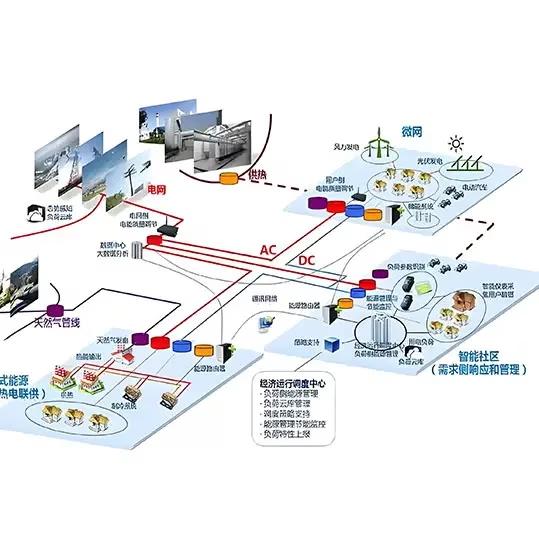


⚡ Off-Grid Microgrid Design: 2.5MWp PV + 2.61MWh BESS Seamlessly Integrated with 5×2000kW Diesel Gensets
📋 1. Project Background & Requirements
An industrial facility operates with no grid connection and is currently powered by five 2,000 kW diesel generator sets running in parallel. The customer aims to reduce diesel fuel costs and emissions by adding 2.5 MWp solar PV and a 2.61 MWh battery energy storage system (comprising ten 261 kWh cabinets), forming a PV + BESS + diesel microgrid.
Existing genset control logic:
- When load < 2,000 kW, only one genset runs.
- When load approaches 2,000 kW, a second genset automatically starts, and so on.
- Typically, 2–3 gensets are running simultaneously, indicating a typical load well above 2,000 kW.
Customer requirement: Integrate PV and BESS with the existing genset system to achieve seamless parallel operation without modifying the original genset start/stop logic. The BESS must not operate in island mode alone; it should work in grid-following mode with at least one genset always online to maintain system stability and avoid load-drop risks.
🔍 Application scenario: Off-grid industrial facility · 5×2000kW gensets (parallel) · 2.5MWp PV · 2.61MWh BESS · Grid-following BESS with genset as grid · Fuel cost reduction
🛠️ 2. Key Engineering Challenges
Challenge 1 — Seamless Integration with Existing Genset Controls
The BESS must operate in parallel with gensets without interfering with the existing load-based start/stop logic. The system must not require STS (static transfer switch) as gensets remain online.
Challenge 2 — Avoiding Load-Drop Risks During Transients
If the BESS were to operate in island mode and a sudden load surge occurs, gensets cannot start instantly — causing overload and potential shutdown. The solution must ensure at least one genset is always running as a stabilizer.
Challenge 3 — Fuel Optimization While Maintaining Stability
Using PV and BESS to reduce genset fuel consumption, while allowing gensets to charge the battery when they have spare capacity, avoiding waste.
📐 3. Engineering Analysis — Why This Design
🔌 System Architecture Decision — Grid-Following with Always-On Genset
After evaluating the risks of island-mode operation (especially load surge and genset start delay), the engineering team recommended a grid-following approach where at least one diesel genset remains online at all times. The genset acts as the grid reference (voltage and frequency source), while the BESS and PV operate in parallel as current sources.
Why not STS or island mode?
- Island mode risk: If the BESS alone supplies the load and a large motor starts, the load surge could exceed the BESS capacity (2.61MWh battery, PCS rated at ~2.5MW). Gensets need 5–10 seconds to start and synchronize — during that time, the BESS would trip on overload, causing a blackout.
- Existing genset controls remain intact: By keeping gensets online, the original load-based start/stop logic is preserved. The BESS simply “sees” the genset as the grid, using standard grid-following PCS control.
- No STS needed: Since there is no transition between island and grid modes, the expensive static transfer switch is eliminated, reducing CAPEX and complexity.
With one genset always running (even at low load), the system is always grid-tied, providing instantaneous response to load changes. The BESS can supply power to reduce genset loading, and when gensets have spare capacity (e.g., load drops), they can charge the battery to capture otherwise wasted energy.
🧠 EMS Control Strategy
The IMAXPWR Energy Management System (EMS) coordinates PV, BESS, and gensets with the following logic:
- Priority 1: Solar PV — PV generation supplies the load first. Any surplus charges the battery.
- Priority 2: Battery discharge — When PV is insufficient, the BESS discharges to support the load, reducing genset output, down to a minimum SOC (e.g., 20%).
- Priority 3: Genset — The running genset(s) supply the remaining load. The number of running gensets is determined by the existing load-based logic (unchanged).
- Opportunistic charging: When the load is low and running gensets have surplus capacity (i.e., they are not fully loaded), the EMS instructs the PCS to draw power from the AC bus to charge the battery — utilizing otherwise wasted fuel.
- Always-on principle: At least one genset is always running, providing grid reference. The EMS never commands a complete genset shutdown unless the site is fully idle (not applicable).
This approach ensures fuel savings without compromising reliability. The BESS reduces the load on gensets, allowing them to operate more efficiently (avoiding low-load operation) and reducing total runtime of additional gensets.
🔄 4. System Architecture
variable, typically > 2,000kW
≥ 1 always running (grid reference)
permanent parallel connection
⚙️ 5. IMAXPWR Engineering Solution
Hardware Configuration
- PV array: 2.5 MWp (customer supplied)
- MPPT: Multiple DC/DC converters matched to PV strings
- Battery: 2.61 MWh LFP (10 × 261 kWh cabinets), 650–900V DC, 80% DOD
- PCS: IMAXPWR bidirectional PCS modules, total rated power ~2.5 MW (grid-following mode)
- EMS: IMAXPWR Energy Management System with genset load monitoring and opportunistic charging logic
- No STS: Permanent parallel connection to the AC bus (gensets always provide grid reference)
- Cooling: Liquid cooling for PCS; forced air for battery cabinets
Operational Strategy
- Always-on genset: At least one 2,000 kW genset remains running at all times, acting as the grid-forming source.
- PV first: Solar generation is prioritized for loads; surplus charges the battery.
- BESS discharge: When PV is insufficient, the BESS discharges (grid-following) to reduce the load on gensets, saving fuel.
- Opportunistic charging: When gensets have spare capacity (e.g., load drops below genset output), the EMS uses the surplus to charge the battery, avoiding waste.
- SOC management: BESS discharges down to 20% SOC, then stops discharging to reserve capacity for emergency.
- Genset start/stop unchanged: The original load-based logic (start second/third genset when load approaches 2,000 kW) remains untouched; the EMS only influences the load seen by gensets.
🛡️ Safety & Reliability Design
- Grid-following protection: Anti-islanding, over/under voltage/frequency, and rate-of-change-of-frequency (ROCOF) protection.
- Parallel synchronization: PCS units synchronize with the AC bus (genset) before connecting.
- Redundant communication: Dual CAN/RS485 links between all PCS, BMS, and EMS.
- Thermal management: Liquid cooling for PCS; battery BMS monitors individual cell temperatures.
- Emergency stop: Manual and automatic trip mechanisms for fault conditions.
Need a Stable Off-Grid Microgrid with Genset Integration?
Our engineering team specializes in seamlessly integrating PV and BESS with existing diesel gensets without modifying your control logic.
We can help you with:
🔋 Grid-following BESS design
🧠 EMS & opportunistic charging
🛡️ No-STS reliable solution
📊 6. Engineering Comparison — Island vs. Grid-Following Approach
| Parameter | Island Mode (BESS alone) | Grid-Following with Always-On Genset (✅ Selected) |
|---|---|---|
| Genset start/stop logic | Must be modified (complex) | Unchanged |
| STS requirement | Required (extra cost) | None |
| Response to load surge | Risk of overload (genset start delay) | Instant (genset already online) |
| Fuel savings potential | High (can shut all gensets) | Moderate-High (optimized with one always on) |
| System complexity | High (islanding control, STS, re-sync) | Low (standard grid-following) |
| Reliability | Lower (single point of failure) | Higher (genset provides inertia) |
📈 7. Expected Engineering Benefits
Estimated Diesel Fuel Reduction
Seamless Load Support (no STS)
CO₂ Reduction / Year
Note: Benefits depend on load profile, PV generation, and genset efficiency. The always-on genset ensures stability while still achieving significant fuel savings through load sharing.
📝 8. Key Engineering Lessons Learned
- Always-on genset provides stability and simplifies integration. By keeping one genset as the grid reference, the BESS can use standard grid-following control, eliminating the need for expensive STS and complex islanding logic.
- Opportunistic charging captures wasted energy. When gensets have spare capacity (load below genset output), using that surplus to charge the battery improves overall system efficiency and reduces fuel consumption.
- Preserving existing genset controls reduces project risk. Not modifying the original start/stop logic minimizes commissioning time and avoids potential conflicts with legacy systems.
- Load surge response is critical. The delayed start of additional gensets (5-10 seconds) can cause blackouts if the BESS is the only source. The always-on genset mitigates this risk.
- Communication with genset controllers must be robust. The EMS needs accurate load data from genset panels to optimize charging and discharging decisions.
⚠️ 9. Common Mistakes to Avoid in Similar Projects
- Attempting island mode without adequate genset start time. Load surges will trip the BESS before gensets can synchronize — always keep at least one genset online.
- Modifying existing genset controls unnecessarily. This can void warranties and introduce unforeseen logic errors. Keep controls intact and let the EMS work in parallel.
- Underestimating the need for precise synchronization. Even in grid-following mode, the PCS must synchronize voltage, frequency, and phase with the genset AC bus — proper droop control is essential.
- Ignoring battery SOC floor. Discharging too deep reduces battery life; set a conservative SOC limit (e.g., 20%) to preserve backup capacity.
- Neglecting the impact of PV variability. Cloud transients can cause rapid power fluctuations; the EMS and PCS must have fast response (sub-second) to avoid voltage/frequency deviations.
Need a Reliable Off-Grid Microgrid with Genset Parallel Operation?
Let our engineering team design a seamless PV+BESS+genset solution for your site.
We’ll analyze your load profile, genset controls, and site constraints to deliver a stable, fuel-optimized microgrid — without modifying your existing logic.
✓ EMS with opportunistic charging
✓ No-STS reliable architecture
✓ Fuel savings projection
Typical response time: within 24 hours
🏢 About IMAXPWR
ImaxPWR (Imax Power Technology Co., Ltd.) is a national high-tech enterprise specializing in new energy solutions. As an OEM/ODM manufacturer, IMAXPWR focuses on energy storage power conversion equipment, bidirectional PCS, DC/DC converters, V2G modules, energy storage cabinets and integrated microgrid solutions. With professional R&D capabilities and power electronics expertise, IMAXPWR provides reliable and customized energy solutions for global customers in industrial and commercial energy storage, renewable energy integration, smart microgrids and charging infrastructure applications.
📞 Contact IMAXPWR
Ready to Optimize Your Off-Grid Genset System with PV+BESS?
Contact IMAXPWR technical team for:
🔋 BESS & PV sizing
🧠 EMS & opportunistic charging
🛡️ Stable no-STS solutions
👨💻 About The Author
This article was reviewed by Ethan Li, an energy storage system specialist focusing on PCS, bidirectional DC/DC converters and microgrid system design.