

How Does Energy Storage Bridge AI Computing and Green Power in the Era of Computing-Power Collaboration?
Abstract
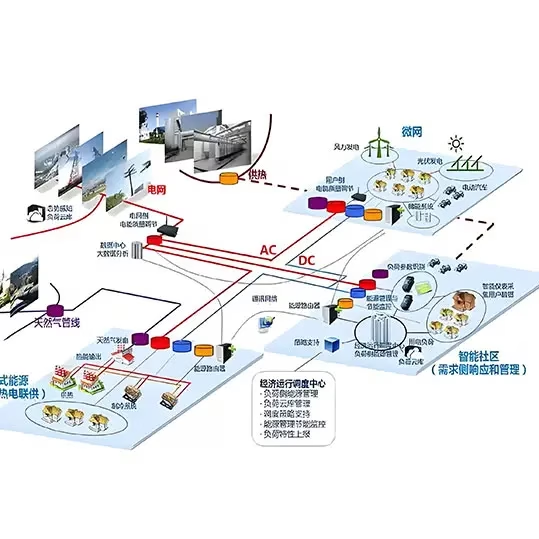
In August 2026, China’s 15th Five-Year Plan for New Power System Construction officially incorporated “computing-power collaboration” into national power planning for the first time. Simultaneously, the world’s largest AI computing center – the Xinghe Base in Ulaanqab – was commissioned with 160 MW capacity, 80% direct green power supply, and million-card parallelism. The explosive growth of AI compute is reshaping the relationship between data centers and the grid. Energy storage has evolved from a simple backup UPS to the core hub of the “computing–storage–grid” synergy. This article provides an engineering perspective on system architecture, PCS sizing, bidirectional DC/DC applications, and practical pitfalls for EPCs and system integrators.
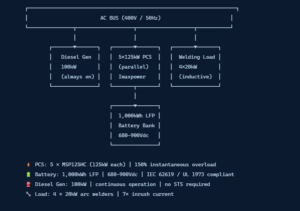
→
→
→
↔
→
→
– – – –
控制/调度
– – – –
– – – –
1. Technical Background
The global AI computing boom has dramatically increased data center power consumption. In 2025, China’s computing centers consumed 170 TWh – 1.6% of total national electricity. The National Energy Administration projects that by 2030, computing will consume 800 TWh, accounting for 6% of total electricity, with annual growth exceeding 100 TWh.
At the same time, China’s “15th Five-Year Plan for New Power System Construction” (August 2026) mandates that by 2030, all national-level computing hubs must achieve >80% green power utilization. This creates a fundamental engineering challenge: how to maintain ultra-high power quality for GPU clusters while dynamically matching intermittent renewables?
The answer lies in computing-power collaboration – treating AI workloads as flexible loads that follow cheap, abundant renewable energy. Energy storage is the enabler that smooths the mismatch between volatile generation and sensitive IT equipment.
2. Core Technical Challenges
Challenge 1 – Ultra-Strict Power Quality Requirements
AI training clusters are extremely sensitive to voltage sags, frequency deviations, and harmonics. A 10 ms voltage dip can cause a distributed training job to fail, wasting tens of thousands of GPU hours. A typical 10,000-GPU cluster consumes 200 MWh per day – equivalent to a small steel plant – but with zero tolerance for power interruptions.
Challenge 2 – Renewable Intermittency
Solar PV output can drop 50% within minutes due to cloud cover, and wind can fluctuate even faster. Without storage, the 80% green power target is impossible. The storage system must respond within milliseconds to compensate for renewable ramps while maintaining the DC bus voltage within ±1%.
Challenge 3 – From “Backup” to “Active Grid Participant”
Traditionally, storage in data centers was just UPS for emergency backup. In the new framework, storage must participate in demand response, peak shaving, and grid ancillary services while ensuring zero interruption to the compute load. This requires a complete rethinking of system architecture and control strategies.
3. Engineering Design Logic
3.1 System Architecture Selection
For most AI data centers, an AC-coupled architecture is preferred because it allows independent operation of PV, wind, grid, and storage. The PCS connects to the AC bus and can be expanded modularly. For greenfield megascale campuses, DC-coupled (PV/wind direct to battery DC bus) is gaining traction as it avoids one AC/DC conversion stage, improving round-trip efficiency by 2–3%.
3.2 PCS Sizing Methodology
Sizing the PCS involves three key factors:
- Battery C-rate: Typically 0.5C to 1C of battery energy capacity. For a 2 MWh battery, choose 1–2 MW PCS.
- Peak load: Measure the 7-day power curve of the computing load. Size PCS to cover the maximum 15-minute average peak with 20% margin.
- Dynamic response: AI workloads can ramp 30% in seconds. PCS must have <20 ms response time (grid-following mode) or grid-forming capability for islanded operation.
3.3 Role of the Bidirectional DC/DC Converter
In DC-coupled systems or high-voltage battery banks (800–1500 V), the bidirectional DC/DC converter is essential for:
- Matching battery voltage to the common DC bus;
- Enabling bi-directional power flow for charging/discharging;
- Providing current sharing among parallel battery racks to prevent circulating currents.
4. Common Mistakes and Optimization
Mistake 1 – Sizing PCS Solely by Battery Capacity
Many engineers simply choose PCS = 0.5 × battery MWh, ignoring the computing load profile. AI training has bursty peaks (checkpoint saving, gradient synchronization) that can exceed 1.5× average power.
Fix: Conduct a 7-day power quality measurement. Size PCS to the maximum peak plus 20% margin. If the peak is 1.2 MW and average is 800 kW, choose at least 1.5 MW PCS.
Mistake 2 – Ignoring Power Quality (Harmonics)
Server power supplies generate significant harmonics (THD up to 30%). This can trip PCS protections or cause BMS misreading. Without active filtering, the entire system becomes unstable.
Fix: Use PCS with built-in active harmonic filtering (THD <3%) or add an external active power filter (APF) on the AC bus.
Mistake 3 – Disconnected EMS Integration
Many projects procure storage as a standalone black box, without deep integration with the data center EMS. This prevents participation in computing-power scheduling.
Fix: Ensure the storage system supports standard communication protocols (Modbus TCP, IEC 61850, or MQTT) and can receive dispatch signals from the EMS to shift computing tasks to low-price renewable periods.
5. IMAXPOWER Technical Solutions
IMAXPOWER offers a comprehensive portfolio tailored for AI data center storage applications:
- PCS (30 kW – 500 kW): High efficiency (up to 98%), <20 ms response, supports both AC- and DC-coupled architectures, and built-in grid-forming capability for islanded operation.
- Bidirectional DC/DC Converter: Wide input range (600–1500 V), suitable for high-voltage battery banks and DC-coupled solar+storage.
- V2G Modules: For charging station integration with EV fleets.
- Integrated Storage Cabinets: Pre-assembled PCS + battery + BMS + EMS for rapid deployment.
- Microgrid Controller: Seamless transition between on-grid and off-grid modes, critical for remote data centers.
Our PCS features advanced grid-forming control that can establish voltage and frequency references during grid outages, ensuring uninterrupted operation of sensitive AI loads.
6. Parameter Comparison Table
| Parameter | Traditional Approach | Optimized Approach |
|---|---|---|
| Efficiency | 92–95% | 96–98% |
| Response Time | >100 ms | <20 ms |
| Expandability | Requires shutdown | Hot-swappable modular |
| Maintenance | Periodic on-site | Remote + predictive |
| Application | Standby backup | Renewable integration + load shaping + backup |
7. Selection Guidelines
Based on data center scale and storage requirements, here is a recommended PCS sizing matrix:
| Data Center Scale | PCS Power | Battery Capacity | Typical Use |
|---|---|---|---|
| Edge / Micro | 30 kW | 60–100 kWh | 5G base stations, edge AI |
| Mid-size Enterprise | 125 kW | 250–500 kWh | Corporate data centers |
| Large AI Cluster | 500 kW – 1 MW | 1–2 MWh | Hyperscale GPU farms |
Key selection criteria:
- Measure real load profile – do not rely on nameplate ratings alone.
- Storage duration: 2–4 hours is optimal for peak shaving and renewable time-shifting.
- Environmental conditions: for cold climates (e.g., Ulaanqab, -30°C), ensure PCS and batteries have wide temperature tolerance.
- Prioritize PCS with grid-forming capability if the site may experience frequent islanded operation.
8. Industry Trends and Outlook
Trend 1 – From Spatial to Multi-dimensional Collaboration
In the coming years, inference workloads will surpass training, introducing more volatile and time-sensitive load patterns. Computing-power collaboration must evolve from geographic load shifting to real-time coordination with grid inertia, frequency regulation, and reserve markets.
Trend 2 – Storage Moves from “Optional” to “Mandatory”
China’s 15th Five-Year Plan mandates 160 GW of new storage by 2030. AI data centers will be a major driver. Global AIDC storage installations are projected to reach 29 GWh in 2026 and 522 GWh cumulative by 2030.
Trend 3 – Competition Shifts to Intelligent Dispatch
The future battleground is no longer battery capacity alone, but conversion efficiency, response speed, and AI-driven predictive dispatch. Systems that can seamlessly interface with virtual power plants (VPP) and automatically bid into ancillary service markets will capture premium value.
9. Frequently Asked Questions
Q1: How do I select the right PCS for my AI data center?
Start with a 7-day power quality measurement of your existing or planned load. Calculate the 15-minute peak power and multiply by 1.2 for margin. Then choose a PCS with at least that power rating, <20 ms response, and >96% efficiency. Also verify communication protocol compatibility with your EMS.
Q2: What is the primary role of BESS in computing-power collaboration?
BESS serves three roles: (1) Renewable integration – storing surplus solar/wind for later use; (2) Load shaping – participating in demand response and VPP dispatch; (3) Power quality – providing voltage/frequency stabilization and harmonic filtering to protect sensitive IT equipment.
Q3: Why do I need a bidirectional DC/DC converter?
In DC-coupled architectures, the DC/DC converter matches the variable battery voltage to a fixed DC bus, enabling efficient charging from PV/wind and discharging to the PCS. It also balances current among parallel battery strings, preventing uneven aging and thermal runaway.
About IMAXPOWER
IMAXPOWER (Shenzhen) Technology Co., Ltd. is a national high-tech enterprise specializing in energy storage PCS, bidirectional DC/DC converters, V2G modules, integrated storage cabinets, and microgrid solutions. Our products are CE, UL, and ROHS certified, serving markets in Europe, Asia, the Americas, Australia, the Middle East, and Korea.
We offer OEM, ODM, and full system design services. Our engineering team has decades of hands-on experience in utility-scale BESS, commercial storage, and mission-critical backup applications.
Need a Custom Storage Solution?
If you are planning:
- BESS for AI data centers
- Commercial & industrial storage
- Microgrid with high renewable penetration
- Solar + storage + EV charging hubs
Our engineering team can provide a customized proposal based on your power profile, required duration, site conditions, and grid interconnection rules.
Contact: Mr. Ding
Phone/WhatsApp: +86-18018752807
Email: info@imaxpwr.com
Website: https://imaxpwr.com