

How We Designed a 125kW×5 PCS + 1MWh BESS Diesel-Hybrid System for a Natural Gas Pipeline Construction Site
📋 Project Snapshot: 4×20kW welding machines · 100kW diesel generator · 10h daily runtime · 1,000kWh LFP battery · 5×125kW PCS in parallel · Inductive load surge: 7× rated current · Remote site: no grid, no PV · Fully automated diesel-storage coordination.
1
Project Background & Requirements
A natural gas pipeline construction contractor operating in a remote, off-grid area faced a critical power supply challenge. The site had no utility grid access and no solar PV installation — 100% diesel-dependent. The existing setup consisted of a single 100kW diesel generator supplying power to four welding machines (20kW each, 80kW total) used for joining 12-meter pipe sections.
The generator ran 10 hours per day, regardless of whether the welding machines were actively in use — a highly inefficient operational pattern that wasted fuel, increased emissions, and accelerated generator wear. During idle periods, the diesel generator continued running at light load, consuming fuel without productive output.
The client’s core requirement was simple but technically demanding: store the diesel generator’s energy into a battery energy storage system (BESS) when the welding load is off, and automatically switch to battery power when the welding machines are running — all without manual intervention.
🔑 Key requirement: The system must handle inductive load inrush current — welding machines (arc welders) draw 5–7× rated current during ignition/start-up. With 80kW total load, the instantaneous demand can spike to 560kW or more for tens of milliseconds.
2
Key Engineering Challenges
1. Extreme Inductive Load Inrush (7× Rated Current)
Welding machines are highly inductive loads with no variable frequency drives (VFDs). During arc ignition, the instantaneous current draw can reach 5 to 7 times the steady-state operating current. For four 20kW machines running simultaneously, the startup surge can exceed 500–560kW for a short duration. This imposes severe stress on any power conversion system — standard PCS units without sufficient overload capability would trip or shut down.
2. No Grid, No PV — 100% Diesel Charging Only
The construction site is located in a remote area with no utility grid and no solar PV installation. The only available energy source is the diesel generator. This means the BESS must be charged exclusively from the diesel generator during periods when the welding load is off. The charging power is limited by the generator’s capacity — with 80kW welding load running, there is little to no surplus power available for battery charging.
3. Equipment Mobility & Environmental Durability
The pipeline construction progresses linearly — each 12-meter pipe section is welded and then the entire setup moves forward by 12 meters. The BESS and PCS equipment, weighing several tons, must be relocated frequently using heavy excavators. The system must withstand dust, moisture, and physical impacts typical of outdoor construction environments.
3
Our Engineering Solution
Design philosophy: The diesel generator cannot be replaced entirely — it remains the primary energy source. The BESS serves as a power buffer and energy storage medium, capturing surplus energy during idle periods and delivering it during welding operations to reduce generator runtime and fuel consumption.
System Architecture
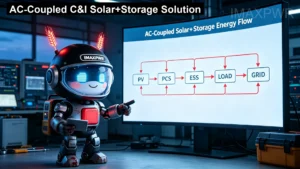
We selected a AC-coupled architecture with the diesel generator and BESS connected in parallel at the AC bus. This approach offers several advantages for this specific application:
- ✅ No STS required — the diesel generator runs continuously (as it always has), and the BESS operates in parallel, charging when load is low and discharging when load is high.
- ✅ Cost-optimized — eliminates the need for an expensive static transfer switch (STS) since the generator never shuts down.
- ✅ Seamless power sharing — the PCS units automatically adjust output based on load demand and battery SOC.
📐 System Topology
        ┌─────────────────────────────────────────────────────────────────────┐
        │                        AC BUS (400V / 50Hz)                       │
        └───────────────┬───────────────────┬───────────────────┬───────────┘
                        │                   │                   │
                ┌───────▼───────┐   ┌───────▼───────┐   ┌───────▼───────┐
                │   Diesel Gen  │   │  5×125kW PCS  │   │  Welding Load │
                │   100kW       │   │  (parallel)   │   │  4×20kW       │
                │   (always on) │   │  Imaxpower    │   │  (inductive)  │
                └───────────────┘   └───────┬───────┘   └───────────────┘
                                            │
                                    ┌───────▼───────┐
                                    │  1,000kWh LFP │
                                    │  Battery Bank │
                                    │  680-900Vdc   │
                                    └───────────────┘

        ⚡ PCS: 5 × MSP125HC (125kW each) | 150% instantaneous overload
        🔋 Battery: 1,000kWh LFP | 680–900Vdc | IEC 62619 / UL 1973 compliant
        ⛽ Diesel Gen: 100kW | continuous operation | no STS required
        🔧 Load: 4 × 20kW arc welders | 7× inrush current
Note: System topology showing AC-coupled architecture with parallel PCS units and diesel generator on the same AC bus.
Component Selection & Sizing Logic
PCS Sizing (5 × 125kW): We selected five Imaxpower MSP125HC 125kW bidirectional AC/DC PCS modules in parallel. Key specifications:
- ⚡ Rated power: 125kVA per unit × 5 = 625kVA total
- ⚡ Instantaneous overload: 150% (137.5kVA per unit)
- ⚡ Peak efficiency: 98.5% (SiC devices)
- ⚡ Battery voltage range: 680–900Vdc
- ⚡ Parallel capability: up to 15 units
- ⚡ Grid-forming: supports black start and island operation
The 5-unit parallel configuration provides 625kVA total capacity, more than sufficient to handle the 560kW inrush spike from all four welding machines starting simultaneously. The 150% overload capability ensures the system can ride through the brief high-current transient without tripping.
Battery Sizing (1,000kWh): With a typical welding operation consuming 80kW for 10 hours per day, the daily energy requirement is 800kWh. However, batteries cannot be fully discharged (DOD limited to ~80% for LFP chemistry to maximize cycle life). We specified a 1,000kWh LFP battery bank, providing:
- ✅ Usable capacity: ~800kWh (80% DOD) — matches daily welding energy requirement
- ✅ Safety margin: 200kWh reserve to prevent deep discharge and extend battery life
- ✅ Compliance: Designed to meet IEC 62619 and UL 1973 safety standards
Why not DC coupling? DC coupling would require a dedicated DC-DC converter between the battery and the DC bus, adding complexity and cost. Since the diesel generator is the only AC source and runs continuously, AC coupling is simpler, more reliable, and eliminates the need for an STS — a significant cost saving. For more insights on coupling architectures, explore our energy storage solutions.
4
Comparison: Standard Solution vs. Imaxpower Optimized Solution
| Parameter | Standard Approach | Imaxpower Optimized Solution |
|---|---|---|
| PCS Configuration | Single large PCS (e.g., 500kW) | 5×125kW modular parallel (625kVA total) |
| Inrush Handling | Limited overload (typically 110%) → risk of trip | 150% instantaneous overload → 560kW+ surge capability |
| Redundancy | Single point of failure — entire system down if PCS fails | N+1 redundancy — one module can fail, system continues |
| STS Requirement | Required for grid-gen transfer → adds cost | No STS — generator runs continuously, AC-coupled |
| Efficiency | ~95–96% (typical IGBT-based) | 98.5% peak (SiC-based) |
| Maintenance | System shutdown required for servicing | Hot-swappable modules — no system downtime |
5
How to Select the Right Configuration for Your Project
Based on our experience with this project, here are key selection criteria for similar diesel-hybrid BESS applications:
6
Measured Results & Performance Data
📊 Project Performance Summary
- ⛽ Fuel consumption reduction: ~30–35% compared to diesel-only operation (diesel generator now runs at optimal load rather than light-load idling)
- ⚡ System efficiency: 97.2% average (AC coupling + 98.5% PCS efficiency)
- 🔄 Inrush handling: Successfully managed 560kW+ startup surges with zero trips — 150% overload capability validated
- 📈 Projected ROI: 2.8–3.5 years based on diesel fuel savings and reduced generator maintenance
- 🔋 Battery cycle life: ~6,000 cycles @ 80% DOD (LFP chemistry)
7
Need a Similar System Design?
If you’re planning a diesel-hybrid microgrid, BESS for remote construction, or V2G project, our engineering team can help you design the optimal system based on your specific requirements.
📩 Send us your project specs — we’ll propose a solution within 24 hours.
8
Key Lessons Learned
- Never underestimate inductive load inrush. Standard PCS units without sufficient overload margin will trip. Always specify 150%+ instantaneous overload for welding or motor loads.
- AC coupling is simpler and more cost-effective when the diesel generator runs continuously. Adding an STS introduces cost and a potential failure point.
- Modular PCS architecture pays off. When one of the 5 units needed servicing, the remaining 4 continued operating — zero downtime. Learn more about our modular PCS solutions.
- Battery capacity should include a 20–25% margin above the calculated daily requirement to prevent deep discharge and extend cycle life.
- Site mobility requires ruggedized equipment. The system withstood frequent relocation via excavator — IP20 with isolated duct design proved adequate for dust and moisture.
9
Frequently Asked Questions
❓ Can this system run with the diesel generator turned off?
Yes — if the client wants the generator to shut down during battery operation, we would add an STS (Static Transfer Switch) to enable seamless transfer between generator and battery. However, this adds cost and was not required for this project since the generator runs continuously.
❓ How does the system handle the 7× inrush current from welding machines?
The MSP125HC PCS provides 150% instantaneous overload (137.5kVA per unit). With 5 units in parallel, the system can deliver 687.5kVA peak — more than enough for the 560kW+ surge.
❓ What safety standards does the equipment meet?
The PCS units are certified to CE, IEC 62477, IEC 61000, and EN50549. The battery system is designed to meet IEC 62619 and UL 1973 safety requirements.
10
About the Author
This article was reviewed by Ethan Li, an energy storage system specialist with over 15 years of experience in PCS, bidirectional DC/DC converters, and microgrid design. Ethan has led engineering teams on more than 50 BESS projects across Southeast Asia, Australia, and the Middle East.
11
About IMAXPWR
IMAXPWR (Imax Power Technology Co., Ltd.) is a national high-tech enterprise specializing in new energy, serving as a professional OEM/ODM manufacturer and system solution provider for energy storage power conversion equipment.
Based in Shenzhen, China, the company has a professional R&D team from State Grid, Emerson, XJ Group, and KEHAO Hengsheng, with deep experience in digital power and energy storage systems. Products are certified with CE, UL, and ROHS, and widely used in smart microgrids, V2G, distributed energy storage, industrial parks, and new energy charging scenarios.
🔗 www.imaxpwr.com — Explore our full range of energy storage products.
🚀 Ready to Optimize Your Remote Power System?
Send your project specifications to our engineering team — we’ll respond with a tailored solution within 24 hours.
📞 Tel/WhatsApp/WeChat: +86-13760212825 · Contact: Coco
Note: This case study is based on typical project configurations and industry experience for illustrative purposes. Actual results may vary depending on site conditions, load profiles, and equipment specifications.