

How We Designed a 1MW PV-Storage-Charging Microgrid for a Commercial Truck Stop (Case Study)
Project Background & Requirements
Our client operates a chain of commercial truck stops along a major highway in the southwestern United States. With the rapid growth of electric commercial trucks, they needed to add EV charging capability while reducing their dependency on grid power, which had high demand charges and frequent outages during peak summer.
The key requirements were:
- 1MW of solar PV generation
- 2MWh of BESS energy storage capacity
- Four 120kW DC fast EV charging stations
- Capability for islanding operation during grid outages
- Payback period target under 8 years
The site was already developed, so space was limited. We needed to fit all generation, storage and charging infrastructure into the available parking area without disrupting existing operations.
Key Engineering Challenges
1. Managing High Peak Loads from Simultaneous Charging
When all four DC fast chargers are operating at full power, the instantaneous load can exceed 480kW, on top of the existing base load of 200kW for the convenience store and lighting. This creates huge peak demand if directly taken from the grid, eroding profitability. The challenge was how to use battery storage to smooth these peaks effectively.
2. Space Constraints on an Existing Site
We only had about 6 acres of available land, which needed to accommodate solar canopies over parking, battery storage containers, and charging stations. Integrated design was essential to maximize utilization of the available space.
3. Grid Interconnection Requirements
The local utility required strict frequency and voltage response, as well as an anti-islanding protection scheme. Our system needed to meet all interconnection requirements while still providing the ability to island and keep critical loads running during outages.
Our Engineering Solution
System Architecture
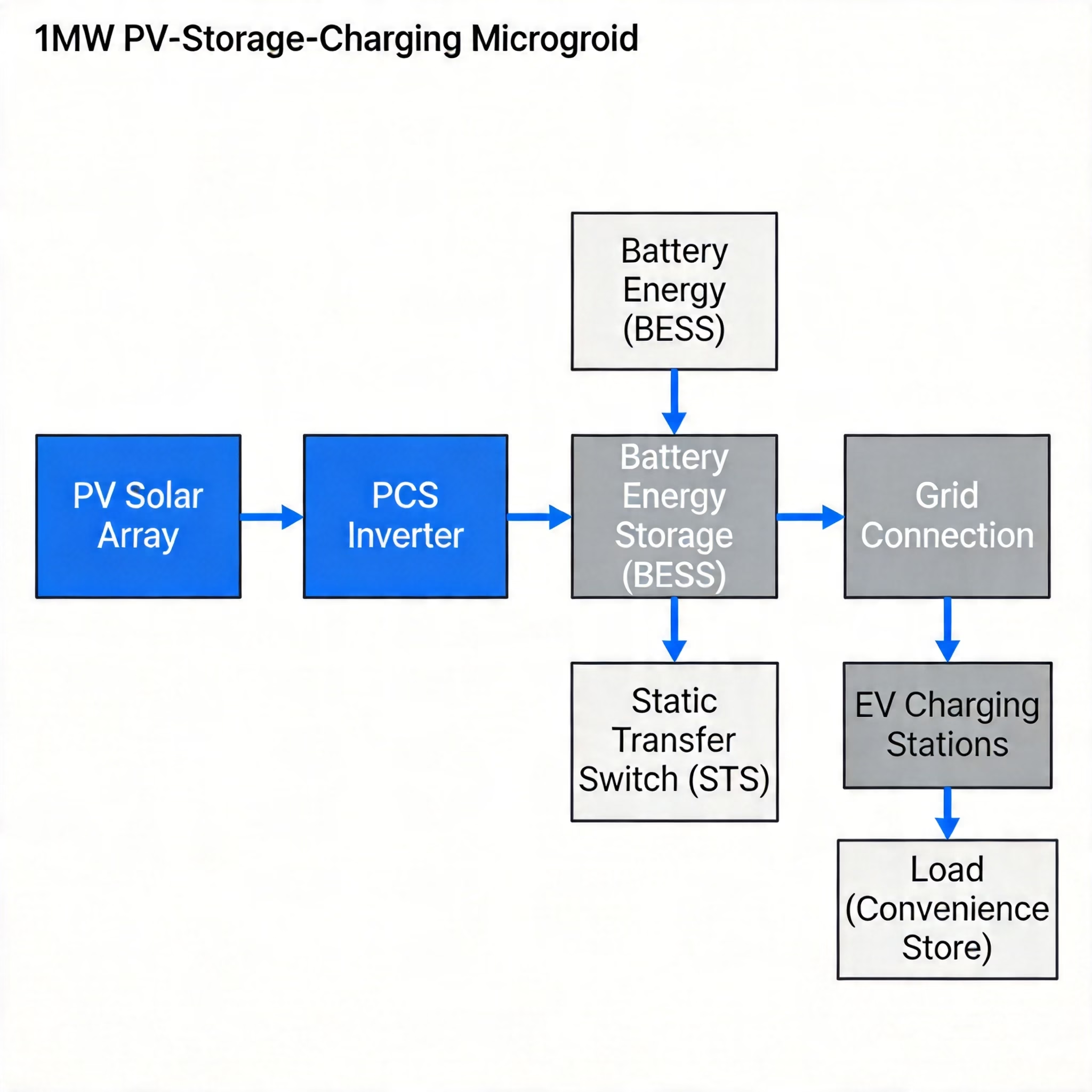
After evaluating different options, we chose an AC-coupled architecture for this project. Why AC-coupled instead of DC-coupled?
- Existing grid interconnection already in place: AC coupling allowed us to add PV, storage and charging without replacing the existing grid connection
- Flexibility for phased construction: The client could start with PV and storage, then add more charging stations later if needed
- Familiar engineering: AC coupling uses standard switchgear and protection that local contractors are comfortable maintaining
The main system components were:
- 1MW DC solar array connected to two 500kW PCS grid-tie inverters
- 2MWh lithium iron phosphate (LFP) battery container with integrated BMS
- Bi-directional battery inverter for charging/discharging control
- Four 120kW DC fast chargers connected to the AC bus
- Microgrid controller with peak shaving and islanding capability
- STS (Static Transfer Switch) for seamless transition between grid-connected and islanding operation
Need a Similar System Design?
If you’re planning a microgrid, BESS or V2G project, our engineering team can help you design the optimal system based on your specific requirements.
Send us your project specs — we’ll propose a solution within 24 hours.
Component Selection
We made several key decisions that impacted both performance and cost:
Battery Chemistry Choice: We specified LFP instead of NMC. While energy density is lower, LFP offers much longer cycle life (over 6000 cycles vs 3000 for NMC) and better thermal stability in the hot desert climate where this site is located. The lower cost also improved the project economics.
Inverter Selection: We used our own DC-DC and PCS products for this project, which gave us full control over the firmware and allowed custom tuning for the microgrid control logic. This integration reduced compatibility issues between different vendors’ equipment.
Solar Canopy Design: We integrated the charging stations under the solar canopies, which provided shade for parked trucks while maximizing solar generation. This dual use of space was critical given the site constraints.
How to Select the Right Configuration
For an integrated PV-storage-charging project like this, here are the key factors we recommend considering:
1. Load Profile Analysis
You must understand when charging will happen. If most trucks charge during daytime hours when solar is generating, you can get away with a smaller battery. If night charging is dominant, you need more storage capacity to shift solar energy to the evening.
2. Grid Tariff Structure
What are the demand charges? Are there time-of-use rates? The financial viability of peak shaving depends directly on these factors. In our case, demand charges were over $15/kW/month, which made battery storage very attractive.
3. Future Expansion Plans
How many more chargers might you add in the next 5 years? AC-coupled architectures are more flexible for incremental expansion compared to DC-coupled, because you don’t need to replace the central inverter when adding capacity.
Measured Results & Performance
After 12 months of operation, here’s how the system performed:
- Peak demand reduction: 65% average reduction in peak demand, saving over $24,000 per year in demand charges
- Solar self-consumption: 92% of solar generation is consumed on-site, with only 8% exported to the grid
- Availability: 99.7% system availability, with only a few scheduled maintenance stops
- Calculated IRR: 12.8%, which gives a projected payback of 7.3 years — under the client’s 8-year target
The system has successfully survived several grid outages during the past year, automatically islanding and keeping the chargers and convenience store operational. This has already generated additional revenue from truckers who specifically stop there because they know they can charge even when the grid is down.
Note: This case study is based on typical project configurations and industry experience for illustrative purposes.
Key Lessons Learned
-
Do detailed load profiling before finalizing battery sizing
We spent a week logging the existing load and interviewing the client about expected charging patterns. That upfront work allowed us to right-size the battery, avoiding both over-sizing (which increases capital cost) and under-sizing (which leaves savings on the table).
-
Engage the utility early in the design process
Interconnection approval can take longer than you expect. We got the utility involved during preliminary design, which helped us identify their requirements for protection and metering early, avoiding costly redesigns later.
-
Don’t underestimate the control system complexity
Coordinating solar generation, battery charging/discharging, and EV charging requires sophisticated control logic. Using an integrated system from a single vendor with experience in microgrid control avoids a lot of integration headaches.
About the Author
This article was reviewed by Ethan Li, an energy storage system specialist with experience in PCS, DC/DC converters and microgrid design.
About IMAXPWR
IMAX (Shenzhen) Power Technology Co., Ltd. (IMAXPWR) is a national high-tech enterprise focused on new energy, professional OEM/ODM manufacturer of energy storage conversion devices and system solutions provider based in Shenzhen, China.
Our R&D team comes from State Grid, Emerson, XJ Group and Kehao Hengsheng, with rich experience in digital power and energy storage systems. We specialize in R&D, production and sales of:
We provide integrated solutions for microgrids, PV-storage-charging integration, commercial and industrial energy storage. Our products are certified by CE, UL and ROHS, widely used in smart microgrids, V2G, distributed energy storage, industrial parks, new energy charging and other scenarios.
📞 Contact Coco for your project inquiry:
- Phone/WhatsApp/WeChat: +86-13760212825
- Email: info@imaxpwr.com
- Website: https://imax-pwr.com
If you have a PV-storage-charging project you’re working on, send us your specifications — our engineering team will help you design a system that meets your performance and financial targets.