

How We Engineered a 50kW Solar-Diesel-Battery Hybrid Microgrid for a Nigerian Exhibition Hall
Engineering Scenario Analysis · Solar-Diesel-Battery Hybrid · 50kW Load · 250kW Diesel Gen-Set
📍 Project Background & Requirements
Application Scenario: A commercial exhibition hall in Nigeria operates daily from 6:00 AM to 6:00 PM. The primary loads are lighting and five 10-HP air conditioning units, with a total base load of approximately 50 kW and a peak demand not exceeding 70 kW.
Customer Situation: The facility already owns a 250 kW diesel generator as its primary power source. However, rising diesel costs — averaging ₦1,570–₦1,700 per litre in 2026[reference:0][reference:1] — and unreliable grid supply have made pure diesel operation increasingly expensive and unsustainable.
Project Objective: Deploy a solar PV + battery energy storage system (BESS) alongside the existing diesel generator to form a hybrid microgrid. The system supplies power to the exhibition hall during daytime operating hours, with diesel generator backup only when solar+battery are insufficient. The business model is energy-as-a-service: IMAXPWR invests in the system and sells electricity to the customer at 0.8 RMB/kWh.
Why Energy Storage? Nigeria receives abundant solar irradiation averaging 5.5 kWh/m²/day with 7–10 hours of daily sunshine[reference:2]. This makes solar+BESS an ideal solution to displace costly diesel generation during daytime hours, while the battery provides grid-forming capability and instantaneous response to load fluctuations — something a diesel genset alone cannot efficiently deliver.
⚙️ Key Engineering Challenges
Challenge 1 — Load Profile & Sizing Mismatch
The 50 kW base load with 70 kW peaks occurs only during 6:00–18:00. Sizing solar PV too large would create midday curtailment; sizing too small would leave the diesel running too often. The battery must bridge the gap between solar generation and load demand while providing peak shaving.
Challenge 2 — System Integration with Existing Diesel Generator
The 250 kW diesel generator is oversized for the 50 kW load, resulting in poor fuel efficiency at partial load. The hybrid system must orchestrate PV, battery, and diesel in a coordinated control strategy — diesel starts only when battery SOC drops below threshold, and operates at optimal loading when engaged.
Challenge 3 — Economic Viability & Payback
With electricity sold at 0.8 RMB/kWh, the system must achieve low LCOE while maintaining high system availability. Diesel avoidance is the primary revenue driver — every litre of diesel not burned directly improves project economics.
📐 Engineering Analysis — Why This Design
PCS Configuration Logic
We selected a 50 kW bidirectional PCS (IMAXPWR BIM series) with three-level topology supporting bidirectional energy flow between battery and AC bus[reference:3]. The rated power matches the base load, with 110% overload capacity to handle 70 kW peaks. The PCS operates in grid-forming mode, establishing voltage and frequency reference for the entire microgrid — critical when the diesel is off and the system runs in island mode.
Battery Capacity Design
Daily energy requirement: 50 kW × 12 hours = 600 kWh. With 5.5 peak sun hours[reference:4] and system efficiency of 88%, required PV array: 600 / (5.5 × 0.88) ≈ 124 kWp. Battery capacity: sized for 4 hours of backup at full load (50 kW × 4h = 200 kWh), allowing the system to ride through cloudy periods and provide peak shaving for the 70 kW surges. We specified a 215 kWh LFP battery cabinet (IMAXBESS series[reference:5]) with 6000+ cycle life at 80% DOD.
System Architecture Decision — AC Coupling
We selected AC-coupled architecture over DC coupling for three reasons: (1) the existing 250 kW diesel generator is AC — AC coupling allows seamless integration without replacing the generator; (2) AC coupling provides greater flexibility for future expansion (additional PV or loads); (3) maintenance and troubleshooting are simpler with standard AC switchgear. DC coupling would require replacing the diesel or adding a complex bidirectional DC/DC interface, increasing cost and single-point failure risk.
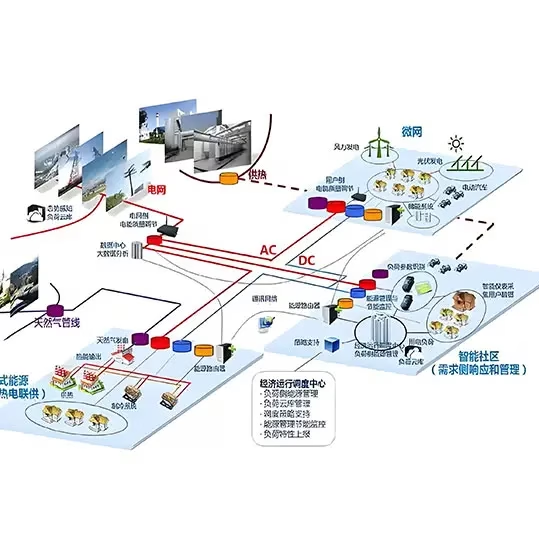
🔌 System Architecture — Single-Line Topology
DC
DC
DC
AC/DC
AC
AC
AC
DC Side
AC Side
🔧 IMAXPWR Engineering Solution
Hardware Configuration
- Bidirectional PCS: IMAXPWR 50kW AC/DC PCS (three-level topology, 98.5% efficiency, grid-forming capable)[reference:6]
- Battery Cabinet: IMAXBESS 215kWh LFP energy storage cabinet with integrated BMS[reference:7]
- PV Side: 124 kWp solar array + MPPT DC/DC converters
- EMS: IMAXPWR Energy Management System with diesel generator coordination logic
- STS: Static Transfer Switch for seamless island/grid transition (<10 ms)[reference:8]
Control Strategy
- Peak Shaving: Battery discharges during 70 kW load surges, keeping diesel loading optimal
- Load Shifting: Solar charges battery during midday excess; battery supplies late-afternoon load
- Diesel Coordination: Diesel starts only when battery SOC < 20% and PV insufficient — operates at >70% load for fuel efficiency
- Grid-Forming: PCS provides voltage/frequency reference when diesel is off
🛡 Safety & Reliability Design
- Electrical Protection: Over-current, over-voltage, under-voltage, reverse polarity, and ground fault protection at every interface
- Thermal Management: Active liquid cooling for PCS + forced air circulation in battery cabinet (ambient 35–45°C Nigeria conditions)
- Communication Monitoring: Real-time 4G remote monitoring with automatic alarm dispatch
- System Safety: BMS + EMS dual-layer battery protection with fire suppression system in battery cabinet
Need a Similar Energy Storage System?
Many EPC contractors and project developers face similar challenges when designing BESS and microgrid systems in regions with unreliable grid and high diesel costs.
IMAXPWR engineering team can help evaluate your:
- Power requirements & load profiling
- Energy capacity & battery sizing
- System architecture (AC/DC coupling)
- Integration strategy with existing generators
📊 Engineering Comparison — Design Alternatives
| Design Parameter | IMAXPWR Hybrid (Selected) | Diesel-Only Baseline | PV-Diesel (No Battery) |
|---|---|---|---|
| Daily Diesel Consumption | ~120 L (backup only) | ~300 L (continuous) | ~200 L (intermittent) |
| Fuel Cost (Daily) | ~₦188,000 | ~₦471,000 | ~₦314,000 |
| Diesel Reduction | ~60% | — | ~33% |
| Load Following | Instant (PCS <20 ms) | Slow (genset ramp) | Poor (genset only) |
| Peak Shaving Capability | ✅ Yes (battery) | ❌ No | ❌ No |
📈 Expected Engineering Benefits
- Diesel Reduction: ~60% reduction in diesel consumption compared to pure diesel operation
- System Availability: >99% expected availability with diesel backup
- LCOE: Projected levelized cost of energy below 0.8 RMB/kWh, ensuring positive margin on electricity sales
- Payback Period: Estimated 4–5 years based on diesel cost avoidance and electricity revenue
- CO₂ Reduction: ~120 tons CO₂ avoided annually
🧠 Key Engineering Lessons Learned
- Correct PCS sizing improves system efficiency. Matching PCS rating to base load (50 kW) with overload capacity for peaks provides optimal efficiency across the operating range.
- Early diesel coordination planning reduces integration risks. Defining start/stop thresholds, ramp rates, and load-sharing logic upfront prevents control conflicts during commissioning.
- AC coupling offers better flexibility for brownfield sites. When an existing diesel generator is already in place, AC coupling avoids costly generator replacement or complex DC interface design.
- Thermal management is critical in tropical climates. Nigeria’s ambient temperatures (35–45°C) require active cooling for both PCS and battery to maintain performance and cycle life.
- Remote monitoring is essential for operational visibility. Real-time data on solar generation, battery SOC, diesel runtime, and load profile enables proactive maintenance and performance optimization.
🚧 Common Mistakes to Avoid in Similar Projects
- ❌ Incorrect PCS sizing — Oversizing reduces efficiency at partial load; undersizing causes overload trips.
- ❌ Poor thermal design — Inadequate cooling leads to PCS derating and accelerated battery degradation in high-temperature environments.
- ❌ Ignoring grid requirements — Even in off-grid mode, the PCS must meet local grid codes for voltage/frequency stability.
- ❌ Underestimating diesel integration complexity — Diesel generators have ramp rates and minimum load requirements; ignoring these causes instability.
- ❌ Skipping load profile analysis — Without accurate 12-hour load data, both PV and battery sizing will be suboptimal.
Need Engineering Support for Your Next Project?
Planning a BESS, microgrid or renewable energy project in Nigeria or other emerging markets?
Send us your project requirements, and our engineering team will provide a customized system recommendation.
✓ PCS configuration support
✓ Energy storage solution design
✓ Hybrid microgrid engineering
Ready to Develop Your Energy Storage Project?
Contact IMAXPWR technical team for:
- BESS system design & engineering
- PCS selection & configuration
- Microgrid solutions (solar-diesel-battery hybrid)
- Customized energy conversion equipment
🏢 About IMAXPWR
ImaxPWR (Imax Power Technology Co., Ltd.) is a national high-tech enterprise specializing in new energy solutions. As an OEM/ODM manufacturer, IMAXPWR focuses on energy storage power conversion equipment, bidirectional PCS, DC/DC converters, V2G modules, energy storage cabinets and integrated microgrid solutions. With professional R&D capabilities and power electronics expertise, IMAXPWR provides reliable and customized energy solutions for global customers in industrial and commercial energy storage, renewable energy integration, smart microgrids and charging infrastructure applications.[reference:9]
📞 Contact IMAXPWR
About The Author
This article was reviewed by Ethan Li, an energy storage system specialist focusing on PCS, bidirectional DC/DC converters and microgrid system design.