

Abstract
As rooftop PV, EV chargers and storage pile onto the low-voltage (LV) side, the old response of “oversize the transformer and pull another cable” stops paying off. Flexible DC interconnection ties two or more adjacent distribution transformers together with a DC bus: PV surplus from an overloaded feeder is exported to a lightly loaded neighbour, power transfers in milliseconds on a fault, and storage plus V2G vehicles back up critical loads when the grid is down. This solution note explains, from the equipment side, exactly which bidirectional converters, DC/DC stages, storage cabinets and V2G chargers must land on that DC bus, and the key sizing points around DC voltage level, grid-forming control and seamless grid-tied/off-grid switching.
1. Overview
A distribution transformer (feeder) is the last and most numerous layer of a distribution network. In emerging markets with rapid rooftop PV rollout and fast EV adoption, the same physical feeder often mixes solar inverters, DC chargers, battery cabinets, air-conditioning load and electric vehicles. Three problems arrive together: uneven loading across neighbouring feeders, reverse power and overvoltage at midday, and slow, mechanical load transfer on faults. Flexible DC interconnection addresses all three with power electronics rather than copper. The design below is equipment-agnostic; it applies to rural and urban feeders alike, and maps directly to ImaxPWR’s grid-forming PCS, bidirectional DC/DC, storage cabinets and V2G converters.
2. Why the Conventional Upgrade Route Runs Out
2.1 Uneven feeder loading
Within one service area, one feeder can be heavily loaded at morning and evening peaks while the next feeder sits light. Conventional reinforcement upgrades each feeder independently, leaving the lightly loaded transformer idle while the overloaded one is reinforced.
2.2 Reverse power and overvoltage from PV
When PV peaks at noon but local load is light, power flows back upstream and the voltage at the line end is pushed above its upper limit. Per DL/T 2860-2024, Technical Guide for Medium-Voltage Flexible Interconnection Connected to Distribution Networks, the core of flexible interconnection is not to add more capacity but to enable controlled power exchange between supply units.
2.3 Slow restoration and weak backup
When a 10 kV line trips or is maintained, the whole LV feeder loses supply. Traditional tie switches are mechanical; critical loads wait minutes for manual switching. In weak grids common across emerging markets, that minutes-long outage is exactly what customers cannot tolerate.
3. How Two Feeders Are Tied by a DC Bus
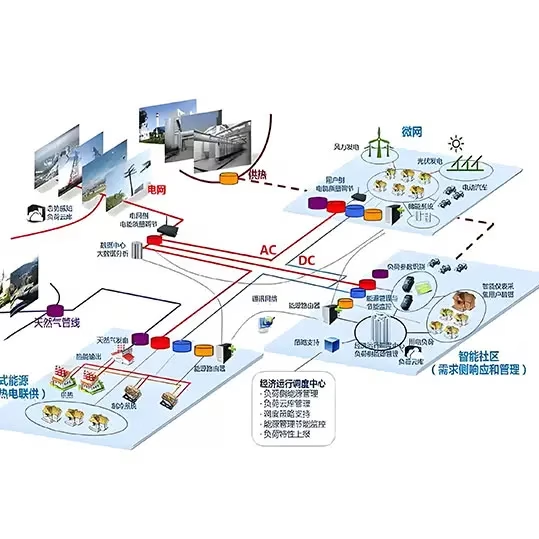
The typical build runs a DC distribution cable between two adjacent feeders, with a bidirectional flexible DC interconnection unit (AC/DC converter) on each end. Feeder 1 and Feeder 2 keep their own 10 kV incoming and 400 V AC bus. Normally both run grid-tied. Every device on the DC side plugs in as a DC “plug-and-play” node:
- PV through a unidirectional DC/DC (MPPT) onto the DC bus, saving one inversion stage;
- Battery energy storage through a bidirectional DC/DC, charge or discharge;
- DC EV chargers taking power straight from the DC bus;
- V2G chargers exchanging power bidirectionally with the bus;
- The two end AC/DC units controlling power exchange between the AC and DC sides.
One DC bus does two jobs at once: an energy channel for cross-feeder transfer and a power-quality buffer that smooths PV fluctuation and supports voltage. According to public reporting from a Shanxi demonstration, a low-voltage PV-storage DC link raised direct-coupling efficiency by about 18% by removing up to five repeated AC/DC conversions in the conventional path.
Grid-forming PCS (AC/DC) to the DC bus
Peak load, local PV and loads
+ power-quality buffer
Cross-feeder transfer · ~45 ms restoration
Grid-forming PCS (AC/DC) to the DC bus
Light load / PV surplus
4. Which ImaxPWR Devices Land on the DC Bus
4.1 End converters: grid-forming PCS are the heart
The interface from each feeder to the DC bus is a bidirectional AC/DC converter. It must switch seamlessly between grid-following, fault-ride-through and island modes, and must control A/B/C phases independently to tame three-phase imbalance. This is exactly where ImaxPWR grid-forming PCS — such as the 100 kW MSP100HC or the 200 kW 750 V isolated PCS module — applies. Per T/CES 243-2023, Technical Specification for Grid-Forming Energy Storage Systems, a grid-forming converter actively supports voltage and frequency on a sag, laying the basis for fault-time transfer.
4.2 DC-side interfaces: DC/DC and power router
PV uses a step-up DC/DC with MPPT; the battery and V2G cars use bidirectional DC/DC. With several devices on one bus, a power router decides which PV feeds which battery and when a V2G car sends power back. The DC voltage level follows GB/T 35727-2017, Voltage Guide for Medium and Low Voltage DC Distribution; a common LV feeder choice is a 750 V DC bus, brought down to 48 V or 400 V by DC/DC. ImaxPWR offers the 125 kW 1500 V bidirectional DC/DC converter for this class of DC link.
4.3 Transformer-area storage cabinet: the backup reserve
A transformer-area storage cabinet (IMAXBESS 125 kW / 216-315 kWh) rides on the bus: it absorbs PV at midday and back up chargers at night. Sizing follows T/CES 386-2025 planning guidance — size to the load curve and PV penetration, not as large as possible. For larger system builds the PS-ESS all-in-one energy storage system gives a cabinet-level package.
4.4 Smart charging and V2G: cars become mobile sources
DC chargers take power straight off the bus, skipping one AC/DC stage; a mobile charging station can serve as a mobile backup node. The V2G bidirectional charger turns an EV from load into a source during a fault or critical-load backup, feeding its battery back through bidirectional DC/DC. This is where PV, storage, charging and the ImaxPWR product line converge.
5. Five Core Functions, Device by Device
| Function | What it does | Key devices |
|---|---|---|
| Peak-valve shifting | Charge at valley, discharge at peak, distribute power across feeders | Grid-forming PCS + storage + EMS |
| Mutual aid | Surplus or deficit transferred to the light neighbour feeder | Two end converters + power router |
| Milli-second restoration | One feeder down, PCS goes island, bus serves critical loads | Grid-forming PCS + storage cabinet |
| Smart charging | EMS dispatches power, slow charge at valley, throttle at peak | DC charger + EMS |
| Critical backup | V2G car sends power back to the bus for essential loads | V2G bidirectional charger + bidirectional DC/DC |
Real figures support the design. According to China Energy News (2023), a Fujian flexible DC interconnection microgrid lifted one factory’s annual full PV self-consumption days from 240 to 330. Published case studies of LV flexible interconnection report load-rate variance cut by about 99.7%, PV curtailment cut by about 82.5%, and full restoration from fault to important-load supply in about 45 ms.
6. Key Sizing Judgements
- DC voltage level: 750 V is a common LV feeder choice, balancing line loss against device rating per GB/T 35727.
- Converter topology: to handle three-phase imbalance, prefer a four-leg or phase-independent grid-forming PCS.
- Grid-tied/off-grid switching: seamless transfer with small transient voltage dip; the grid-forming device builds voltage in island mode.
- Storage size: size to PV penetration and load curve per T/CES 386 planning guidance, avoiding over-sizing.
- Protection coordination: DC faults clear fast; DC breakers and converter protection must grade properly.
7. Frequently Asked Questions (FAQ)
Q1: How is flexible DC interconnection different from an ordinary PV-plus-storage feeder?
An ordinary PV-plus-storage feeder regulates source and load inside one feeder. Flexible DC interconnection ties two or more feeders together with a DC bus for cross-feeder power transfer, fault mutual aid and outage backup, breaking the physical boundary of a single feeder.
Q2: What DC bus voltage is typical?
A common LV feeder DC bus is 750 V, selected per GB/T 35727-2017 based on line length, loss and device withstand rating.
Q3: How fast is supply restored on a fault?
With a grid-forming converter building voltage and the DC bus transferring power, important-load restoration reaches the millisecond range. Published case studies report the whole fault-to-restoration process in about 45 ms, with important-load recovery close to 100%.
Q4: What role does V2G play in flexible interconnection?
A V2G bidirectional charger turns an EV from a load into a mobile source: it sends the battery back through bidirectional DC/DC during a fault or critical-load backup, raising emergency resilience.
Related Reading: 8 C&I Energy Storage Architectures · Product Center
About the Author
Ethan Li, energy storage systems engineer at ImaxPWR Power Co., Ltd., with years of experience in PCS, DC/DC converters, BESS, and microgrid design. He has participated in multiple domestic and international energy storage projects in solution design and technical support.
ImaxPWR is a National High-Tech Enterprise and a source manufacturer of integrated energy storage products and system solutions. This article was reviewed by Ethan Li.
About ImaxPWR
ImaxPWR Power Co., Ltd. (Brand: ImaxPWR) is a National High-Tech Enterprise and source manufacturer, covering bidirectional converters, DC/DC, energy management, and energy storage cabinet integration, providing design, delivery, and O&M services. Products are CE, UL, and ROHS certified. For flexible DC interconnection and PV-storage-charging microgrid projects, ImaxPWR supplies grid-forming PCS, bidirectional DC/DC, transformer-area storage cabinets and EMS.
Heavily loaded feeders, PV reverse power, outage backup? Need a flexible DC interconnection design?
From grid-forming PCS and bidirectional DC/DC to transformer-area storage cabinets and EMS, ImaxPWR sizes the DC bus voltage, converter rating and storage capacity to your feeder loading, PV penetration and load curve.
Contact: COCO
Tel / WhatsApp: +86-13760212825
Email: info@imaxpwr.com
Website:https://imax-pwr.com
© 2026 ImaxPWR Power Co., Ltd. · This article is for engineering practice purposes. Data sourced from industry public materials, international standards, and engineering practice.