

How We Delivered a 125kW/200kWh Mobile Energy Storage Vehicle for Silent, Zero-Emission Temporary Power: A Case Study
Note: This case study is based on a typical mobile energy storage configuration and field experience for illustrative purposes.
Project Background & Requirements
A remote pipeline construction camp in Western China needed temporary power for three months. The site had no grid connection, strict local noise limits after 22:00, and a mixed load profile: welding machines, drilling rigs, site lighting, office containers, and a small EV used for patrols.
The original plan was a 200 kVA diesel generator running 18 hours per day. Fuel logistics were expensive, the noise violated camp rules, and the genset was heavily under-loaded during night shifts — burning fuel while delivering less than 30% of its rated output. The EPC contractor asked us to propose a cleaner, quieter, and more cost-effective temporary power solution.
Our answer was a 125kW/200kWh mobile energy storage vehicle built around IMAXPWR’s mobile charging station platform. The unit integrates a bidirectional PCS, high-voltage LFP battery pack, MPPT solar input, generator hybrid port, and cloud EMS — all on a single trailer.
Key Engineering Challenges
1. Inrush Current from Heavy Industrial Loads
Welding transformers and drilling motors do not draw steady current. A 30 kW welder can pull 150% of its rated current during arc strike, and multiple welders starting simultaneously created brief load spikes above 180 kW.
Standard inverter overload windows are too short for this pattern. If the PCS trips on overload, the whole site goes dark and welders have to restart their arc — costing time and rework.
2. 100% Three-Phase Unbalance
Site loads were connected phase-to-phase in a chaotic way. One phase might carry 80 A while another carried 20 A. A conventional three-phase inverter under these conditions either derates heavily or shuts down on phase imbalance.
3. Multi-Energy Input with Seamless Switching
The vehicle had to accept four power sources — PV, battery, diesel generator, and grid — and switch between them without interrupting sensitive loads such as the site server and medical fridge. Any transfer glitch longer than 20 ms would cause equipment resets.
Our Engineering Solution
System Architecture
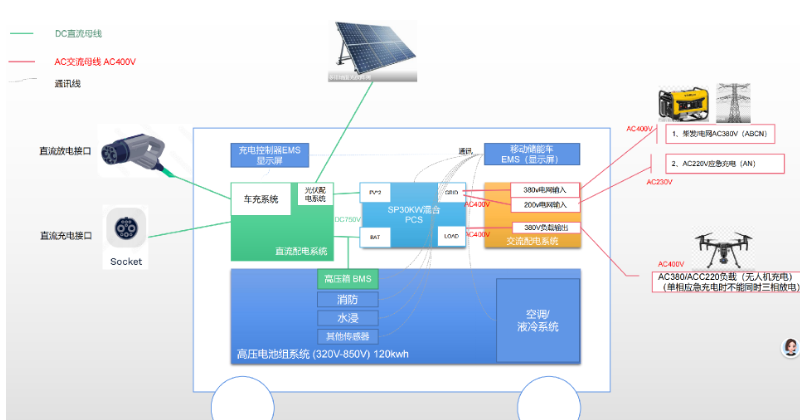
We used an AC-coupled architecture. The mobile unit’s internal DC bus connects the battery cluster and PV MPPT inputs; a 125 kW SiC bidirectional PCS interfaces to the 400 V AC bus. A static transfer switch (STS) selects between the PCS output, a backup diesel generator, and an optional grid input.
During the day, 40 kWp of portable PV panels charge the battery and directly feed the AC loads. When solar drops, the battery discharges. If SOC falls below 25%, the EMS auto-starts a 100 kVA diesel genset and runs it at 70–80% load — its fuel-efficiency sweet spot — until the battery is recharged.
Figure 1 shows the energy flow: PV → DC bus → battery/PCS → AC loads, with diesel and grid as backup sources.
Component Selection
| Component | Model / Spec | Why We Chose It |
|---|---|---|
| Bidirectional PCS | 125 kW SiC, 600–1000 Vdc, 400 Vac, ≥99% peak efficiency | Four-leg topology supports 100% unbalanced load and 150% overload. |
| Battery | 200 kWh LFP, 320–850 Vdc operating range | Enough energy for 6–8 hours of night load; wide voltage range matches PCS. |
| MPPT | 2-channel, 200–950 Vdc, 120 kW per channel | Portable PV arrays can be wired in different string lengths without re-engineering. |
| STS | <10 ms passive transfer, 0 ms active transfer | Keeps server and medical loads online during source changes. |
| EMS | Cloud + local HMI, 4G/Wi-Fi | Remote monitoring, fault alerts, and diesel start/stop scheduling. |
For larger mobile deployments, IMAXPWR also offers the Sunlight Series 500kW all-in-one cabinet, which packages the same architecture in a fixed outdoor enclosure.
How to Select the Right Configuration
Sizing a mobile BESS is not about copying a datasheet. We use this logic:
- Peak power (kW): 1.5× the largest simultaneous load. Here: 125 kW × 150% overload = 187.5 kW brief capacity, covering welder inrush.
- Energy (kWh): Desired autonomous runtime × average load. Night average was 25 kW; 200 kWh gives 6–7 hours at 80% usable SOC.
- Solar ratio: PV peak power ≈ 0.3–0.5 × daily load. We installed 40 kWp to cover daytime base load and partial charging.
- Diesel backup: Sized to 1.2× average load, not peak. A 100 kVA genset recharges the battery at 70–80 kW while carrying base load.
For smaller mobile units, the HI30KW hybrid converter offers a 30 kW footprint with the same grid-forming and generator-hybrid capability.
Measured Results & Performance
The mobile unit ran for 92 days. Key figures:
- Diesel fuel reduction: 41% compared with the original genset-only plan.
- Site noise: Battery-only operation measured 48 dB(A) at 7 m, versus 78 dB(A) for the diesel genset.
- System availability: 99.6% — only interrupted during a planned firmware update.
- Round-trip efficiency: 88.5% (PV → battery → AC load), including PCS and auxiliary losses.
- Diesel runtime: Reduced from 18 h/day to 4.5 h/day, and always above 65% load.
The EPC team reported that the biggest operational benefit was not the fuel savings alone — it was the ability to run quiet power after 22:00 without violating camp rules, and the elimination of generator maintenance during low-load night shifts.
Need a Similar System Design?
If you are planning a mobile BESS, microgrid, or temporary power project, our engineering team can size the optimal configuration based on your load profile, runtime requirement, and ambient conditions.
Send us your project specs — peak load, average load, desired runtime, available solar area, and site temperature range — and we’ll propose a solution within 24 hours.
Contact: Coco | Tel / WhatsApp / WeChat: +86-13760212825 | Email: info@imaxpwr.com
Key Lessons Learned
- Overload capability matters more than rated power. A 125 kW PCS with 150% overload handles real site loads better than a 160 kW PCS with 110% overload.
- Unbalanced load support is non-negotiable on construction sites. Four-wire, four-leg topology avoids nuisance trips.
- Run the diesel at high load, not continuously. A smaller genset cycling at 70–80% load uses less fuel than a large genset idling at 20%.
- Pre-wire portable PV in plug-and-play strings. Crews can deploy or pack panels in under two hours.
- Cloud EMS pays for itself in O&M. Remote fault alerts cut site visits by more than half.
About the Author
This article was reviewed by Ethan Li, an energy storage system specialist at IMAXPWR with hands-on experience in PCS, DC/DC converters, and microgrid design.
About IMAXPWR
IMAX Power Technology Co., Ltd. (IMAXPWR) is a national high-tech enterprise based in Shenzhen, China. We design and manufacture bidirectional PCS, DC/DC converters, V2G modules, MPPT controllers, and integrated BESS cabinets for microgrid, C&I energy storage, and mobile power applications.
Our R&D team includes engineers from State Grid, Emerson, Xuji Group, and Kehua Hengsheng. Products are certified to CE, UL, IEC, and RoHS standards, and we have delivered more than 1,000 projects globally.
Contact: Coco | Tel / WhatsApp / WeChat: +86-13760212825 | Email: info@imaxpwr.com | Website: www.imax-pwr.com
Frequently Asked Questions
What is a mobile energy storage vehicle?
A mobile energy storage vehicle is a truck- or trailer-mounted BESS with integrated PCS, battery, EMS, and multi-source inputs. It replaces or supplements diesel generators for temporary, remote, or emergency power.
Can a mobile BESS really power heavy industrial equipment?
Yes, if the PCS is sized for inrush current and unbalanced loads. IMAXPWR’s 125 kW mobile unit supports 150% overload and 100% three-phase unbalance, making it suitable for welders, drills, and motor loads.
How does the diesel generator interact with the battery?
The EMS runs the battery as the primary source and starts the diesel only when SOC is low. The genset charges the battery at its most efficient load point, then shuts off. This hybrid strategy typically cuts fuel use by 30–50%.
What certifications does IMAXPWR mobile BESS equipment carry?
Relevant products carry CE certification and comply with GB/T 42288. Project-specific UL or IEC 62619 certification can be arranged depending on destination market requirements.