

Stop treating district-level energy storage as just a large power bank. How many “tuition fees” are you willing to pay for this misconception? Let me clarify: By 2026, the game will have completely changed. If you’re still fixated on peak-valley price differentials, you’re on the brink of obsolescence. The biggest wave of benefits in the distribution network sector is already upon us.
First, the Data:
- National distributed photovoltaic (PV) installed capacity has surpassed 500 million kilowatts, equivalent to stuffing an elephant into the distribution network.
- Over 150 counties have become PV “red zones,” with no room for new additions.
- In rural areas, end-of-line voltage often drops below 180 volts, rendering air conditioners and rice mills inoperative—a clear case of “intestinal obstruction” in the grid.
Traditional Solutions:
- Previously, grid operators resorted to replacing transformers and copper wires, a costly, time-consuming process requiring village-wide power outages. This approach is now outdated.
Enter District-Level Energy Storage:
- It’s not just a cabinet; it’s the hemostatic forceps and special forces of the distribution network.
- During peak PV generation hours, it silently absorbs excess energy.
- During peak demand periods, it discharges power to alleviate transformer stress, enabling flexible capacity expansion and seamless grid management without transformer upgrades or cable replacements.
- Costs are slashed by 70%, and project timelines are reduced to just one week, benefiting both grid operators and contractors.
Profitability Debate:
- Before 2026, this was a debatable topic. Now, with Document No. 1710, State Grid officially recognizes it as “grid-substituting energy storage,” elevating it from a temporary fix to a permanent solution.
- Real Numbers:
- In Shandong, with a peak-valley price differential of RMB 0.8, a 100 kWh system can generate annual profits of RMB 50,000-60,000 through arbitrage.
- Add frequency and voltage regulation compensation, plus savings from avoided capacity expansions, and the comprehensive internal rate of return (IRR) exceeds 12%, with a payback period of five years and pure profits thereafter.
Technological Advancements:
- Full liquid-cooling temperature control ensures near-silent operation.
- AI scheduling accurately predicts tomorrow’s load, optimizing charging and discharging cycles.
Essence of the Revolution:
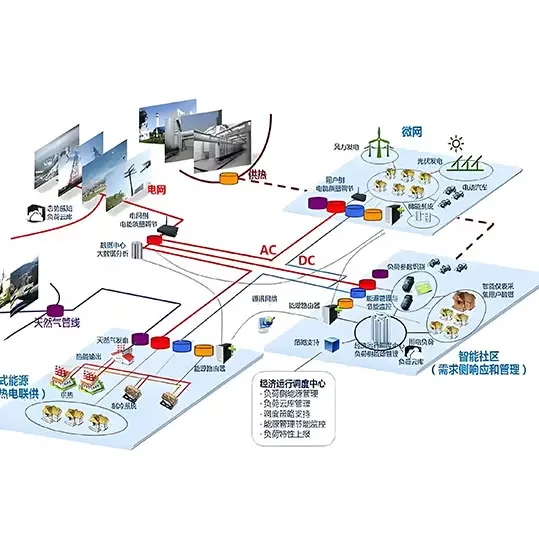
- District-level energy storage represents a fundamental transformation of the distribution network. Every transformer will soon house its own “heart,” paving the way for a future where isolated grids are replaced by interconnected microgrids.
- 2026 marks the golden year for large-scale deployment. The signal is clear; the decision to accelerate is yours.
Final Advice:
- Shift your focus from grand narratives to practical implementation. This industry doesn’t lack storytellers; it needs craftsmen who can embed energy storage solutions into the very fabric of the grid.