

Note: This article presents engineering guidance for PV-diesel-storage microgrids at island resorts in Southeast Asia. Market and illustrative project figures are based on typical regional industry reporting; product specifications are from official Imaxpower datasheets.
The Technical Challenge: Why Island Resorts Can’t Rely on the Grid
Southeast Asia’s island resorts offer guests a tropical paradise — but behind the scenes, the power supply is anything but idyllic. For hotels and resorts on remote islands or at the end of weak feeders, electricity is a daily struggle with four recurring problems:
- Unreliable grid: Many islands sit beyond the main grid or at the end of long feeders. In parts of Myanmar, Cambodia and the Philippines, outages can exceed 8 hours a day, and voltage swings of up to ±45% can damage sensitive equipment such as kitchen controls, refrigeration and smart-hotel systems.
- Diesel cost: Where there is no grid, diesel generators are the default. Fuel and logistics push the levelized cost of diesel-only power to roughly $0.30–0.45/kWh on remote islands — a heavy burden for energy-hungry resorts (in the Maldives, for example, island electricity cost is commonly several times the mainland rate).
- Carbon & noise pressure: Guests increasingly choose green destinations. A diesel-only resort faces both environmental-compliance pressure and a weaker “eco-luxury” brand story.
- Remote O&M: Skilled technicians are scarce on small islands. When a generator fails, response times are measured in days, not hours — and resort operations stall.
1. Grid Coverage Gap and Voltage Instability
The fundamental problem is that the grid, where it exists, was not designed for modern resort load density — air-conditioning, kitchens, cold storage, pools and water treatment running simultaneously. Long feeder runs and weak transformers produce chronic undervoltage, phase imbalance and brownouts. A hotel cannot wait for grid reinforcement that may never come; it needs its own reliable power island.
2. Diesel’s True Cost: Fuel, Logistics and O&M
Diesel generation on an island carries three compounding costs: the fuel itself (often 30–50% higher than mainland due to shipping), the logistics of barge delivery and on-site storage, and the maintenance burden of running generators around the clock — low-load running is both inefficient and damaging to genset life. For a resort consuming 3,000–5,000 MWh a year, every 10% of diesel replaced by solar-plus-storage translates into tens of thousands of dollars of annual saving.
3. High-Humidity, Salt-Air Environment
Outdoor power equipment on tropical islands faces aggressive corrosion from salt spray, high humidity and intense UV. Equipment must be outdoor-rated with sealed control compartments and wide temperature windows — indoor-grade hardware degrades quickly on a beachfront.
Our Engineering Solution: PV-Diesel-Storage Microgrid in a Single Cabinet
System Architecture
Imaxpower’s answer is a PV-diesel-storage microgrid built around all-in-one hybrid cabinets that integrate PCS, MPPT, EMS, STS and distribution in one unit. The cabinet couples PV, LFP battery and diesel generators into one grid-forming microgrid: PV serves daytime loads first, surplus charges the battery, the battery carries evening peaks, and diesel is reduced to a true backup role.
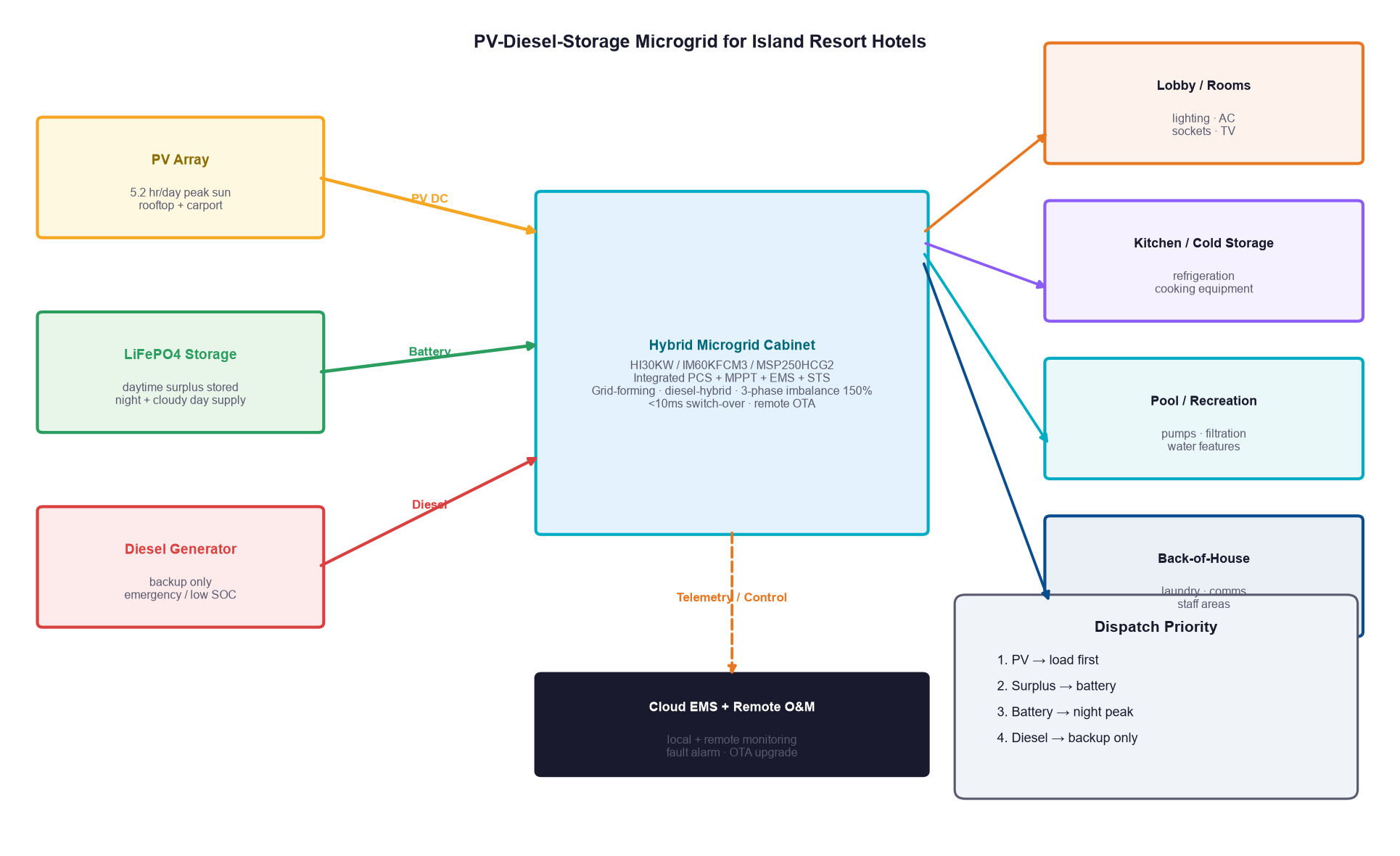
The design logic is PV first, storage second, diesel last. The EMS continuously balances solar forecast, battery SOC and hotel load. When the sun is up, PV runs the hotel and charges the battery. In the evening, the battery shaves the peak. Diesel starts only when battery SOC falls below a configurable threshold (e.g. 25%) or during prolonged bad weather — cutting generator runtime by 60–80% versus diesel-only operation.
This is the same grid-forming architecture we applied in our remote-island hybrid BESS project (2MW/4MWh, 72% diesel reduction, 99.3% availability) and the 700kW solar + 1.5MWh BESS island project — a proven pattern for keeping island loads online at a fraction of the diesel cost.
Component Selection: Matching the Cabinet to the Resort
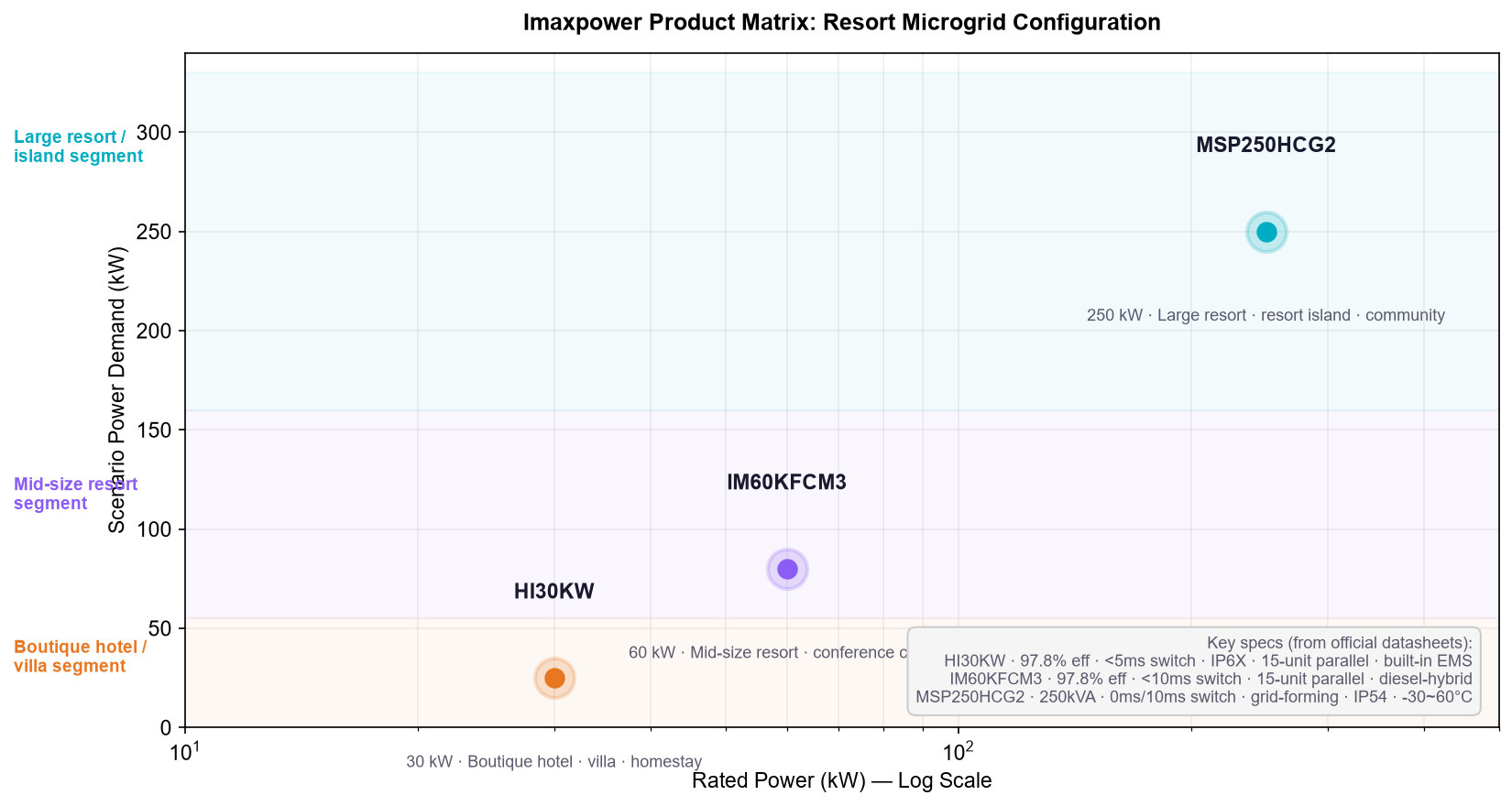
| Parameter | HI30KW | IM60KFCM3 | MSP250HCG2 (Sunlight) |
|---|---|---|---|
| Rated power | 30 kW | 60 kVA | 250 kVA (max 275 kVA) |
| Max efficiency | 97.8% | 97.8% | — |
| Grid/off-grid switch-over | <5 ms | <10 ms | Active 0 ms / passive <10 ms |
| Battery voltage range | 200–850 V DC | 200–820 V DC | 680–950 V DC |
| Parallel units | Up to 15 | Up to 15 (AC side) | Up to 3 cabinets (750 kVA) |
| Protection rating | IP6X (sealed control) | IP5X (core control) | IP54 outdoor |
| Operating temperature | Desert/island ready | Desert/island ready | -30°C to +60°C |
| Key capability | Built-in EMS, 150% overload, diesel hybrid | Diesel hybrid, 3-phase independent control | Grid-forming, PV-storage-diesel microgrid |
| Typical resort scenario | Boutique hotel, villa, homestay | Mid-size resort, conference center | Large resort, island community |
How the EMS Runs a Full Day at a Resort
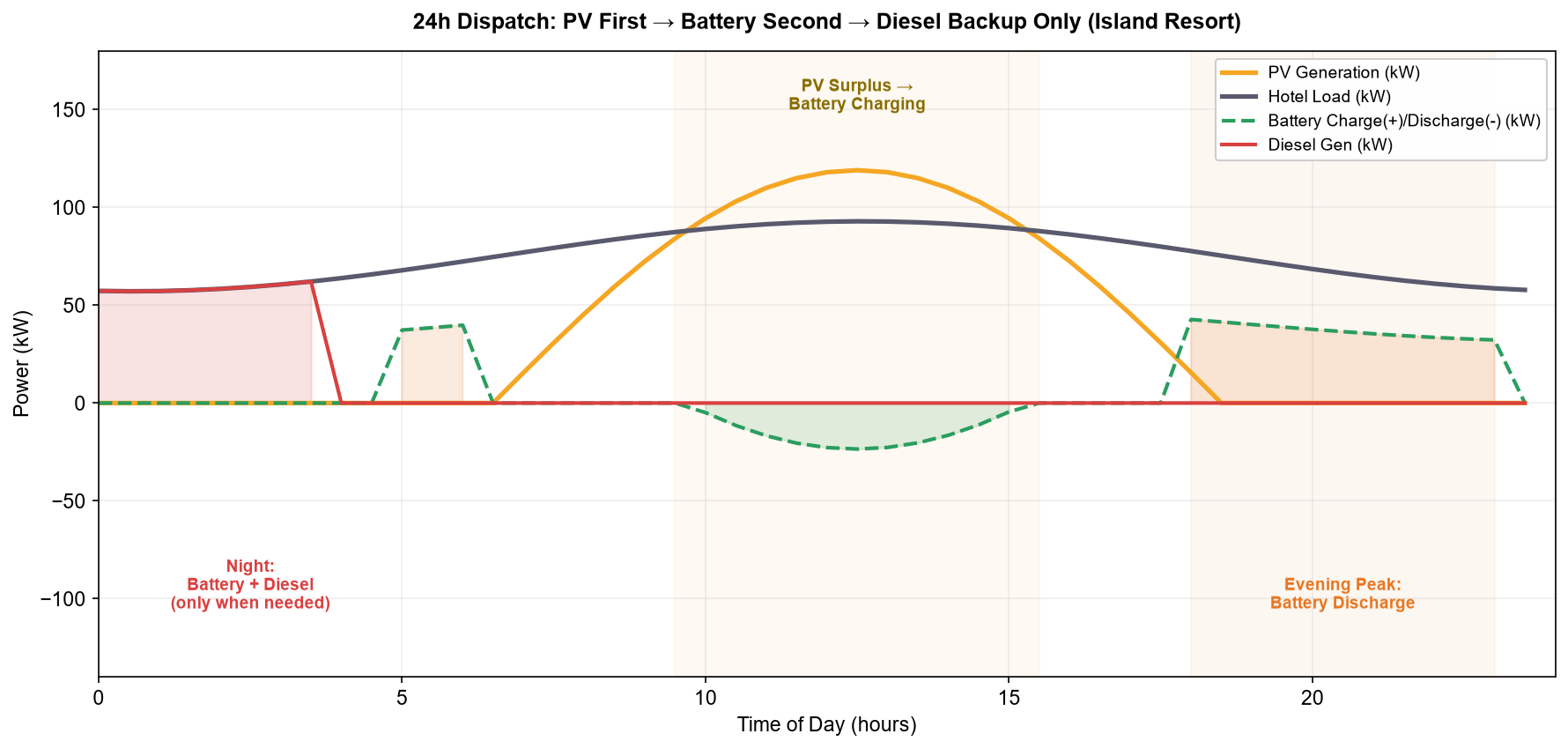
The built-in EMS coordinates three energy sources across a typical 24-hour cycle to maximise green share and minimise cost:
- Daytime (9:30–15:30): PV serves the hotel directly; surplus charges the battery. Self-consumption first — no energy exported or wasted.
- Evening peak (18:00–23:00): Battery discharges to cover the dinner-and-entertainment load peak, avoiding expensive late diesel running.
- Night: Battery carries base load; if SOC drops to the threshold, the EMS soft-starts the diesel to top up — never at low-load inefficiency.
- Grid / generator outage: The cabinet islands in <10 ms and grid-forms — lobby, kitchen, cold storage and pool pumps stay online without interruption.
How to Select the Right Configuration
Sizing a resort microgrid comes down to four decisions, each driven by the hotel’s load profile and site conditions:
| Decision | Rule of Thumb | Why It Matters for an Island Resort |
|---|---|---|
| Cabinet power | Match continuous load + 25–30% margin | Kitchen, AC and cold-storage surge can be 2× steady load |
| Battery capacity | 2–4 hours of evening/night critical load | Night guest comfort and cold storage must never drop |
| PV sizing | 1.2–1.5× daily consumption / peak-sun hours | SE Asia averages ~5.2 h/day peak sun; oversize to maximise green share |
| Switch-over speed | <10 ms for uninterruptible loads | POS, kitchen controls and cold storage cannot tolerate a gap |
Measured Results & Performance
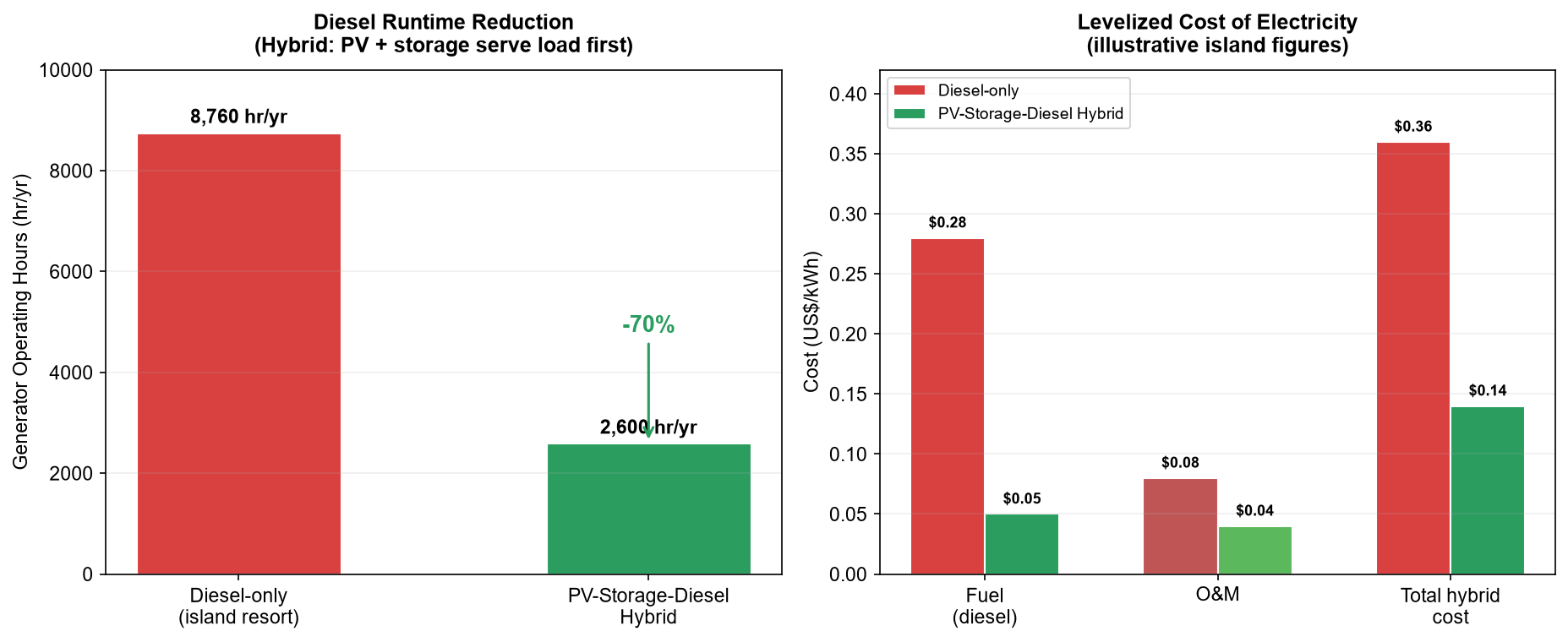
Across comparable island and off-grid deployments, the engineered outcomes follow a consistent pattern:
- Fuel saving: Generator runtime falls 60–80%; annual diesel consumption drops by 30–50% (up to 70% in high-sun islands).
- Cost reduction: LCOE drops from $0.30–0.45/kWh (diesel-only) to $0.10–0.18/kWh — a 50–60% cut.
- Availability: Seamless <10 ms switch-over delivers 99%+ availability for critical resort loads.
- Emissions: A typical 500 kW-scale resort microgrid can displace hundreds of tonnes of CO₂ per year and cut generator noise dramatically.
- Payback: In high-sun Southeast Asian islands, simple payback for resort microgrids commonly lands in the 3–5 year range.
Project Note: In a representative off-grid island deployment, our hybrid BESS delivered 72% diesel reduction with 99.3% system availability — the operating pattern described above, applied in the field. Figures here are illustrative and site-specific; we model each project before committing to a design.
Need a Similar System Design?
If you’re planning a resort, hotel, or island-community PV-diesel-storage microgrid project, our engineering team can size and configure the right cabinet for your load profile, fuel cost, irradiance, and site constraints — including salt-air exposure and remote O&M.
Send us your project specs — monthly consumption, peak demand, current diesel cost, roof area and island location — and we’ll propose a solution within 24 hours.
Contact: info@imaxpwr.com | Tel/WhatsApp: +86-13760212825 | www.imax-pwr.com
Key Lessons Learned
- Diesel-hybrid, not diesel-replacement, is the safe first step. Keep the existing generator as grid-forming backup; add PV and storage first, then retire diesel hours. This de-risks the transition and protects resort uptime.
- Size for the kitchen, not the brochure. Cooking and cold-storage surges drive peak load. Undersizing the inverter guarantees nuisance trips at the worst possible moment.
- Salt air is the real enemy. Specify outdoor-rated (IP5x+) sealed equipment with wide temperature windows. The environment, not the electronics, usually kills cheap gear on a beachfront.
- Remote O&M must be designed in. Cloud monitoring, fault alarms and OTA upgrades let a resort manager (or a remote support engineer) resolve most issues without a site visit — critical on small islands.
- Grid-forming capability is non-negotiable for resorts. A backup that cannot form its own grid is useless in an island blackout. Grid-forming hybrid cabinets keep critical loads alive end to end.
FAQ
Q: Can we keep our existing diesel generators and just add solar and storage?
A: Yes — that is exactly the recommended path. A PV-diesel-storage hybrid microgrid keeps your existing generator as the grid-forming backup and adds PV plus battery as the primary energy sources. The EMS dispatches PV first, storage second, and soft-starts the diesel only when battery SOC falls below the configured threshold or during prolonged bad weather. This typically cuts generator runtime by 60–80%, lowers fuel spend by 30–50%, and avoids the cost and risk of a full rip-and-replace. Your diesel investment stays productive; it just runs far less.
Q: How much can we realistically save by moving from diesel to a PV-diesel-storage microgrid?
A: Savings come from two levers: replacing expensive diesel kWh with free solar, and running the generator at higher, more efficient loads for fewer hours. On Southeast Asian islands, where diesel-only LCOE is roughly $0.30–0.45/kWh, a well-sized hybrid typically lands at $0.10–0.18/kWh — a 50–60% reduction. Annual fuel spend commonly drops 30–50%, and simple payback falls in the 3–5 year range at high-sun locations. Exact figures depend on your load profile, current fuel cost and irradiance; send us your consumption and fuel data and we’ll run the model.
Q: Will the equipment survive the humidity, salt spray and storms on a tropical island?
A: Yes, when correctly specified. The HI30KW has a sealed IP6X control compartment, the IM60KFCM3 an IP5X-rated core, and the MSP250HCG2 is an outdoor IP54 cabinet rated from -30°C to +60°C with forced-air cooling. All use isolated air-duct layouts designed for harsh environments. For beachfront installations we confirm salt-spray requirements at the design stage so the correct enclosure and coating options are applied. We also recommend a covered, elevated mounting pad to keep equipment out of direct storm surge and standing water.
About the Author
This article was reviewed by Ethan Li, an energy storage system specialist with experience in PCS, hybrid inverter and microgrid design for island and remote applications. Ethan has supported PV-diesel-storage projects across Southeast Asia and the Pacific, focusing on grid-forming architectures, remote O&M and cost-optimized sizing for hospitality loads.
About IMAXPWR
Imaxpower (Imax Power Technology Co., Ltd.) is a China national high-tech enterprise headquartered in Shenzhen, specializing in integrated energy storage products and system solutions. Founded in 2015, the company has delivered 999+ projects worldwide with a 99% customer recognition rate. Its hybrid microgrid experience spans PV-diesel-storage deployments across emerging markets.
The R&D team comprises senior experts from State Grid, Xuji Group, Emerson, and Kehua Hengsheng, with 20+ years of power electronics experience. Imaxpower develops full-stack self-developed PCS, BMS/EMS, DC/DC converters, and all-in-one BESS cabinets, covering 30 kW to 2 MW+ system deployments. For island resorts, the HI30KW, IM60KFCM3 and MSP250HCG2 cabinets form a complete PV-diesel-storage microgrid portfolio.
Products are certified to UN38.3, IEC, UL, CE, and RoHS standards and shipped to Europe, North America, Southeast Asia, the Middle East, and Africa without re-engineering. The company offers full customization — from system design and engineering to O&M services — tailored to specific project requirements.
Contact: Coco | Tel/WhatsApp/WeChat: +86-13760212825 | Email: info@imaxpwr.com | www.imax-pwr.com