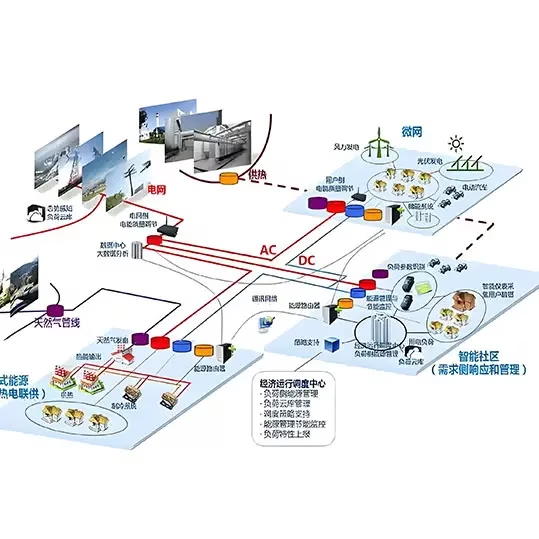


Note: This article presents market context and engineering guidance for solar-plus-storage microgrids in the Middle East. Market figures are illustrative and based on typical regional industry reporting; product specifications are from the official Imaxpower datasheets.
The Technical Challenge: Why the Middle East Grid Lets You Down
The Middle East’s skyline tells a story of modern ambition — but the grid behind it is far more fragile than it looks. Structural power shortages, 50°C+ summer peaks, and a heavy dependence on oil-and-gas generation leave luxury villas, hotels, and data centers exposed to outages precisely when electricity matters most.
1. Structural Shortage + Summer “Perfect Storm”
Traditional oil-and-gas generation accounts for 70–80% of the region’s power mix. Countries like Saudi Arabia and the UAE are comparatively well supplied, but Iraq, Egypt and others run structural deficits with capacity factors below 80%. Population growth exceeds 2% a year (over 5% in some countries), while cooling loads multiply electricity demand 2–3× during summer. In Riyadh, air-conditioning alone can represent ~67% of a villa’s household electricity consumption. The result: when the thermometer climbs, the grid falls short.
2. Heat, Sand, and Salt: The Equipment-Killer Environment
Outdoor power equipment in the Gulf faces three relentless enemies: ambient temperatures that regularly exceed 50°C, airborne sand that clogs filters and fins, and saline coastal air that accelerates corrosion. Conventional indoor-grade inverters derate sharply or fail outright. Any credible solution must be rated for outdoor, high-dust, high-temperature duty — with sealed control compartments and a wide operating window.
3. Water and Power Are Bound Together
Over 90% of the UAE’s drinking water comes from desalination, and the region’s desalination plants are among the biggest single electricity consumers on the network. A grid failure is not just a blackout — it can become a water outage. This makes uninterrupted, self-sufficient power a resilience issue, not just a comfort issue, for hotels, compounds and critical infrastructure.
4. Weak-Grid Dynamics: Voltage Fluctuation and Three-Phase Imbalance
Beyond outright outages, many Middle East feeders suffer from voltage sag/swell and significant three-phase imbalance. Sensitive loads — smart-home systems, wine-cellar cooling, hotel elevators, IT infrastructure — are the first to be damaged. A conventional grid-tied inverter has no way to protect these loads when the feeder degrades; the system must be able to island instantly and keep critical loads powered.
Our Engineering Solution: Solar-Storage Microgrid in a Single Cabinet
System Architecture
Imaxpower’s answer is a solar-plus-storage microgrid built around all-in-one hybrid cabinets that integrate PCS, MPPT, EMS, STS and distribution in a single unit. The cabinet couples PV, LFP battery, utility grid and (optionally) a diesel generator into one independent microgrid that can form its own grid when the utility fails — a “grid-forming” architecture rather than a passive backup.
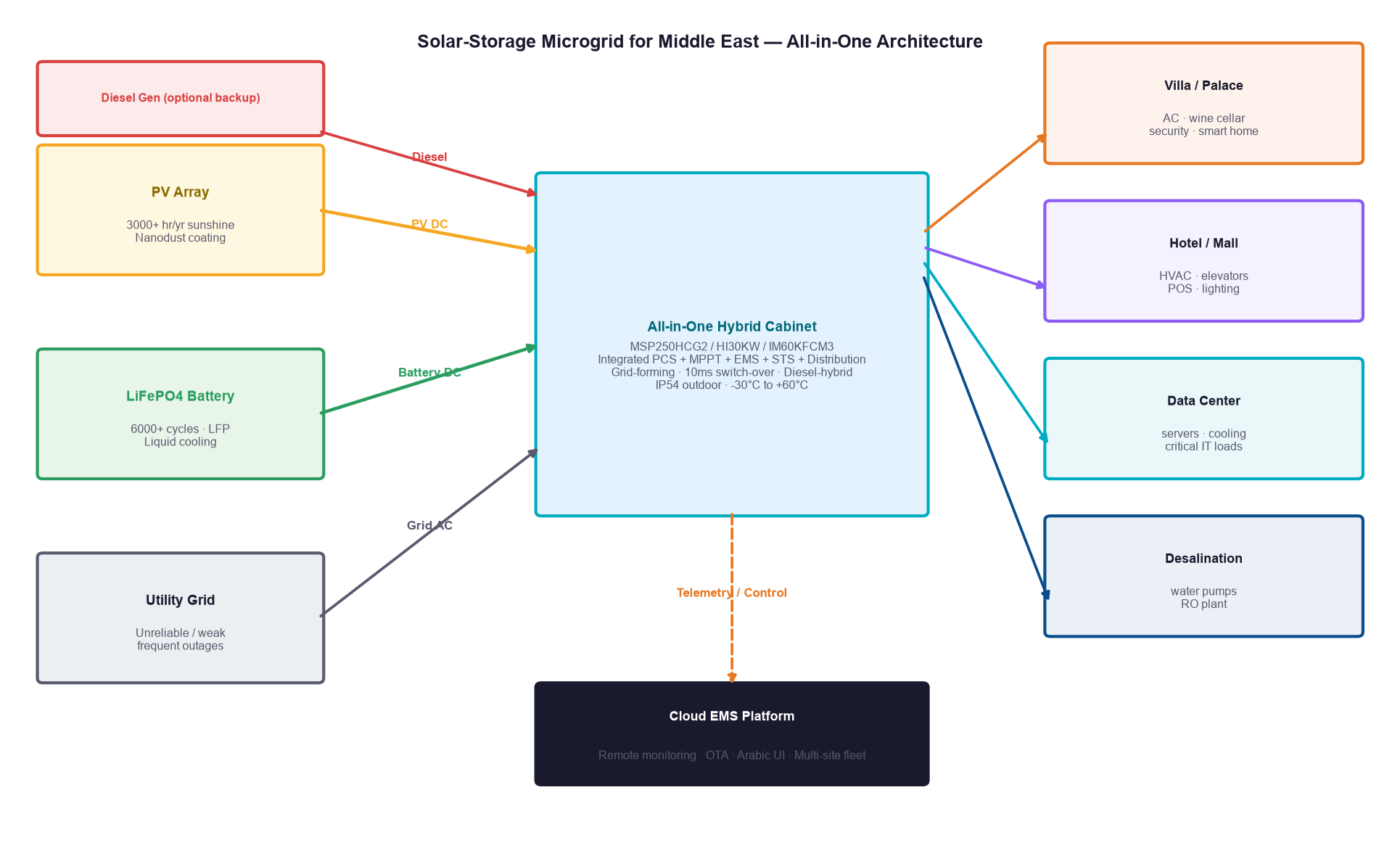
The core design principle is layered independence: PV serves daytime loads first, surplus charges the LFP battery, and the battery carries evening and night peaks. When the grid drops, the cabinet switches to off-grid in 0–10 ms (active switch at 0 ms, passive at <10 ms) — critical loads never notice the transition. With the built-in EMS in “self-consumption + economic mode,” the system automatically shifts charging to cheap/noon solar hours and discharges during expensive evening peaks.
Component Selection: Matching the Cabinet to the Scenario
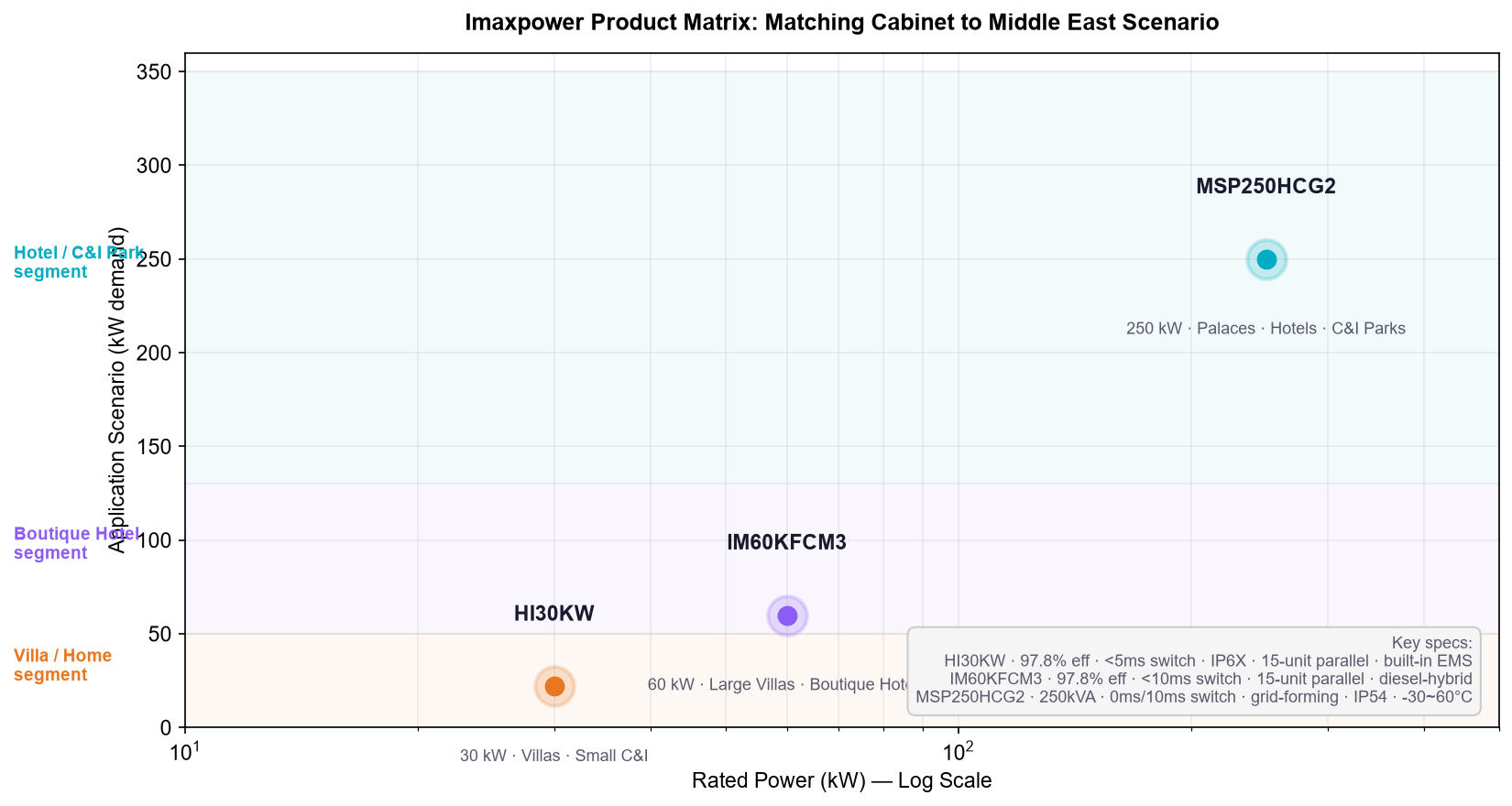
Three cabinet families cover the full Middle East spectrum, from a single villa to a hotel or industrial park:
| Parameter | HI30KW | IM60KFCM3 | MSP250HCG2 (Sunlight) |
|---|---|---|---|
| Rated power | 30 kW | 60 kVA | 250 kVA (max 275 kVA) |
| Max efficiency | 97.8% | 97.8% | — |
| Grid/off-grid switch-over | <5 ms | <10 ms | Active 0 ms / passive <10 ms |
| Battery voltage range | 200–850 V DC | 200–820 V DC | 680–950 V DC |
| Parallel units | Up to 15 | Up to 15 (AC side) | Up to 3 cabinets (750 kVA) |
| Protection rating | IP6X (sealed control) | IP5X (core control) | IP54 outdoor |
| Operating temperature | Wide-range, desert-ready | Wide-range, desert-ready | -30°C to +60°C |
| Key capability | Built-in EMS, 150% overload, diesel hybrid | Diesel hybrid, 3-phase independent control | Grid-forming, PV-storage-diesel microgrid |
| Typical scenario | Villas, small commercial | Large villas, boutique hotels | Palaces, hotels, C&I parks |
How the EMS Runs a Full Day: Multi-Mode Dispatch
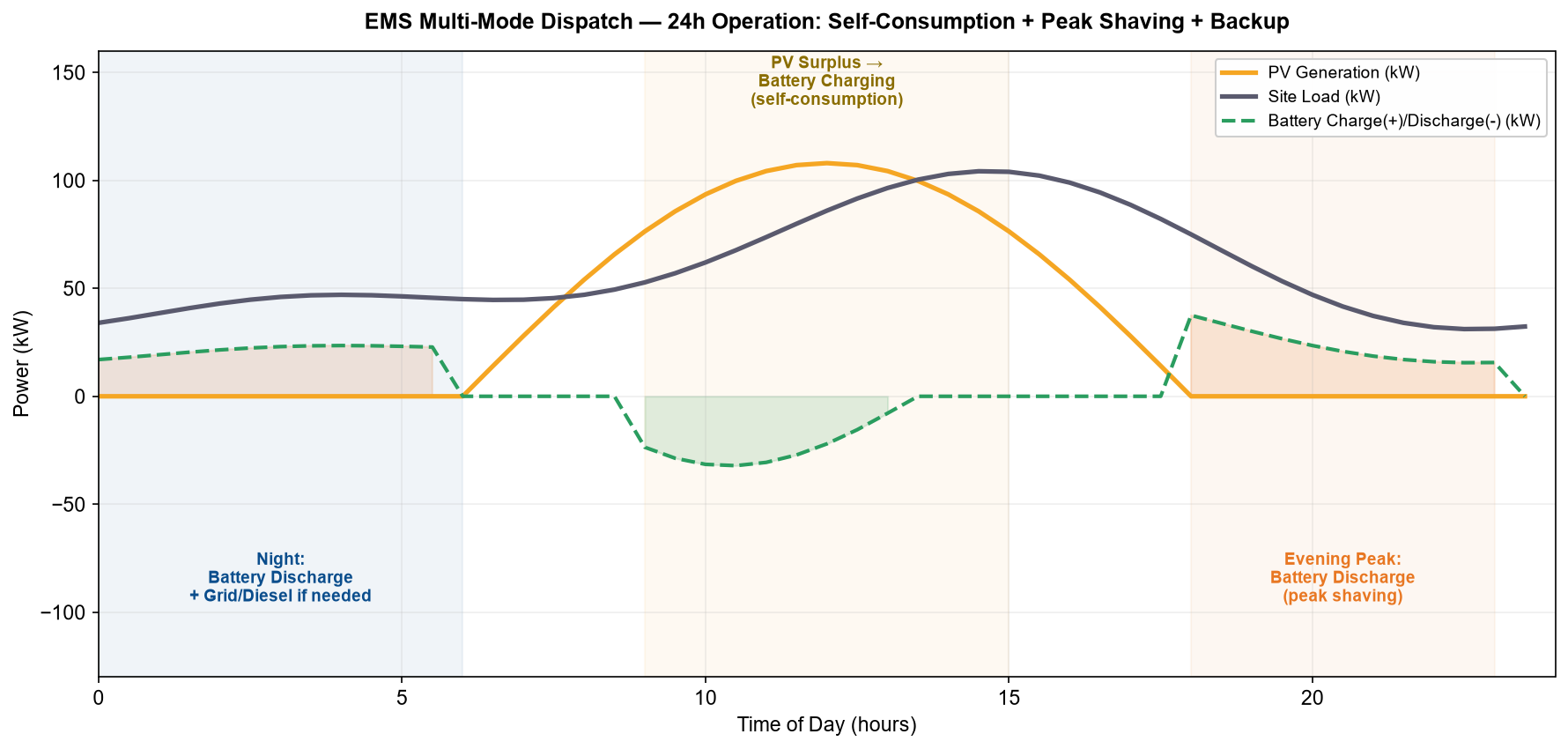
The built-in EMS continuously balances three objectives — self-consumption, cost saving, and resilience — across a typical 24-hour cycle:
- Daytime (9:00–15:00): PV serves the load directly; surplus solar charges the battery (self-consumption first, no energy wasted).
- Evening peak (18:00–23:00): Battery discharges to shave the expensive peak, cutting electricity bills while keeping the villa or hotel running.
- Night / pre-dawn: Battery continues to serve base load; if SOC falls to the configurable threshold (e.g. 25%), the system soft-starts the diesel generator or pulls from the grid to top up.
- Grid outage: The cabinet islands in <10 ms and becomes the microgrid’s voltage and frequency source — critical loads (security, wine cellar, IT, pumps) stay online.
How to Select the Right Configuration
Sizing a solar-storage microgrid for the Middle East comes down to five decisions:
| Decision | Rule of Thumb | Why It Matters in the Gulf |
|---|---|---|
| Cabinet power | Match continuous load + 20–30% margin | Air-conditioning surge can be 2–3× steady load |
| Battery capacity | 2–4 hours of evening/night critical load | Night cooling and desalination pumps must keep running |
| PV sizing | 1.2–1.5× daily consumption / peak sun hours | High irradiance (3000+ hr/yr) means fast payback, but battery must absorb surplus |
| Switch-over speed | <10 ms for uninterruptible loads | IT, security and wine-cellar loads cannot tolerate any gap |
| Environmental rating | Outdoor, IP5x+, wide temperature window | 50°C+ heat and sand demand sealed, derate-free designs |
Measured Results & Performance
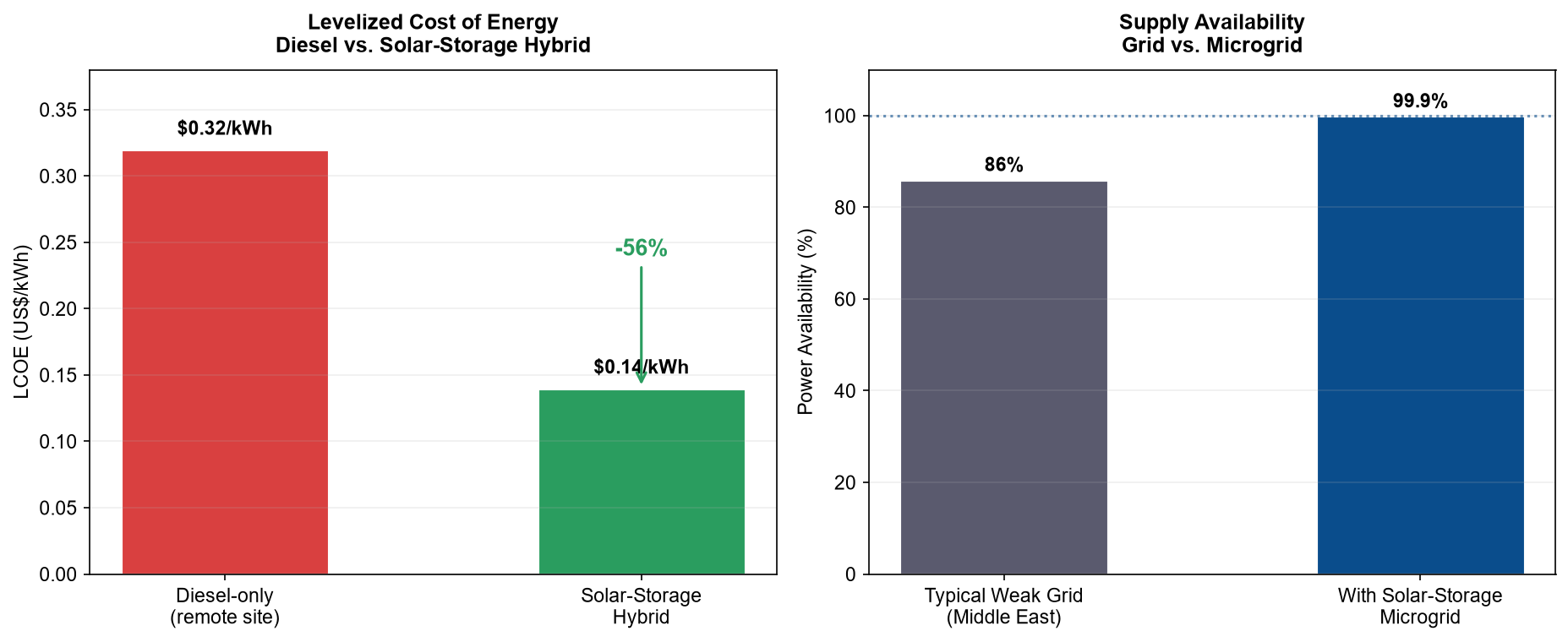
Across comparable PV-storage-diesel microgrid deployments in hot, weak-grid environments, the engineered outcomes follow a consistent pattern:
- Electricity cost: LCOE typically drops from $0.25–0.40/kWh (diesel-only) to $0.10–0.18/kWh with a PV-storage-diesel hybrid — a 50–60% reduction.
- Supply availability: Seamless <10 ms switch-over takes availability from “grid-dependent” toward 99.9% for protected critical loads.
- Peak-shaving savings: Time-of-use arbitrage plus demand-charge reduction typically cuts monthly energy spend by 40–60%.
- Diesel fuel savings: In diesel-hybrid sites, generator operating hours fall 50–70%, with fuel savings of 30–50%.
- Payback: In high-irradiance Gulf locations, simple payback for villa and small commercial systems commonly lands in the 3–5 year range.
Need a Similar System Design?
If you’re planning a villa, hotel, compound, or commercial solar-storage microgrid project in the Middle East, our engineering team can size and configure the right cabinet for your load profile, tariff structure, and site conditions — including three-phase imbalance, high ambient temperature, and sand exposure.
Send us your project specs — monthly consumption, peak demand, site temperature, roof area, and outage frequency — and we’ll propose a solution within 24 hours.
Contact: info@imaxpwr.com | Tel/WhatsApp: +86-13760212825 | www.imax-pwr.com
Key Lessons Learned
- Never undersize the inverter for cooling surge. Air-conditioning starts draw far more than steady-state load; a 20–30% power margin is the difference between reliable operation and nuisance trips.
- Design for islanding from day one. A grid-following backup that can’t form its own grid is worthless when the feeder collapses. Choose grid-forming hybrid cabinets for real resilience.
- Sand and heat beat electronics before electricity does. Specify outdoor-rated (IP5x+) sealed equipment with a wide temperature window — indoor-grade hardware fails within a Gulf summer.
- EMS automation is the ROI engine. Automatic time-of-use shifting, SOC-based dispatch and cloud monitoring turn a passive battery into a cost-cutting asset — and let you manage remote villas without on-site staff.
- Battery chemistry matters at 50°C. LFP (LiFePO4) with liquid cooling and 6,000+ cycle life holds up far better than alternatives in desert heat, both in safety and degradation.
FAQ
Q: Can a solar-storage microgrid really keep a villa running through a full grid outage?
A: Yes — if the system is grid-forming. A grid-forming hybrid cabinet (such as the MSP250HCG2 Sunlight series or a parallel group of HI30KW/IM60KFCM3 units) creates its own AC voltage and frequency reference, so it keeps running with no utility input. During a grid drop the cabinet switches to off-grid in <10 ms and powers critical loads (security, wine cellar, IT, cooling) from battery and, if installed, PV. Runtime is set by battery capacity: a typical villa with a 2–4-hour evening battery can ride through most outages; longer outages are covered by adding capacity or a diesel-hybrid option that soft-starts only when battery SOC falls below a set threshold.
Q: How much can a solar-plus-storage system actually cut electricity bills in Saudi Arabia / UAE?
A: The saving comes from two levers: self-consumption of PV (offsetting grid purchases at retail rates) and peak shaving / time-of-use arbitrage (charging during cheap solar hours, discharging during expensive evening peaks). In high-irradiance Gulf locations, commercial and villa installations commonly reduce monthly energy spend by 40–60%, and LCOE for PV-storage-diesel hybrid sites drops to $0.10–0.18/kWh versus $0.25–0.40/kWh for diesel-only. Exact figures depend on tariff structure, load profile and irradiance — send us your consumption data for a site-specific calculation.
Q: Will the equipment survive 50°C heat, sandstorms, and coastal salt?
A: Yes, when correctly specified. The HI30KW carries a sealed IP6X control compartment; the IM60KFCM3 has an IP5X-rated core; the MSP250HCG2 is an outdoor IP54 cabinet rated to operate from -30°C to +60°C with forced-air cooling (front intake, rear exhaust). All are designed with isolated air-duct layouts and derate-free operation in desert conditions. For coastal installations we recommend confirming salt-spray requirements at the design stage so the correct coating and enclosure options are applied.
About the Author
This article was reviewed by Ethan Li, an energy storage system specialist with experience in PCS, hybrid inverter and microgrid design for hot, weak-grid markets. Ethan has supported commercial and industrial solar-storage projects across the Middle East and Africa, focusing on grid-forming architectures, thermal management, and cost-optimized system sizing.
About IMAXPWR
Imaxpower (Imax Power Technology Co., Ltd.) is a China national high-tech enterprise headquartered in Shenzhen, specializing in integrated energy storage products and system solutions. Founded in 2015, the company has delivered 999+ projects worldwide with a 99% customer recognition rate.
The R&D team comprises senior experts from State Grid, Xuji Group, Emerson, and Kehua Hengsheng, with 20+ years of power electronics experience. Imaxpower develops full-stack self-developed PCS, BMS/EMS, DC/DC converters, and all-in-one BESS cabinets, covering 30 kW to 2 MW+ system deployments. For the Middle East, the HI30KW, IM60KFCM3 and MSP250HCG2 cabinets form a complete solar-storage microgrid portfolio.
Products are certified to UN38.3, IEC, UL, CE, and RoHS standards and shipped to Europe, North America, Southeast Asia, the Middle East, and Africa without re-engineering. The company offers full customization — from system design and engineering to O&M services — tailored to specific project requirements.
Contact: Coco | Tel/WhatsApp/WeChat: +86-13760212825 | Email: info@imaxpwr.com | www.imax-pwr.com