

C&I Energy Storage & The 42nd Mandate
How mandatory renewable targets drive engineering decisions in industrial BESS
Executive Summary: China’s 42nd Mandate (effective Aug 1, 2026) imposes mandatory renewable consumption targets on key industries. For C&I users, energy storage shifts from cost-saving to compliance necessity. This article presents engineering data from IMAXPWR’s 500kW/4MWh European industrial park project — a system designed for 8‑hour duration, sub‑100ms grid‑forming transfer, and thermal resilience.
📋 Contents
3. Solution & Architecture4. Selection Guide
5. Results & Lessons6. FAQ & CTA
1. Project Background & Requirements
The 42nd Mandate establishes a dual‑layer responsibility system: mandatory minimum renewable shares for energy‑intensive sectors (steel, electrolytic aluminum, cement, data centers) and provincial consumption weights. Compliance pathways include self‑consumption, green power direct connection, or certificate trading.
Our client, a European industrial park, faced similar pressure: high peak demand charges and grid capacity constraints. They required a 500kW/4MWh containerized BESS to cover two daily peak windows (6h morning + 4h evening) while maintaining backup reserve.
2. Key Engineering Challenges
2.1 8‑Hour Duration vs. Typical 2‑4h
The 500kW/4MWh ratio implied an 8‑hour discharge at rated power. Standard peak‑shaving systems use 2‑4h. We sized the PCS to match the load baseline (avoiding transformer overload), and battery capacity to cover both peak windows without deep cycling — critical for LFP longevity.
2.2 Dual‑Mode Transition <100ms
Typical commercial inverters have 200‑500ms transfer time, risking PLC resets. Our spec required <80ms to protect CNC machinery. The EMS also had to maintain SOC >20% for backup while executing peak shaving — a dual‑objective logic.
2.3 Thermal Management in 40‑ft Container
Summer ambient 38°C plus battery heat required 25±3°C internal temperature. Inadequate cooling reduces LFP cycle life by ~30%, so redundant HVAC was non‑negotiable.
3. Our Engineering Solution
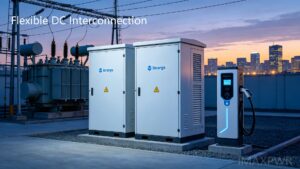
IMAXPWR delivered a turnkey 40‑ft container with BYD LFP racks, a 500kW bidirectional grid‑forming PCS, smart EMS, aerosol+FM200 fire suppression, and redundant HVAC.
3.1 AC‑Coupled Architecture
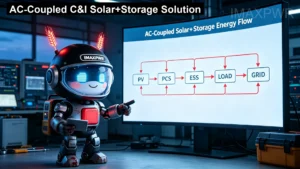
We chose AC coupling over DC for three reasons: (1) existing AC infrastructure, (2) higher fault tolerance (PV, storage, loads operate independently), and (3) easier scalability.
🔧 System Topology (AC‑Coupled)
│
├─ IMAXPWR 500kW PCS (grid‑forming) → 4MWh LFP Battery
│
└─ Industrial Loads (CNC, HVAC, lighting)
│
└─ EMS Controller (peak shaving + backup reserve)
3.2 Component Selection
| Component | Selection | Rationale |
|---|---|---|
| PCS | IMAXPWR 500kW grid‑forming | VSG control, <80ms transfer, parallel ready |
| Battery | BYD LFP Cube T31 (4MWh) | 6,000+ cycles @80% DoD, thermal stability |
| EMS | IMAXPWR Smart EMS | Neural forecasting, SOC floor logic |
4. How to Select the Right Configuration
- PCS sizing: Match peak load baseline, not total connected capacity.
- Battery duration: Calculate based on tariff windows + renewable generation profile. 4‑8h is typical for C&I.
- AC vs DC coupling: AC for retrofits, DC for greenfield sites.
- Thermal: Liquid cooling for >2MWh in hot climates; forced air for smaller systems.
- EMS logic: Must simultaneously execute peak shaving, maintain SOC reserve, and track renewable consumption for compliance reporting.
🔧 Need a Similar System?
Send your load profile, tariff structure, and compliance targets — our engineers will propose a solution within 24h.
5. Measured Results & Key Lessons
The system operates daily across two peak windows, keeping SOC ≥20% for backup. The grid‑forming PCS has performed seamless transfers with zero production interruptions. Thermal control has preserved battery cycle life.
Lessons Learned
- Duration is critical — 8h was essential to cover both peak windows; 2‑h systems would have missed evening peak.
- EMS must reserve SOC — without floor logic, peak shaving drains batteries, leaving no outage protection.
- Thermal is an investment, not cost — the 30% life reduction penalty makes redundant HVAC a payback accelerator.
- AC coupling simplifies retrofits — avoids DC bus re‑engineering and improves fault tolerance.
❓ FAQ
🔗 Related Products
✍️ About the Author
🏢 About IMAXPWR
IMAX Power Technology Co., Ltd. (Brand: IMAXPWR) is a national high‑tech enterprise specializing in energy storage power conversion — an OEM/ODM manufacturer and system solution provider.
Based in Shenzhen, with R&D team from State Grid, Emerson, and XJ Group. Products are CE, UL, ROHS certified, used in microgrids, V2G, industrial parks, and distributed storage.
Contact: Coco | Tel/WhatsApp: +86-13760212825 | Email: info@imaxpwr.com | Web: imax-pwr.com
🚀 Ready to Engineer Your C&I Storage?
Send your project specs — we’ll deliver a custom design within 24 hours.
📋 Include: load profile, tariff structure, solar capacity (if any), and target year
Note: This case study is based on typical project configurations for illustrative purposes. Always consult qualified professionals for specific applications.