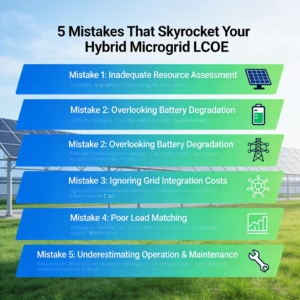


5 Mistakes That Skyrocket Your Hybrid Microgrid LCOE (And How to Avoid Them)
When designing and building a hybrid microgrid, one metric reigns supreme when it comes to long-term project viability: the Levelized Cost of Energy (LCOE). This key figure represents the average cost of generating electricity over the entire lifetime of your project, and it’s what ultimately determines whether your hybrid microgrid delivers on its promise of affordable, reliable power.
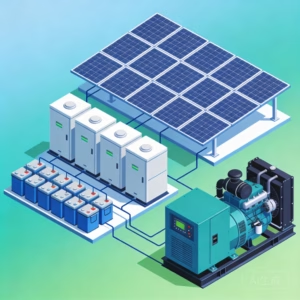
For photovoltaic-storage-diesel hybrid microgrids, getting the LCOE right is especially critical. These systems are often deployed in remote areas or off-grid locations where alternatives are expensive, and even a small miscalculation can turn a promising project into a financial burden.
Over our years of engineering hybrid microgrids for clients around the world, the Imaxpower team has seen firsthand how common design and operational mistakes can send LCOE soaring. In this article, we break down the five most costly mistakes we see regularly—and share proven strategies to help you avoid them.
Mistake 1: Under-sizing Your Energy Storage System (ESS)
It’s easy to understand why this mistake happens so often. Batteries are typically the single most expensive component in a modern PV-storage-diesel hybrid microgrid, so it’s tempting to cut corners on capacity to hit a lower upfront capital expenditure (CAPEX) target.
The problem? When your BESS is too small for your load profile and renewable resource, you end up running your diesel generator much more often than you should. Diesel fuel is expensive—especially in remote locations where transportation costs can double or triple the price per liter—and frequent starts and stops also increase maintenance costs and shorten generator lifespan.
When you run the numbers, the extra fuel and maintenance costs over the project lifetime almost always outweigh the upfront savings from buying a smaller battery. This creates a vicious cycle where lower CAPEX leads to dramatically higher operating expenditure (OPEX), and your LCOE ends up being much higher than projected.
How to Avoid This Mistake
The solution is to conduct a thorough time-series simulation based on actual measured load data and solar resource data for your specific site. Don’t rely on rules of thumb or generic sizing recommendations. A proper simulation will consider:
- Daily and seasonal load variations
- Solar irradiance patterns throughout the year
- Your diesel fuel cost delivered to site
- Battery cycling characteristics and degradation
- Required reliability and availability targets
At Imaxpower, we often find that optimal battery sizing from an LCOE perspective is larger than what most first-pass designs suggest. The slightly higher upfront investment almost always pays for itself quickly through fuel savings.
Mistake 2: Poor Power Conversion Architecture Choices
The architecture of your AC-DC power conversion system has a surprisingly large impact on your LCOE over the long term. We frequently see projects where the wrong architecture choice adds 10-15% to the lifetime energy cost.
Common architectural mistakes include:
- Using multiple separate converters when an integrated solution would be more efficient and lower cost
- Choosing a fully AC-coupled system when DC-coupling would deliver higher efficiency for your PV and storage
- Overloading conversion stages, leading to higher conversion losses
- Not accounting for future expansion in your converter sizing
Each unnecessary conversion stage costs you roughly 3-5% in energy losses. Over 20+ years of operation, those losses add up to thousands of megawatt-hours of wasted energy—and thousands of dollars in extra diesel fuel costs.
How to Avoid This Mistake
The key is to match your power conversion architecture to your specific project requirements. For example:
- If you have significant PV generation and battery storage, DC-coupling can eliminate one full conversion stage, improving efficiency by 3-5%
- Integrated power-router systems reduce balance of plant costs and footprint compared to discrete components
- Properly sized converters operate more efficiently at typical loads than severely oversized units
Don’t just default to the most common architecture—work with your engineering team to model the efficiency and cost implications for your specific mix of PV, storage, diesel, and load.
Mistake 3: Ignoring Climate Impacts on Performance
Most LCOE calculations use standard temperature assumptions for battery and PV performance—typically 25°C. But many hybrid microgrids are deployed in harsh climates: deserts with extreme heat, high-altitude locations with cold temperatures, or tropical regions with high humidity.
Extreme temperatures have a significant impact on component performance and lifespan:
- High temperatures accelerate battery degradation, reducing usable capacity much faster than projected
- PV panel efficiency drops at higher temperatures, reducing energy output
- Cold temperatures can reduce battery available capacity and affect starting reliability for diesel generators
When your actual performance is worse than your LCOE projection, you end up with lower energy output, shorter component lifespan, and higher replacement costs—all of which drive up your LCOE.
How to Avoid This Mistake
Climate adaptation doesn’t have to be complicated, but it does need to be accounted for in your initial design and LCOE calculation. Simple steps include:
- Derating PV and battery capacity based on actual site temperature expectations
- Adding passive or active cooling for battery containers in hot climates
- Specifying components rated for your site’s temperature range
- Accounting for faster degradation in your financial model
The extra upfront cost of climate-appropriate design is minimal compared to the extra replacement costs you’ll face if you ignore this factor.
Mistake 4: Inadequate Maintenance Planning and Spare Parts
When project developers are putting together their LCOE models, maintenance is often an afterthought. They plug in a generic percentage of CAPEX per year and move on. But in remote locations, inadequate maintenance planning can quickly sink your project economics.
The problem is compounded on remote sites where:
- Getting a technician to site can take days or weeks and costs a fortune in travel
- Spare parts have long lead times and high shipping costs
- Downtime means you’re either not delivering power (losing revenue) or running on more expensive backup
Proper maintenance isn’t just about reliability—it’s also about preserving the performance and lifespan of your capital equipment. A poorly maintained PV inverter will fail years before its expected lifespan, forcing you to replace it early and adding significant unexpected costs to your LCOE calculation.
How to Avoid This Mistake
Build realistic maintenance and spare parts costs into your LCOE model from day one. This should include:
- Annual on-site preventive maintenance by qualified technicians
- A local spare parts stock for critical components
- Remote monitoring to catch issues early before they cause failures
- A preventive replacement schedule for life-limited components
Modern remote monitoring systems from suppliers like Imaxpower allow you to track performance and detect anomalies in real time, so you can address small problems before they become expensive failures. This proactive approach reduces overall maintenance costs and helps keep your LCOE on target.
Mistake 5: Overestimating PV Yield and Underestimating Load Growth
This might be the most common mistake we see in hybrid microgrid project planning. Optimism bias often leads developers and clients to:
- Use overly optimistic PV yield projections that don’t account for soiling, shading, system downtime, and other real-world losses
- Underestimate future load growth, especially for commercial and industrial projects where demand increases over time
When your actual PV generation is lower than projected and your load is higher, you once again end up running your diesel generator more often, burning more fuel, and increasing your OPEX. If you haven’t left any design headroom, you may even need to add additional capacity early, which requires reinvestment and drives up your lifecycle cost.
How to Avoid This Mistake
Conservative, realistic projections are your friend when it comes to LCOE. We recommend:
- Using measured solar resource data from ground-based monitoring if possible, or applying realistic derating to satellite data
- Accounting for all real-world losses: soiling, shading, inverter inefficiency, wiring losses, degradation over time
- Including at least 10-15% headroom in your design for load growth
- Modeling LCOE with sensitivities to see how changes in PV yield or fuel price affect your outcome
A good rule of thumb: if your project only pencils out with the most optimistic possible assumptions, it’s probably not a good project. Your LCOE calculation should be robust against reasonable variations in key parameters.
Conclusion: Getting LCOE Right for Long-Term Success
Your hybrid microgrid’s LCOE isn’t just a number you calculate to satisfy investors—it’s the key metric that will determine whether your project delivers long-term value. By avoiding these five common mistakes, you can keep your LCOE under control and ensure that your PV-storage-diesel hybrid system delivers on its promise of affordable, reliable power for decades.
The core principles are simple:
- Size your battery properly based on actual site conditions, not just CAPEX targets
- Choose your power conversion architecture carefully to minimize losses
- Account for climate impacts on component performance and lifespan
- Build realistic maintenance costs into your model from day one
- Be conservative with PV yield projections and account for future load growth
At Imaxpower, we’ve engineered dozens of successful hybrid microgrid projects around the world, and we’ve learned these lessons through hands-on experience. Our team works with you from initial design through commissioning to ensure that your project’s LCOE matches your projections and delivers the economic benefits you expect.
About Imax Power
Imax Power is a national high-tech enterprise focusing on the research and development, sales and manufacturing of intelligent microgrid converters (grid-connected and off-grid energy storage converters), V2G modules and V2G charging piles, DC microgrids, photovoltaic storage charging and inspection, distributed energy storage, regenerative charging and discharging power supplies, portable energy storage converters, integrated energy storage systems and other products.
If you’re planning a hybrid microgrid project and want to ensure you get the design right to minimize your LCOE, contact our engineering team today for a consultation.
Contact: Coco
Phone: +86-13760212825
Email: info@imaxpwr.com
We’re here to help you build a reliable, cost-effective hybrid microgrid that meets your needs for decades to come.