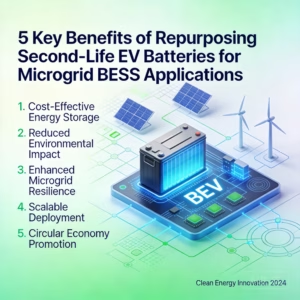


5 Key Benefits of Repurposing Second-Life EV Batteries for Microgrid BESS Applications
As the global electric vehicle (EV) revolution accelerates, millions of electric vehicle batteries are reaching the end of their automotive service life. When EV batteries drop to 70-80% of their original capacity, they are no longer suitable for automotive applications, but they still possess substantial energy storage potential. Repurposing these second-life EV batteries for microgrid battery energy storage systems (BESS) is emerging as a cost-effective and sustainable solution that benefits both the environment and project economics.
In this article, we explore the five key benefits that make second-life EV battery repurposing an attractive option for modern microgrid projects.
1. Significant Capital Cost Reduction
The most immediate and compelling benefit of using repurposed EV batteries in microgrid BESS is the dramatic reduction in upfront capital expenditure. Brand-new lithium-ion batteries typically account for 40-60% of the total capital cost of a microgrid energy storage project. Second-life batteries are typically available at 30-50% lower cost compared to new batteries, making them highly attractive for microgrid developers working with constrained budgets.
For rural and remote microgrid projects where cost competitiveness is critical, this cost reduction can make the difference between a project being financially viable or not. Many project developers have reported capital cost savings of 25-40% when incorporating second-life EV batteries into their microgrid designs, enabling them to offer more competitive energy prices to end-users.
Additionally, as the volume of EVs on the road continues to grow exponentially, the supply of second-life batteries will only increase, driving costs even lower over the next decade. This creates a sustainable circular economy ecosystem where automotive batteries get a second useful life before final recycling.
2. Environmental Sustainability and Circular Economy
From an environmental perspective, repurposing second-life EV batteries for microgrid BESS applications extends the useful life of these batteries by 5-10 years before they need to be recycled. This maximizes the energy return on the initial manufacturing investment and reduces the environmental impact associated with battery production and raw material extraction.
Lithium-ion battery manufacturing requires significant amounts of energy and critical raw materials including lithium, cobalt, and nickel. By extending the service life of these batteries through repurposing, we reduce the demand for new raw material extraction and lower the overall carbon footprint of energy storage. This aligns perfectly with the sustainability goals of most microgrid projects, which typically aim to increase renewable energy penetration and reduce greenhouse gas emissions.
Furthermore, the circular economy approach creates new business opportunities for automotive manufacturers, battery recyclers, and microgrid system integrators. Many major automotive companies are already establishing dedicated second-life battery programs, recognizing the significant environmental and economic benefits of this approach.
3. Satisfactory Performance for Microgrid Applications
While second-life EV batteries have reduced capacity compared to new batteries, they still offer more than adequate performance for most microgrid applications. Most microgrid BESS systems are designed for peak shaving, load shifting, and backup power applications that do not require the extremely high cycle life and depth of discharge that automotive applications demand.
With 70-80% remaining capacity, second-life batteries can still provide 5-10 years of reliable service in microgrid applications, depending on the operating profile and management strategy. Modern power conversion systems and battery management systems (BMS) can effectively handle the increased cell-to-cell variation that typically occurs in second-life batteries, ensuring safe and reliable operation.
For many microgrid projects located in areas with lower energy costs or less intensive cycling requirements, the performance characteristics of second-life batteries are more than sufficient to meet project requirements. This makes them an excellent match for the majority of microgrid installations around the world.
4. Improved Project Economics and Faster Payback
The combination of lower capital costs and satisfactory performance translates directly into improved project economics and faster payback periods for microgrid BESS projects. With lower upfront investment, projects can achieve positive cash flow more quickly, reducing financial risk and making them more attractive to investors and lenders.
Independent studies have shown that when using second-life EV batteries, the levelized cost of energy (LCOE) for microgrid projects can be reduced by 15-30% compared to using new batteries. This significant reduction in LCOE makes microgrid projects more competitive with grid-connected power in many regions, accelerating adoption.
Moreover, many governments and environmental agencies are beginning to offer grants and incentives for circular economy projects including battery repurposing. These additional incentives can further improve project economics, making second-life battery projects even more financially attractive.
5. Reduced Pressure on Battery Supply Chains
The global energy transition is creating unprecedented demand for lithium-ion batteries across multiple sectors including EVs, stationary energy storage, and consumer electronics. This massive demand has put significant pressure on global battery supply chains, leading to supply shortages and price volatility.
By repurposing second-life EV batteries for microgrid BESS applications, we reduce the demand for new battery production, helping to alleviate pressure on strained supply chains. This allows battery manufacturers to focus their production capacity on EVs and other applications where new batteries are truly needed, reducing overall market tension.
As the EV fleet continues to grow, the available volume of second-life batteries will increase exponentially. By 2030, industry analysts estimate that there will be over 100 GWh of second-life batteries available globally each year. This massive volume can supply a significant portion of the total demand for microgrid BESS capacity, reducing the need for new battery production and helping to stabilize battery prices.
Challenges to Consider
While the benefits are clear, it’s important to acknowledge that there are still challenges to overcome when implementing second-life EV batteries in microgrid projects. Understanding these challenges helps developers plan appropriately and implement effective solutions.
1. Variability in Battery State-of-Health
One of the primary challenges with second-life EV batteries is the inherent variability in state-of-health (SOH) and performance characteristics among different batteries. Even batteries from the same model EV can have different remaining capacities and performance characteristics depending on how they were used, the charging patterns, and environmental conditions they experienced during their automotive service life.
This variability means that careful testing, sorting, and grouping are required before batteries can be deployed in a second-life application. Batteries with similar SOH need to be grouped together to ensure optimal performance and avoid accelerated degradation of better-performing cells. Advanced testing facilities and processes are required to properly sort and grade second-life batteries, which adds some complexity and cost to the supply chain.
2. Need for Advanced Battery Management Systems
The increased cell-to-cell variation in second-life batteries requires more sophisticated battery management systems (BMS) compared to systems using new, homogeneous batteries. The BMS must be able to handle greater variation in cell voltage, capacity, and internal resistance while still maintaining safe operation and maximizing system performance.
Fortunately, modern BMS technology has advanced significantly in recent years, and many manufacturers now offer BMS solutions specifically designed for second-life battery applications. These advanced systems can effectively manage cell variation through active balancing and sophisticated monitoring algorithms, ensuring safe and reliable operation.
3. Limited Availability of Standardized Modules
Currently, the second-life battery market is still developing, and there is limited standardization in terms of battery module formats, electrical characteristics, and connectors. Each EV model uses different battery designs, which means that second-life modules from different manufacturers are often incompatible with each other.
This lack of standardization can make it more challenging and expensive to source sufficient quantities of compatible modules for larger microgrid projects. However, as the market matures and more players enter the space, we’re beginning to see increased standardization and the emergence of consolidated, remanufactured second-life battery modules that are purpose-built for stationary energy storage applications.
4. Concerns About Warranty and Long-Term Reliability
Many project developers and investors have understandable concerns about warranty coverage and long-term reliability when it comes to second-life batteries. Since these batteries have already seen several years of use in automotive applications, there’s naturally some uncertainty about how long they will last in their second life application.
However, extensive field testing and commercial deployments over the past decade have shown that when properly tested, sorted, and managed, second-life EV batteries can provide 5-10 years of reliable service in microgrid applications. Additionally, an increasing number of suppliers are offering warranty coverage for second-life battery systems, helping to address investor concerns and reduce project risk.
However, the industry is rapidly addressing these challenges through standardization, improved testing and sorting processes, and advances in battery management technology. As the market matures, these challenges will become less significant, opening the door for much wider adoption.
Conclusion
Repurposing second-life EV batteries for microgrid BESS applications offers compelling benefits including lower capital costs, improved sustainability, satisfactory performance, better economics, and reduced pressure on supply chains. While there are still challenges to address, the industry is making rapid progress in overcoming these obstacles.
As the global EV fleet expands and more batteries reach the end of their automotive service life, we expect to see rapid growth in the use of second-life batteries for microgrid and other stationary energy storage applications. This trend aligns perfectly with the broader transition toward a more sustainable and circular economy in the energy sector.
For microgrid developers and project owners looking to reduce costs and improve sustainability, second-life EV batteries represent an attractive opportunity worth serious consideration. When properly implemented, they can deliver excellent value while contributing to a more sustainable energy future.
About Imax Power
Imax Power is a national high-tech enterprise focusing on the research and development, sales and manufacturing of intelligent microgrid converters (grid-connected and off-grid energy storage converters), V2G modules and V2G charging piles, DC microgrids, photovoltaic storage charging and inspection, distributed energy storage, regenerative charging and discharging power supplies, portable energy storage converters, and integrated energy storage systems.
We provide comprehensive solutions for microgrid projects around the world, including expertise in integrating different battery technologies including second-life EV batteries. If you’re planning a microgrid project and would like to discuss whether second-life battery repurposing makes sense for your application, our expert engineering team is ready to help.
Contact: Lee
Phone/WhatsApp: +86-19066355917
Email: lee@imaxpwr.com
Contact us today for a free consultation on your microgrid project!