

4 Key Benefits of Hybrid AC-DC Coupled Microgrids for Commercial Applications
As commercial facilities increasingly adopt microgrid solutions to improve energy resilience, reduce costs, and integrate more renewables, the architecture becomes a critical design decision. One of the most important choices is whether to use AC coupling, DC coupling, or a hybrid AC-DC coupled approach. Hybrid AC-DC coupled microgrids have emerged as a versatile solution combining the best of both architectures, offering unique advantages especially for commercial applications.
In this article, we explore the four key benefits hybrid AC-DC coupled microgrids offer to commercial facilities compared to traditional pure AC or pure DC architectures. Understanding these advantages helps you make an informed decision when designing your microgrid.
Understanding Hybrid AC-DC Coupling
Before diving into the benefits, let’s briefly clarify what we mean by hybrid AC-DC coupling. In a traditional AC-coupled microgrid, all generation and storage resources connect to an AC bus, which is then connected to the main grid and loads. Any DC power from solar panels or battery storage must be converted to AC before use, resulting in additional conversion losses.
In a DC-coupled microgrid, by contrast, solar panels and battery storage connect to a common DC bus, reducing the number of conversion steps needed for DC power. However, most commercial loads still require AC power, so you still need a large AC-DC converter to serve these loads.
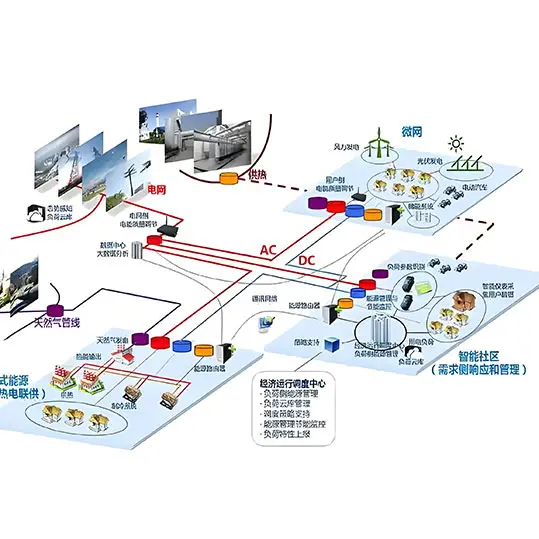
A hybrid AC-DC coupled microgrid includes both an AC bus and a DC bus, connected through a bidirectional converter. This allows you to connect DC resources like solar and batteries directly to the DC bus, while still accommodating conventional AC generators and AC loads on the AC bus. The power-router architecture from Imaxpower implements this hybrid approach, enabling efficient power flow between both buses.
1. Higher Overall Energy Efficiency
One of the most significant advantages of hybrid AC-DC coupling is improved energy efficiency compared to pure AC coupling. When you have a lot of DC resources like solar panels and battery storage, hybrid coupling reduces the number of power conversion steps needed for many common operating modes.
For example, when solar panels generate DC power directly charging a battery, in a hybrid AC-DC system the power goes directly from solar to battery via the DC bus – only one conversion step. In an AC-coupled system, DC solar power must go to AC, then back to DC again for charging – two extra steps adding 5-10% more losses depending on converter efficiency.
Similarly, when the battery discharges to a DC load, power goes directly without multiple conversions. For commercial facilities with high penetrations of solar and storage, these savings add up to several percent more energy delivered from the same capacity.
Over the 20-25 year lifetime of a microgrid, these efficiency gains translate directly into more energy cost savings and higher returns. Even a 3% improvement makes a significant difference in total energy delivered over the system life.
Modern power converters like our PCS systems already have very high efficiency – 96-98% per conversion step. But eliminating unnecessary steps still compounds gains and delivers better overall performance.
2. Greater Flexibility in System Sizing and Expansion
Another major benefit of hybrid AC-DC coupling is the greater flexibility it provides in system sizing and future expansion. Because you have separate AC and DC buses, you can add more DC resources (like additional solar or more BESS capacity) to the DC bus without needing to upgrade the main AC interconnection to the grid.
This flexibility is particularly valuable for commercial facilities that may want to start small and expand gradually as needs change or budgets allow. You don’t need to oversize all your AC infrastructure upfront for future expansion – you can just add more DC capacity to the DC bus as needed.
Hybrid architectures also make it easier to integrate different types of generation and storage. You can connect DC sources like solar and batteries to the DC bus for maximum efficiency, while still connecting AC sources like conventional backup generators to the AC bus. This gives you the freedom to choose the best technology for each application.
For example, if you have an existing AC backup generator, you don’t need to replace it or add extra conversion equipment to integrate it – it connects directly to the AC bus. At the same time, you can add new solar and battery storage on the DC bus to capture efficiency benefits. This makes hybrid architectures particularly attractive for retrofit projects adding new resources to existing facilities.
The flexible nature also makes it easier to incorporate new technologies as they emerge. If you want to add DC-powered resources like fast EV charging, you can connect them directly to the DC bus with minimal additional infrastructure.
3. Improved Grid Resilience and Reliability
Hybrid AC-DC coupled microgrids offer improved resilience and reliability compared to single-bus architectures. Because you have two separate buses with independent control, you have more options for operating through fault conditions. If there’s a problem on one bus, the other can often continue operating, limiting outage scope.
When operating in islanded mode disconnected from the main grid, the hybrid architecture provides more flexibility in managing power supply and demand. Battery storage on the DC bus responds very quickly to changes in load or generation, providing the fast frequency and voltage control needed for stable operation. Meanwhile, larger AC generators can be brought online gradually for longer-term energy production.
This combination of fast response from batteries and longer-duration energy from conventional generators creates a more resilient system that can handle a wider range of operating conditions. It also provides more redundancy – if one converter fails, alternative paths keep critical loads running while repairs are made.
Another resilience benefit is that hybrid architectures typically use multiple smaller converters rather than one large central converter. If one converter fails, the rest of the system can continue operating, maintaining power to most critical loads during repairs. In a system with one large central converter, a single failure can take down the entire system.
For commercial facilities that cannot afford downtime, this improved resilience translates directly into avoided outage costs. The modest additional complexity of a hybrid architecture is more than offset by the improved reliability it provides.
4. Better Integration of Emerging DC Technologies
As more commercial energy technologies feature DC outputs or require DC inputs, hybrid AC-DC architectures are better positioned to accommodate these emerging technologies efficiently. DC-based technologies like solar photovoltaic, battery storage, and EV charging are already widespread, and this trend will continue as more DC loads become common in commercial buildings.
Many modern commercial buildings now incorporate DC-powered LED lighting, which is more efficient from a DC bus than converting to AC first. Fast EV chargers are also inherently DC devices, and connecting them directly to the DC bus eliminates unnecessary conversion steps.
New technologies like DCDC fast chargers and vehicle-to-grid (V2G) capable V2G EV chargers also integrate much more cleanly into a hybrid architecture. With V2G, electric vehicles can provide storage and grid support back to the microgrid, and this exchange is much more efficient via the DC bus.
MPPT for solar panels also benefits from DC integration. By integrating MPPT directly into the DC bus architecture, you achieve better overall efficiency and more precise control of solar output.
By designing a hybrid AC-DC architecture from the beginning, you future-proof your microgrid for the ongoing shift towards more DC-based generation and consumption already underway. This means you won’t need major architectural changes when adding new DC technologies in the future.
Comparing Costs: Is Hybrid AC-DC Coupling Worth It?
A common question about hybrid AC-DC architectures is whether the benefits justify the slightly higher upfront cost compared to a simple pure AC-coupled design. In most commercial applications, the answer is yes when you consider the total lifetime cost of the system.
While hybrid architectures require an extra bidirectional converter to connect the AC and DC buses, the efficiency gains from eliminating other conversion steps often offset most or all of this extra cost over time. Additionally, the flexibility for future expansion saves significant costs compared to reworking the entire architecture when you do expand.
For facilities with high penetration of solar and battery storage – increasingly common in modern commercial microgrids – the efficiency gains alone can justify the modest extra investment. When you add the resilience benefits and future-proofing for emerging DC technologies, the case becomes even stronger.
At Imaxpower, we’ve found that for most commercial solution applications, hybrid AC-DC coupling offers the best balance of efficiency, flexibility, resilience, and cost-effectiveness. It’s a versatile approach that works well for everything from small retail centers to large industrial complexes.
Conclusion
Hybrid AC-DC coupled microgrids offer significant benefits for commercial applications compared to traditional pure AC or pure DC architectures. The four key advantages – higher overall energy efficiency, greater flexibility in sizing and expansion, improved resilience and reliability, and better integration of emerging DC technologies – make the hybrid approach an attractive choice for most commercial microgrid projects.
As commercial facilities continue to integrate more solar, battery storage, and EV charging, the benefits of hybrid AC-DC coupling will only become more pronounced. The architecture provides DC coupling efficiency for DC resources while still maintaining compatibility with existing AC equipment and loads, giving you the best of both worlds.
Whether you’re planning a new microgrid or retrofitting an existing facility with additional renewables and storage, a hybrid AC-DC approach is definitely worth considering for your commercial application.
Contact Imaxpower for Your Microgrid Project
Looking to design a hybrid AC-DC coupled microgrid for your commercial facility? Contact Coco at Imaxpower today to discuss your project and get expert engineering guidance.
Contact: Coco
Phone: +86-13760212825
Email: info@imaxpwr.com
We specialize in designing and building high-performance hybrid AC-DC coupled microgrids that deliver maximum efficiency, resilience, and value for commercial applications. Send us your inquiry today to get started with a customized design and quotation.