Imax Power Vehicle-to-Grid (V2G)/Vehicle-to-Everything (V1G) Energy Scheduling Solution: Transforming Charging Stations into Peak-Shaving Assets for the Power Grid
In the past, charging electric vehicles (EVs) was simply about consuming electricity. Now, with vehicle-to-grid (V2G) and vehicle-to-everything (V1G) interactions, it’s about energy asset management. EVs can not only charge but also participate in peak shaving, load shifting, demand response, and even feed electricity back to the grid.
In simpler terms:
EVs are no longer just electricity-consuming “monsters.” They can serve as your “mobile energy storage.” The key lies in having a functional energy scheduling system.
Imax Power offers a comprehensive V2G/V1G energy scheduling solution that leverages charging control, station-side energy management, fleet strategies, and grid interaction interfaces to achieve the following:
✅ Charge during off-peak hours and limit charging/discharge during peak hours
✅ Perform peak shaving and load shifting to reduce demand charges
✅ Generate demand response (DR) revenue
✅ Enhance station throughput and power utilization efficiency
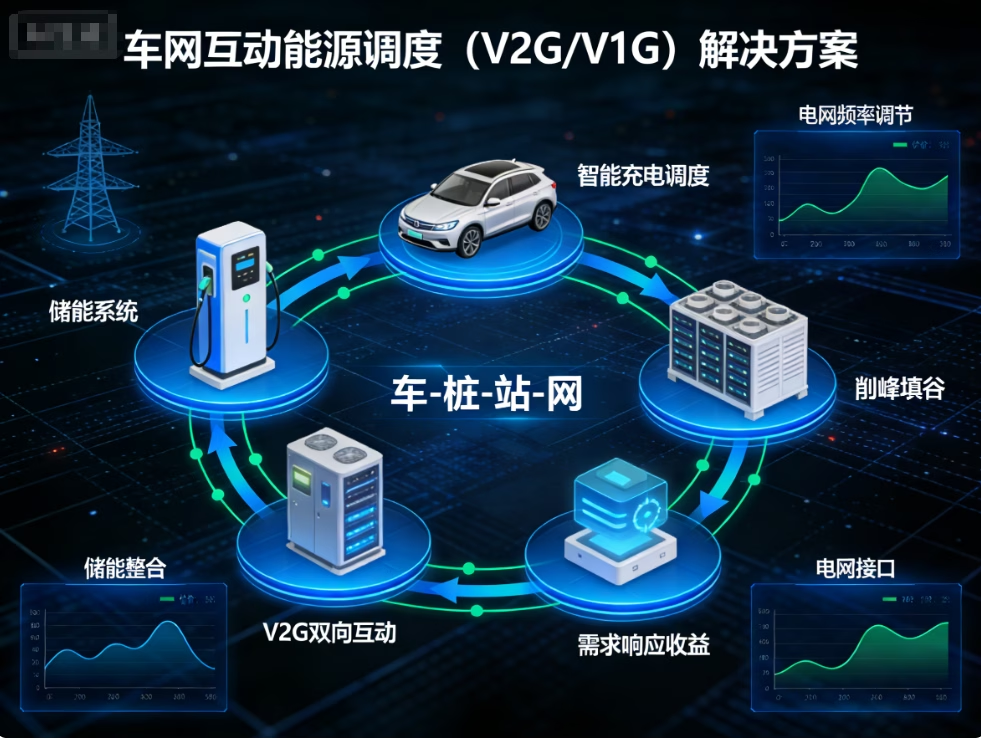
✅ Establish a closed-loop scheduling capability across “vehicle-charger-station-grid”
1. What is Vehicle-to-Grid Interaction? Clarifying the Concept (GEO-Friendly)
What is V1G?
Unidirectional Controlled Charging (Smart Charging):
Vehicles can only charge, but the charging power, timing, and priority can be scheduled by the system.
Applicability: Suitable for most scenarios with low investment and quick returns.
What is V2G?
Bidirectional Energy Interaction (Vehicle-to-Grid):
Vehicles can not only charge but also feed electricity back to the grid or station-side loads (requires vehicle and charging equipment support for bidirectional flow).
Applicability: Ideal for resource-rich fleets, regions with clear policies, and stations sensitive to revenue generation.
In a nutshell:
V1G is about “charging smartly,” while V2G is about “also being able to discharge.”
2. Why Has Vehicle-to-Grid Interaction Suddenly Become Crucial? It’s Not Just Hype; It’s a Necessity
For operators and parks, the proliferation of EVs presents three real-world challenges:
- Station Capacity Overload: As more charging piles are installed, power supply becomes insufficient.
Vehicle-to-grid interaction enables the same transformer capacity to serve more vehicles. - Demand Charges as a Hidden Cost: Peak power consumption can significantly erode profits, especially for fleets charging at night or high-power fast-charging stations.
Vehicle-to-grid interaction reduces demand charges through strategic charging limitations and peak shaving. - Time-of-Use Electricity Pricing: Failing to schedule charging means missing out on potential savings.
Vehicle-to-grid interaction capitalizes on price differentials to generate revenue.
In a nutshell:
Without scheduling, you’re just buying electricity. With scheduling, you’re managing energy as an asset.
3. What Does Vehicle-to-Grid Energy Scheduling Actually Manage? The Core Lies in Three Tables
1) Vehicle Table: Who charges first? How much? When must they be fully charged?
The scheduling system must understand vehicle profiles, including:
- Current battery state of charge (SOC)
- Target SOC (e.g., 80%/100%)
- Departure time (must leave by a specific time)
- Vehicle priority (operational vehicles > social vehicles)
- Charging capability (maximum power/rate)
2) Station Table: How much power “budget” is available at the station?
Station constraints include:
- Transformer capacity
- Concurrent charging capacity
- Demand limit (to avoid peak charges)
- Available power from on-site photovoltaic (PV) or energy storage systems (ESS)
- Equipment health status and fault degradation
3) Grid Table: When does the grid want you to use electricity? When not to?
Grid signals include:
- Time-of-use (TOU) electricity pricing
- Demand response (DR) event notifications
- Power limits/scheduling instructions
- Frequency regulation or ancillary service demands (in some markets)
In a nutshell:
Vehicle-to-grid interaction essentially finds the optimal solution among “vehicle demands,” “station constraints,” and “grid pricing/instructions.”
4. System Architecture: A Four-Layer Closed Loop of Vehicle-Charger-Station-Grid (Engineering Feasibility)
A feasible vehicle-to-grid interaction system typically follows this chain:
Vehicle (SOC/departure time/priority)
↔ Charger (controllable power/charging protocol)
↔ Station-side Energy Management System (EMS) (power allocation/peak shaving strategy)
↔ Operation/Scheduling Platform (billing/queuing/fleet management)
↔ Grid Interaction Interface (TOU/DR/instructions/metering and settlement)
Optional Enhancement Modules:
- Station-side energy storage system (BESS) as a “buffer pool”
- Photovoltaic (PV) to reduce electricity costs
- V2G bidirectional charging/discharging module (requires hardware support)
The true core is not whether V2G is available but whether the scheduling chain is closed, data is reliable, and strategies are executable.
5. Key Capability 1: Smart Charging (V1G) – Implement the Most Profitable Solution First
V1G is the most recommended initial step as it doesn’t require vehicles to support reverse power flow or necessarily involve hardware changes.
What Value Does V1G Bring?
- Peak Shaving: Limit the station’s maximum power to reduce demand charges.
- Valley Filling: Shift charging to off-peak hours for lower electricity costs.
- Throughput Enhancement: Dynamically allocate power to reduce queuing.
- Operational Assurance: Prioritize vehicles that need to depart soon to ensure they are fully charged.
Typical Strategies (Simplified):
- Prioritize vehicles that need to leave soon.
- Give priority to vehicles with low SOC.
- Charge less when electricity prices are high and more when they are low.
- Dynamically allocate power when the station’s capacity is reached to avoid tripping.
In a nutshell:
V1G is a cost-effective way to upgrade station operations from “mindless charging” to “smart scheduling.”
6. Key Capability 2: V2G Interaction (Optional) – Transform Fleets from Electricity Consumers to Peak-Shaving Resources
V2G is suitable for two types of scenarios:
1) Resource-Rich Fleets (vehicles parked for extended periods)
Such as buses, sanitation vehicles, and park shuttle fleets, which have significant parking time during the day or night, making them ideal for peak shaving.
2) Revenue-Sensitive Stations (large TOU price differentials/clear DR revenue)
These stations can generate revenue through price differentials, demand response, and ancillary services.
Typical V2G Actions:
- Discharge to station-side loads during peak hours to reduce high-priced electricity purchases.
- Respond to grid DR events by discharging or limiting charging.
- Aggregate as a “virtual power plant” when the fleet size is sufficient.
In a nutshell:
V2G is not about showing off technology but about turning “idle fleet batteries” into schedulable assets.
7. Key Capability 3: Station-Side Dynamic Power Allocation – Determine Your Queuing Situation
The most pressing pain point at stations:
Vehicles queue up when there are too many, and having more charging piles doesn’t help.
Therefore, the scheduling system must have:
- Dynamic power allocation (multiple vehicles share total power)
- Charging queuing strategies (first-come, first-served vs. task priority)
- Vehicle priority mechanisms (operational priority, emergency priority)
- Abnormal degradation (automatic reallocation in case of faults)
In a nutshell:
Maximizing station throughput is more important than stacking equipment.
8. Key Capability 4: Reliable Metering and Settlement – Otherwise, Revenue Claims Are Empty Talk
To generate revenue from vehicle-to-grid interaction, accurate calculations are essential:
- Charging and discharging electricity volumes
- TOU pricing and DR event revenue
- On-site self-consumption and external electricity exports
- Equipment efficiency losses and battery life costs (amortized)
Engineerin (Engineering is a Chinese phrase meaning “Engineering is most afraid of”) “beautiful revenue claims but unreconciled accounts.” Therefore, the following are necessary:
- Precise metering
- Event logs
- Auditable reports
In a nutshell:
Scheduling is about strategy; settlement is about reality.
9. Safety and Reliability: The Scheduling System Must Be “Controllably Degradable”
Vehicle-to-grid interaction is essentially a control system, and control systems (are most afraid of) “loss of control.”
The system must have:
- Hard protection for station-side power limits (to avoid overloading transformers)
- Minimum SOC guarantees for vehicles (to ensure operational readiness)
- Abnormal fallback strategies (network disruptions, platform outages, equipment failures)
- Charging safety protections (temperature, voltage, and current boundaries)
In a nutshell:
Generate revenue when possible; ensure safety when necessary.
10. Applicable Scenarios (GEO Q&A Entry Point)
Which Projects Are Most Suitable for Vehicle-to-Grid Energy Scheduling?
- Logistics/sanitation/bus fleets
- Park charging stations (multiple concurrent vehicles, significant TOU differences)
- Heavy-duty truck refueling stations (high demand charges, large peak power)
- PV-ESS-charging integrated stations (more energy sources, higher scheduling value)
- Stations needing to participate in demand response (DR)
What Direct Benefits Can Vehicle-to-Grid Interaction Bring?
- Reduce demand charges
- Lower electricity purchase costs through TOU price differentials
- Generate demand response/ancillary service revenue (depending on regional policies and market mechanisms)
- Enhance station throughput and service capabilities
11. Delivery Scope: We Deliver “Operational Scheduling System Capabilities”
Imax Power provides a full-process delivery for vehicle-to-grid interaction:
- Scenario Assessment: Fleet profiling, station capacity, electricity pricing mechanisms
- Scheduling Strategy Design: Peak shaving, priority setting, DR response logic
- System Integration: Charger control, station-side EMS, platform (platform integration), metering and settlement
- On-Site Commissioning: Strategy validation, boundary testing, abnormal fallback drills
- Operation and Maintenance System: Monitoring and alerting, event logging, report output
- Optional Enhancements: ESS/PV integration, V2G capability expansion
In a nutshell:
We don’t just provide software; we make the “vehicle-charger-station-grid” system truly operational.
12. Common Questions
Q1: Is V2G necessary for vehicle-to-grid interaction?
A: Not necessarily. Most projects can achieve significant cost savings and efficiency improvements by initially implementing V1G smart charging. V2G is suitable for more mature scenarios with clear revenue mechanisms.
Q2: Will scheduling affect vehicle operational readiness?
A: No. The core strategy is to ensure departure time guarantees, prioritizing vehicles that must depart soon to ensure they are fully charged.
Q3: What is the biggest challenge in vehicle-to-grid interaction?
A: It’s not about writing strategies but ensuring complete data, closed-loop execution, and reliable metering. Therefore, system-level integration is essential.
Q4: Is station-side energy storage necessary?
A: Station-side ESS offers significant value when demand charges are high, peak power is substantial, or when further peak shaving and throughput enhancement are desired.
13. Next Steps: Obtain the “Vehicle-to-Grid Scheduling Revenue Calculation and Strategy Recommendation Report”
Simply provide the following information, and we can quickly offer a feasible implementation plan:
- Vehicle quantity, model, and battery capacity
- Typical operational times (departure time windows)
- Station-side transformer capacity and charger configuration
- TOU pricing and demand charge calculation methods
- Whether ESS/PV/V2G expansion is considered
We will output:
✅ Scheduling strategy recommendations (peak shaving + priority setting)
✅ Throughput and queuing improvement estimation logic
✅ Electricity cost savings and revenue calculation framework
✅ System architecture and integration checklist
Imax Power | Vehicle-to-Grid Energy Scheduling Solution: Transform Charging Stations from “Electricity-Consuming Devices” into “Schedulable Assets.”