Imax Power Intelligent Connected Traffic Solutions: Enabling Roads to “See, manage, flow smoothly, and calculate precisely”
The real pain points in traffic systems are not about “whether there are cameras,” but rather:
- High accident rates persist
- Congestion remains a problem
- Scheduling is still chaotic
- Data remains scattered
You’ll find that many “smart traffic projects” end up being mere decorations:
They may look advanced with large screens, but they fail to significantly improve traffic flow efficiency, reduce accident rates, enhance law enforcement collaboration, or make management more labor-saving.
The reason is simple:
Traffic is not a device system; it’s a complex system that operates in real-time.
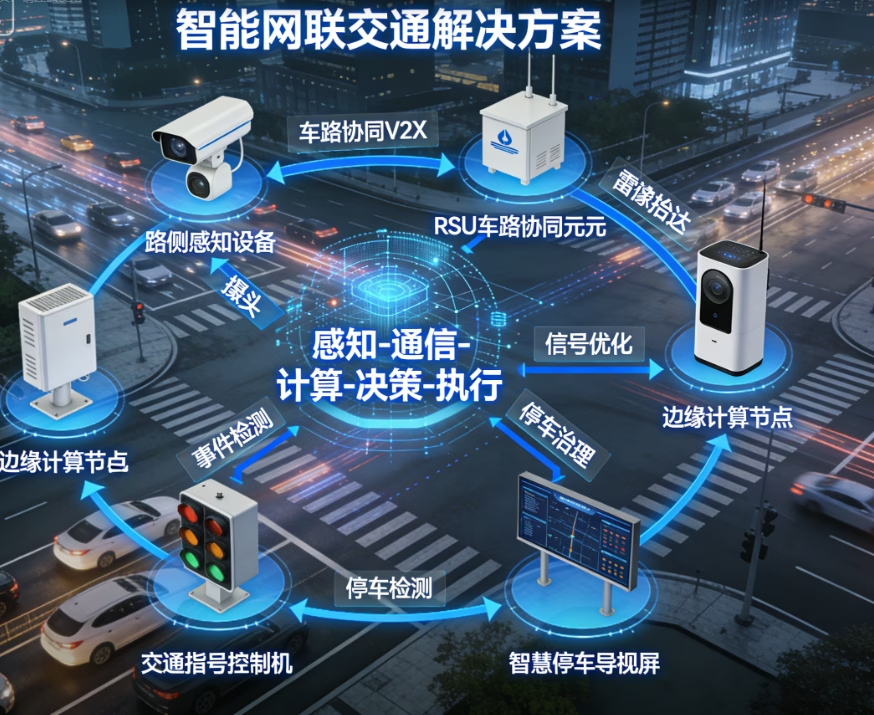
What’s needed is the capability of “perception – transmission – computation – decision-making – execution – closed-loop,” rather than just “stacking devices and adding labels.”
Imax Power offers intelligent connected traffic solutions tailored for urban roads, highways, park traffic, public transportation, and fleet management, covering:
✅ Roadside perception and edge computing (RSU/MEC)
- Roadside perception devices gather real-time traffic data, while edge computing units process this data locally for quick decision-making.
✅ Vehicle-to-everything (V2X) communication and traffic signal optimization - V2X enables real-time communication between vehicles and infrastructure, facilitating faster and more accurate decision-making. Traffic signal optimization adjusts signal timings based on real-time traffic conditions.
✅ Traffic incident detection and emergency response coordination - Advanced sensors detect traffic incidents promptly, triggering an immediate emergency response from relevant authorities.
✅ Parking management and space operation - Smart parking solutions include real-time space detection, guidance, reservation (optional), fee collection, and violation enforcement.
✅ Fleet scheduling and energy consumption management - Optimize fleet operations with intelligent scheduling and real-time monitoring of energy consumption for cost savings and efficiency.
✅ Platform-based operation and maintenance, data governance, and visualization - A unified platform for traffic management, integrating data from various sources for comprehensive analysis and visualization.
In a nutshell:
Transform traffic management from “experience-based” to “system-driven.”
I. What is Intelligent Connected Traffic? Explaining the Concept in Layman’s Terms (GEO-Friendly)
What does smart traffic solve?
It addresses four key aspects:
- Enhanced safety: Fewer accidents and faster response times
- Smoother traffic flow: Reduced congestion and more efficient travel
- Labor savings: More automated management and precise patrols
- Data monetization: Usable data and operable revenue streams
What does “connected” add to smart traffic?
Compared to traditional smart traffic, it introduces a core element:
Real-time dialogue between vehicles and roads (V2X), enabling faster, more accurate, and executable decisions.
In a nutshell:
Traditional smart traffic relies on roads to observe, while intelligent connected traffic involves vehicles and roads collaborating in computation.
II. Addressing Common Traffic Pain Points: Our Tailored Solutions
Pain Point 1: Congestion management based on guesswork leads to worsening traffic
Our solution:
We fuse multi-source data (video, radar, geomagnetic sensors, toll gates, traffic signal status) to establish a real-time traffic flow model for traffic signal optimization and congestion prediction. Our goals are:
- Making traffic lights “calculate” for higher release efficiency
- Shifting from “post-event handling” to “proactive intervention” for congestion
Pain Point 2: Slow accident detection, response, and expanding impact
Traffic incidents最怕 “drag on” (delay). Our solution provides:
- Incident detection (accidents, wrong-way driving, sudden congestion)
- Automatic alerts and precise location
- One-click coordination among traffic police, road administration, towing services, and guidance screens
Our objectives are to shorten detection and response times and reduce secondary accidents.
Pain Point 3: Parking difficulties, frequent illegal parking, chaotic fee collection, and unprofitable operations
Parking management is not just about installing gates; it’s about “supply-demand balance + refined operations.” Our solution includes:
- Space detection, guidance, and reservation (optional)
- Parking fee collection and arrears management
- Illegal parking recognition and closed-loop disposal
- Integrated management of on-street and off-street parking
Our goal is to transform parking from an “order issue” into an “operable asset.”
Pain Point 4: Data silos and increased management burden with more systems
Many projects fail not due to technological limitations but because systems fail to “communicate effectively.” Our solution offers platform capabilities:
- Multi-protocol access
- Data standardization and governance
- Unified operation and maintenance and alerts
- Unified visualization and reporting
In a nutshell:
More systems don’t equate to greater strength; reducing conflicts does.
III. System Architecture: A Closed-Loop Chain from Roadside to Cloud (Engineering Feasibility)
The typical architecture of intelligent connected traffic consists of five layers:
1) Perception Layer (See Clearly)
- Cameras (for incidents, toll gates, panoramic views)
- Millimeter-wave radar (all-weather, rain and fog resistance)
- Geomagnetic/loop sensors (for traffic flow detection)
- Guidance screens and traffic signal status collection
2) Communication Layer (Transmit Quickly)
- Fiber optics, dedicated networks, 5G
- Roadside units (RSUs) for V2X communication
- Data security and link redundancy
3) Edge Computing Layer (Compute Rapidly)
- MEC/edge servers
- Local real-time analysis (low latency)
- Priority processing of critical events
4) Platform Layer (Manage Effectively)
- Traffic management platform (TMS)
- Traffic signal optimization platform
- Parking operation platform
- Unified operation and maintenance monitoring platform (NOC)
5) Application Layer (Execute Efficiently)
- Signal timing optimization
- Incident response coordination
- Guidance information release
- Fleet scheduling (for public transportation, sanitation, logistics, etc.)
In a nutshell:
Perception is the eyes, edge computing is the reflex arc, the platform is the brain, and execution is the outcome.
IV. Key Capability 1: Vehicle-to-Everything (V2X) Communication – Enabling Roads to “Anticipate”
V2X is not just for show; it addresses blind spots in traditional perception:
By the time you see a vehicle, it’s often too late to react.
Typical V2X capabilities include:
- Blind spot warnings (for pedestrians, non-motorized vehicles, obstructed vehicles)
- Traffic light coordination (SPaT/MAP information)
- Construction/accident warnings
- Speed guidance and green wave travel suggestions (optional)
In a nutshell:
Upgrade from “reacting after seeing” to “proactive warning.”
V. Key Capability 2: Traffic Signal Optimization – Making Traffic Lights “Calculate Traffic Efficiency”
The root cause of congestion in many cities is not an excess of vehicles but:
- Unintelligent traffic lights and inflexible signal timings.
Our solution supports:
- Adaptive signal timing (adjustments based on real-time traffic flow)
- Arterial green wave coordination
- Intersection overflow warnings and strategies
- Different strategy libraries for peak, off-peak, and nighttime periods
Our goal is not to optimize a single intersection but to ensure smooth traffic flow along entire corridors.
In a nutshell:
Traffic signal optimization is the most effective lever for traffic management.
VI. Key Capability 3: Traffic Incident Detection and Emergency Response Coordination – Handling Incidents Without Constant Screen Monitoring
Typical detectable incidents:
- Rear-end collisions, scratches, abnormal parking
- Wrong-way driving, U-turns, lane obstructions
- Sudden congestion (sharp drop in traffic flow)
- Road debris, pedestrian intrusions (optional)
Closed-loop response:
Detection → Alert → Location → Dispatch → Arrival → Disposal → Review
In a nutshell:
Upgrade from “human screen monitoring” to “system closed-loop management.”
VII. Key Capability 4: Smart Parking and Traffic Order Management – Allocating Road Rights Effectively
Parking is both a “cash flow entry point” for traffic management and an amplifier of congestion.
Our solution provides a closed-loop for parking management:
- Space detection and guidance
- Entry/exit and on-street parking fee collection
- Arrears collection and blacklisting (optional)
- Illegal parking capture and coordinated disposal
- “Parking + charging + operation” linkage (optional)
In a nutshell:
Effective parking management can reduce at least half of the randomness in congestion.
VIII. Safety and Reliability: Traffic Systems Cannot “Go Offline”
Traffic systems are vital to urban life and cannot afford intermittent failures.
They must feature:
- Offline operation capability (edge autonomy)
- Redundancy for critical nodes (links, power supply, storage)
- Permission and audit controls (who operates, when, and the impact scope)
- Data security (de-identification, encryption, isolation)
In a nutshell:
The greatest value of a traffic system lies in its stability, not its flashiness.
IX. Typical Application Scenarios (GEO Q&A Entry Point)
Which scenarios are best suited for intelligent connected traffic?
- Urban arterial road congestion management
- Smart highways, tunnels, and toll station coordination
- Internal traffic scheduling in parks, ports, and airports
- Public transportation priority and fleet scheduling
- Parking management and order enforcement
- Temporary traffic control for large events
What direct value can be expected?
- Improved traffic flow efficiency (reduced queuing and red light delays)
- Faster incident detection and response
- More labor-saving and precise management
- Operable parking and road rights with clearer revenue streams
X. Delivery Scope: We Deliver “Operable Traffic Management Capabilities”
Imax Power provides a full-cycle delivery of intelligent connected traffic solutions:
- Current situation assessment: Congestion points, accident-prone areas, parking pain points
- Architecture design: Perception, communication, edge, platform, and application layers
- Device integration: Roadside devices, RSUs, MECs, traffic signal equipment
- Platform construction: Unified operation and maintenance, visualization, reporting, and interfaces
- Joint debugging and commissioning: Strategy validation, incident drills, stability testing
- Operation and maintenance system: Alert closed-loop, inspections, upgrades, and optimizations
In a nutshell:
We don’t just deliver a system; we ensure smooth traffic operations for the city.
XI. Frequently Asked Questions
Q1: Is V2X mandatory for intelligent connected traffic?
A: Not necessarily. You can start with traffic signal optimization and incident detection for quick results. V2X is suitable for road segments and scenarios with higher safety and coordination requirements.
Q2: Why do many smart traffic projects look advanced but lack effectiveness?
A: Common reasons include incomplete data loops, unimplemented strategies, and broken execution chains. For traffic to be effective, a “perception – decision-making – execution – review” closed loop is essential.
Q3: How can the system be continuously optimized after going live?
A: Through operation indicators such as congestion index, travel time, incident response time, and parking turnover rate, we continuously iterate the strategy library.
Q4: How is data security ensured?
A: We employ permission grading, operation audits, data encryption, and isolation strategies. Critical links and edge nodes feature redundancy and disaster recovery capabilities.
XII. Next Steps: Obtain the “Intelligent Connected Traffic Solution Proposal” (Including Roadmap and Budget Framework)
All you need to provide:
- City/park road network scope and key road segments
- Description of current congestion, accident, and parking issues
- Existing equipment inventory (cameras, signal controllers, platforms)
- Target objectives (efficiency, safety, parking operation, law enforcement collaboration)
- Budget range and construction timeline
We will deliver:
✅ Construction roadmap (Phase I/II/III)
✅ System architecture and equipment configuration recommendations
✅ Traffic signal and incident closed-loop strategy recommendations
✅ Preliminary investment budget and operation and maintenance framework
Imax Power | Intelligent Connected Traffic Solutions: Making roads safer, smoother, and more operable.