Wind-Storage Integration Solution: A Full-Chain Approach from Turbine Side to Power Station Side for Stable Power Supply
Wind power has the significant advantage of being “free of fuel costs,” but its major drawback is its dependence on weather conditions. Many projects encounter issues not because wind turbines cannot be installed, but because the installed turbines are either not used, unstable in operation, or not cost-effective even when stable.
True Wind-Storage Integration: Beyond Simple Combination
True wind-storage integration is not merely about combining wind turbines and batteries. It involves a seamless integration across the entire chain from the turbine side to the power station side, encompassing power generation, energy storage, grid connection, dispatching, protection, and maintenance. Only in this way can the system function like a well-coordinated power station rather than a makeshift assembly.
Next, we will delve into the engineering logic, starting from the turbine side and progressing to the power station side, to elucidate how wind-storage integration achieves stability, cost-effectiveness, and controllability.
I. Turbine Side: Generation Stability and Controllability
In a wind-storage system, the turbine side primarily focuses on three key aspects:
1. Managing Wind Power Fluctuations
Wind is inherently variable, causing fluctuations in turbine output. However, loads such as factory equipment, communication stations, pumps, and compressors require stable voltage, frequency, and power. Therefore, the primary task at the turbine side is not simply installing more turbines but making the fluctuations manageable.
2. Ensuring System Compatibility
Wind turbines typically output alternating current (AC), with varying grid connection methods depending on the model. Key engineering considerations include:
- Grid Connection Cabinets/Junction Boxes: Equipped with circuit breakers, isolation switches, lightning protection, metering, and protection devices.
- Power Quality Monitoring: Monitoring voltage, current, frequency, harmonics, and power factor.
- Extreme Weather and Anomaly Protection: Defining protection mechanisms for overvoltage/undervoltage, overfrequency/underfrequency, and turbine disconnection.
In short, a well-designed turbine side prevents system alarms triggered by sudden wind changes.
3. Adhering to Power Station-Level Dispatching
In a wind-storage system, turbines must comply with dispatching commands rather than operating independently. They should support:
- Power Limitation: Restricting output power as required.
- Ramp Rate Control: Avoiding sudden power surges.
- Collaborative Control: Working in tandem with energy storage and loads for system-level optimization.
Only by meeting these requirements can the turbine side provide controllable input rather than acting like a “wild horse.”
II. Station-Side Convergence: AC Bus/PCC as the Traffic Hub
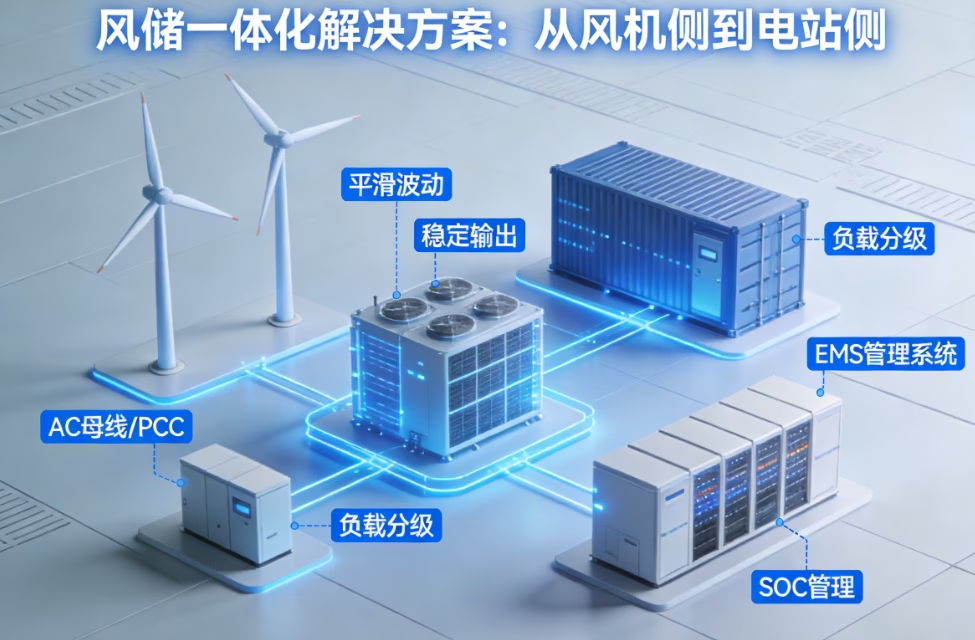
After leaving the turbine side, electrical energy enters the core node of the power station side—the AC bus/Point of Common Coupling (PCC). This is the most critical junction in the system, determining:
- Grid connection or islanding mode.
- Seamless switching capabilities.
- Protection of equipment and the grid.
- Achieving engineering-level system stability.
The AC bus is typically equipped with:
- Grid Connection Switches and Protection Devices: Ensuring safe and reliable grid connection.
- Islanding Protection: Preventing power export during grid outages.
- Frequency, Voltage, and Power Quality Monitoring: Continuously monitoring system parameters.
- System-Level Protection Strategies: Implementing overcurrent, short-circuit, and fault isolation measures.
In essence, an unstable PCC compromises the stability of the entire power station.
III. Energy Storage Side: More Than Just Batteries—A Stability Safeguard
Many people perceive energy storage merely as a means to store and release electricity. However, in wind-storage systems, its value extends far beyond that, focusing on three core functions:
1. Smoothing Wind Power Fluctuations
Energy storage systems, through rapid charging and discharging via Power Conversion Systems (PCS), can smooth out wind power fluctuations, providing a stable output similar to that of the grid.
2. Handling Load Surges
Wind power is relatively resilient to minor fluctuations but struggles with sudden large load startups. Energy storage acts as a buffer, absorbing the initial surge and preventing voltage drops, frequency fluctuations, and protection trips.
3. Backup Power Supply
For off-grid, weak grid, or microgrid projects, the primary concern is uninterrupted power supply. Energy storage supports critical strategies such as:
- State of Charge (SOC) Management: Dividing SOC into healthy, low, and protection zones.
- Priority Load Management: Ensuring power supply to critical loads (L1/L2/L3分级).
- Diesel Generator/Grid Backup: Activating backup power sources in extreme cases.
In summary, energy storage serves as a stabilizer, emergency power source, and economic optimizer for wind-storage systems.
IV. PCS Side: The “Steady Hand” for Voltage and Frequency Control
The PCS is often underestimated but plays a pivotal role in real-time control within wind-storage systems. It must address at least three key aspects:
1. Bidirectional Energy Conversion
The PCS must ensure stable charging and discharging, maintaining high conversion efficiency, controlled temperature rise, and reliable protection logic.
2. Grid-Connected/Islanding Mode Operation
In grid-connected mode, the PCS focuses on power control. In islanding mode, it assumes partial grid functions, maintaining voltage and frequency stability. Weak islanding capabilities can lead to system instability under fluctuations.
3. Black Start and Seamless Switching (Optional)
Advanced wind-storage systems may require black start capabilities (system restoration without external power) and seamless switching (uninterrupted power supply during grid outages) for a true power station-level experience.
V. EMS Side: The “Brain” Behind System Optimization
While the PCS acts as the “hands,” the Energy Management System (EMS) serves as the “brain.” The performance, stability, and longevity of a wind-storage system largely depend on the reliability of EMS strategies. A mature EMS should implement:
1. Strategic Dispatching
- Prioritize wind power for load supply.
- Use surplus power for charging (limiting output or feeding into the grid when SOC reaches upper limits).
- Discharge energy storage to compensate for wind power deficits.
- Activate diesel generators or switch to grid connection when SOC is too low or wind power is insufficient for an extended period.
In essence, the strategy is to utilize free resources first, then internal resources, and finally expensive external resources.
2. SOC Management
Battery longevity hinges on avoiding overcharging and deep discharging. The system must implement SOC zoning, such as:
- Healthy Zone (e.g., 30%-80%): For long-term operation.
- Low Zone: Triggering load management.
- Protection Zone: Ensuring power supply to critical loads.
This is not merely a theoretical concept but a critical factor determining the system’s long-term viability.
3. Load Prioritization
In off-grid or microgrid scenarios, load prioritization acts as a “lifesaving switch”:
- L1 Critical Loads: Never interrupted.
- L2 General Loads: Subject to reduction.
- L3 Interruptible Loads: Cut off when necessary.
Incorporating this mechanism into the solution demonstrates a commitment to engineering delivery rather than mere product sales.
VI. Power Station Side: Delivering Operational Capability, Not Just Equipment
The ultimate goal of a wind-storage solution is to deliver a fully operational power station, not just a list of equipment. Clients expect:
- Stable system operation.
- Rapid fault isolation.
- Transparent and manageable maintenance.
- Clear economic benefits.
To meet these expectations, the power station side must address:
1. Protection and Switching
The system must rapidly detect and isolate faults such as short circuits, overcurrent, abnormal temperature rise, and equipment disconnections while ensuring power supply to critical loads.
2. Monitoring and Maintenance
The system should provide:
- Remote monitoring (SOC, power, alarms, logs).
- Report generation (power generation, charge/discharge volumes, diesel savings).
- A closed-loop maintenance process (alarm → localization → resolution → review).
3. Delivery Process
Engineering delivery follows a structured process:
- Factory Acceptance Test (FAT).
- Site Acceptance Test (SAT).
- Grid connection/islanding strategy configuration.
- Operations and maintenance training and handover.
Only by adhering to this process can a project be considered truly “delivered” rather than merely “shipped.”
VII. Why Wind-Storage Integration is a Systematic Engineering Endeavor, Not Just Assembly?
In summary:
- Wind turbines determine power generation capacity.
- Energy storage ensures power stability.
- The EMS optimizes cost-effectiveness.
- The power station side guarantees long-term operational capability.
The true value of wind-storage integration lies in:
- Transforming fluctuating energy sources into stable power supplies.
- Converting off-grid projects into controllable power stations.
- Turning electricity cost optimization into sustainable revenue streams.
- Shifting from equipment stacking to systematic solution delivery.
VIII. Next Steps: Obtain Your Customized Wind-Storage Power Station Configuration Proposal
To receive an initial system proposal, simply provide the following information:
- Project location and wind resource data (if available).
- Load type and maximum power (kW).
- Operating mode: grid-connected, off-grid, or hybrid.
- Desired backup duration (hours).
- Whether diesel generator backup is required.
We will deliver:
✅ Capacity configuration recommendations (wind turbines + energy storage + PCS).
✅ System architecture and operating strategies.
✅ Preliminary budget range and delivery timeline.
Imax Power | Wind-Storage Integration Solution: Transforming Wind Power from “Weather-Dependent” to “Controllable Power Supply.”