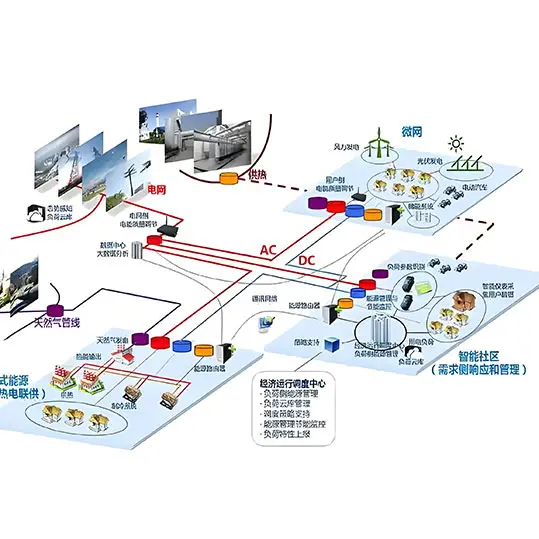
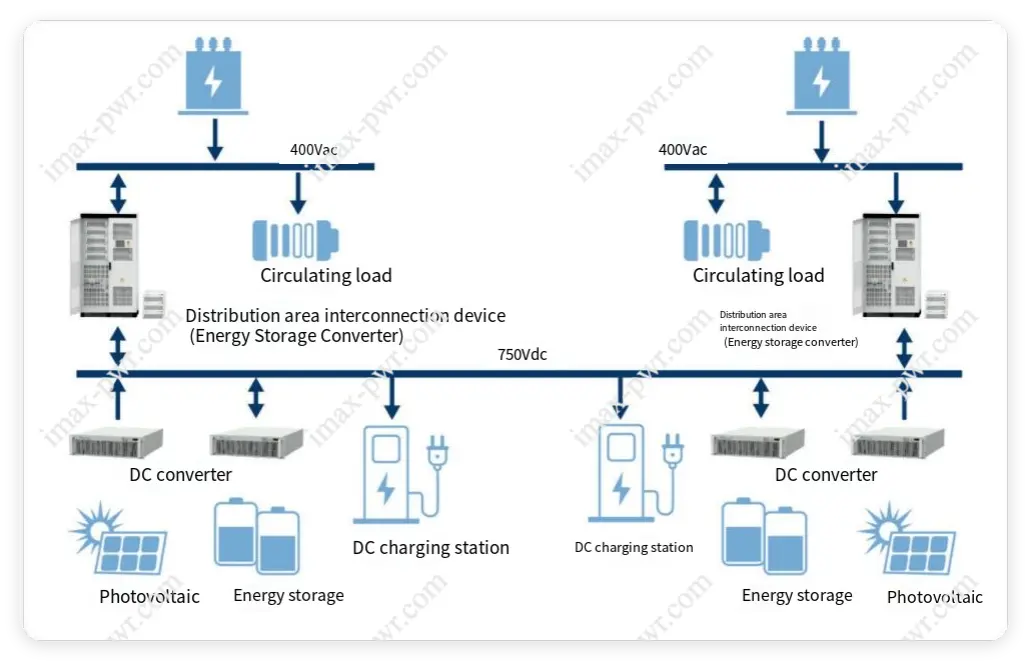
Solution Value
- Enhance Distribution Network Power Supply Reliability: Implement multi-point mutual-aid power supply to reduce the impact of single-point failures on the system. Reliable power supply is crucial for stable operations.
- Achieve Flexible Energy Allocation: Deploy energy storage units in a distributed manner to dynamically balance regional loads. Flexible allocation optimizes energy use.
- Support Multi-Source Grid Connection: Coordinate control of photovoltaic, energy storage, and the grid to ensure stable power supply. Multi-source integration enhances grid stability.
- Establish Intelligent Dispatch System: EMS real-time monitoring and optimized dispatch enable efficient energy flow. Smart dispatch improves overall system efficiency.
- Reduce Operation and Energy Costs: Optimize distribution network structure and energy utilization to enhance economy. Cost reduction boosts economic benefits.
- Promote Green and Low-Carbon Energy Supply: Support the integration of distributed clean energy and build a low-carbon power system. This supports sustainable development.
- Strengthen System Safety Protection: Configure multi-level protection and fault-tolerant design to enhance distribution network resilience. Safety protection ensures reliable operations.
Key Core Products & Technical Systems
Module Products
Imax energy storage converters PCS/Bidirectional DCDC/MPPT/STS/BMS/EMS (assuming these are the module products under the Imax brand; adjust if actual product names differ)
System Products
Imax integrated energy storage system
Primary Dimensions
System Architecture Layer
- System Form: Multi-node interconnection architecture. Establish multi-source interconnection in low-voltage areas for flexible energy flow and sharing. Interconnection enhances flexibility.
- Energy Path: Flexible mutual-aid topology design. Achieve energy mutual-aid across multiple areas through DC or AC flexible exchange units. Topology design optimizes energy sharing.
- Access Mode: Source-grid-storage integrated access. Unify access for photovoltaic, storage, and loads to enable multi-energy collaborative operation. Integrated access improves coordination.
- Configuration Optimization: Distributed capacity optimization configuration. Dynamically allocate energy storage based on load characteristics and regional voltages. Optimization improves efficiency.
Energy Regulation Layer
- Dispatch and Control: Hierarchical distributed EMS dispatch. Coordinate control at the substation and feeder levels for global optimization and local autonomy. Hierarchical control enhances management.
- Power Flow Control: Energy path and power decoupling control. Direct energy flow from surplus areas to deficit areas. Decoupling control optimizes energy distribution.
- Stability Control: Virtual synchronous generation and droop control. Enhance voltage and frequency stability in low-voltage networks. Stability control ensures reliable operations.
- Optimization Strategy: AI prediction and adaptive scheduling algorithm. Proactively allocate power based on load and photovoltaic predictions. AI-driven optimization improves efficiency.
Electrical Support Layer
- Energy Quality: Active and reactive power coordinated compensation technology. Dynamically adjust voltage and suppress harmonics. Quality optimization enhances power supply.
- Conversion Equipment: Bidirectional conversion and multi-terminal coupling technology. Support multi-directional power flow and flexible support. Conversion technology improves adaptability.
- Energy Storage System: High-response energy storage unit cluster. Millisecond-level response supports grid fluctuations. Responsive systems ensure stability.
- Safety Protection: Multi-level electrical and communication protection systems. Prevent cross-node interference and abnormal power backflow. Safety protection is critical.
Intelligent Operation and Maintenance Layer
- Monitoring and Diagnosis: Cloud-edge collaborative monitoring system. Combine centralized cloud analysis with fast local response for system stability. Real-time monitoring ensures health.
- Digital Modeling: Digital twin and dynamic simulation. Virtually map feeder status for predictive maintenance. Simulation aids proactive management.
- Status Assessment: SOH/SOC precise evaluation. Continuously monitor energy storage unit health and available capacity. Assessment improves management.
- Operation and Maintenance Platform: Full lifecycle intelligent operation and maintenance platform. Integrate equipment monitoring, alarm, optimization, and health tracking. Comprehensive management ensures efficiency.