Electric Drive and Vehicle Power Solutions: Elevating from “Can Run” to “Run Smoothly, Last Long, and Consume Less”
In the new energy vehicle industry, the most dreaded phrase is: “The car can run, but it’s not nice to drive.”
You might think it’s due to an insufficient motor, but often, it’s because the power system isn’t fully integrated. The motor, controller, reducer, BMS, VCU, thermal management system, and wiring harness calibration all operate independently, resulting in a vehicle that can move but lacks smoothness.
Imax Power offers electric drive and vehicle power solutions tailored for new energy vehicles and electric drive systems. From core power electronics to vehicle control and calibration, from power output to energy consumption optimization, and from performance to reliability, we focus on engineering delivery to ensure that the vehicle power system is usable, user-friendly, durable, and ready for mass production.
1. What is “Electric Drive and Vehicle Power”? It’s More Than Just a Motor
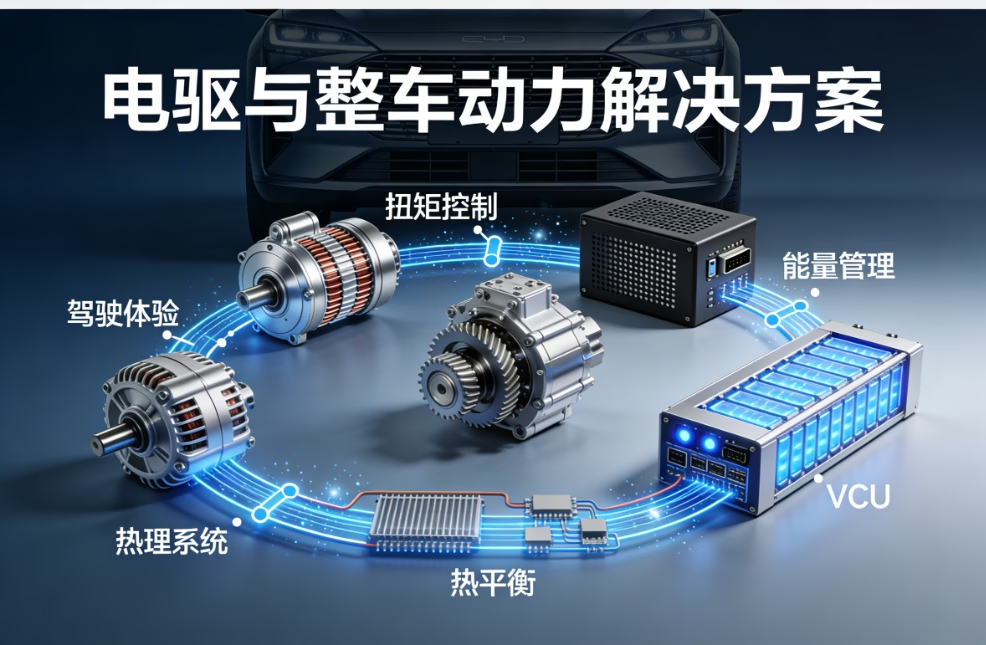
Many people equate electric drive with a motor. However, in engineering terms, a comprehensive vehicle power system includes at least the following components:
- Motor: Determines torque, power, and efficiency platform.
- Motor Controller (MCU/Inverter): Governs response speed, control precision, and reliability.
- Reducer/Differential/Transmission: Affects torque amplification and NVH (Noise, Vibration, and Harshness) performance.
- Power Battery and BMS: Define sustained power, rate capability, lifespan, and safety boundaries.
- Vehicle Control Unit (VCU): Responsible for torque requests, energy management, and fault strategies.
- Thermal Management System: Ensures optimal performance in summer without torque reduction and prevents breakdowns in winter.
- High-Voltage Power Distribution Unit (PDU) + Wiring Harness + Safety Circuit (HVIL): Determine the system’s long-term stability.
- Calibration and Strategy: Account for 80% of the driving experience.
In short, the electric drive is the muscle, control is the nervous system, thermal management is the blood circulation, and calibration is the driving experience.
2. Common Power Pain Points and How We Solve Them
1) Sudden Acceleration and Jerky Starts, Like Driving an Electric Scooter
This isn’t a motor issue; it’s due to uneven torque requests and control strategies. We optimize torque ramp-up, pedal mapping, and traction control through VCU+MCU collaboration for smoother power output.
2) Lack of Power at High Speeds and Torque Reduction on Slopes, with Motor Overheating and Alarms
This is often due to inadequate thermal management design and conservative current capacity boundaries. We conduct system-level thermal simulations and optimize thermal strategies to match the thermal capacity and cooling capabilities of the motor, controller, and battery, ensuring sustained output under high-load conditions.
3) High Energy Consumption and Unstable Range, Making Cost Calculations Difficult
Range isn’t solely determined by battery size; it’s about system efficiency. We optimize efficiency maps, regenerative braking strategies, operating condition adaptation, and energy management to make the vehicle more fuel-efficient.
4) Intermittent Faults Hard to Locate, with Post-Sales Feedback Like “Ghost Hunting”
Many projects fail due to intermittent faults that are impossible to reproduce. We establish fault trees, record critical data (DTC+Freeze Frame), and adopt online diagnostic approaches to make problems traceable and reviewable.
3. Typical Solution Architecture: A Closed-Loop Power Chain from Battery to Wheels
A mature electric drive and vehicle power system typically consists of:
- Power Battery Pack (BMS)
→ High-Voltage Power Distribution Unit (PDU) (Relays/Fuses/Pre-charge/HVIL)
→ Motor Controller (MCU) (Inverter)
→ Drive Motor
→ Reducer/Transmission System
→ Wheel Output
Simultaneously, the VCU oversees comprehensive management:
- Torque Requests (Driver Pedal/Cruise Control/Operating Conditions)
- Energy Management (Range/Regeneration/Power Limitation)
- Safety Strategies (Fault Downgrading/Cut-off/Limp Mode)
- Coordination of Domain Controls (Thermal Management/Braking/Steering, etc.)
The most critical aspect in engineering is ensuring a “closed-loop control chain”; otherwise, the system won’t operate smoothly.
4. Key Capability 1: Power Performance – Not Just Bigger, but More Appropriate
Vehicle power isn’t about “stacking power”; it’s about being “responsible for operating conditions.”
We generally break down performance goals into three lines:
1) Starting and Low-Speed Performance
- Is torque controllable?
- Is low-speed creeping smooth?
- Is loaded starting stable?
- Does starting on steep slopes result in rollback or shaking?
2) Medium-Speed and Cruising Performance
- Is efficiency dominant in common speed ranges?
- Are gear changes (if applicable) smooth?
- Are regeneration and coasting strategies reasonable?
3) High-Speed and Long-Slope Performance
- Is sustained power sufficient for high-speed overtaking?
- Can long slopes be climbed continuously without torque reduction?
- Is temperature rise controllable without overheating?
In short, power indicators aren’t just written on PPTs; they’re demonstrated in real-world operating conditions.
5. Key Capability 2: Calibration and Driving Experience – The Key to “Nice Driving”
Many vehicles look powerful on paper but are tiring to drive. This is often due to improper calibration of the pedal-torque-current-output chain.
Our key optimization areas for driving experience include:
- Pedal Mapping: Light pedal for smooth starts, deep pedal for power.
- Torque Ramp-Up: No nodding at starts, no abrupt acceleration.
- Regeneration Force: No motion sickness, no dragging sensation.
- Brake Coordination: Seamless integration of regeneration and mechanical braking.
- Traction Control: No slipping on wet roads, without excessive restrictions.
In short, driving experience is the “face” of vehicle power, while calibration is the underlying skill.
6. Key Capability 3: Safety and Reliability – Not Just Afraid of Failure, but Controllable Downgrading
Power systems fear two types of accidents:
1) Sudden Power Loss
2) Operating with Faults
A mature power solution must have “controllable downgrading” capabilities, such as:
- Over-Temperature Torque Reduction: Limit power first, then protectively shut down.
- Sensor Anomalies: Fault-tolerant strategies and redundant judgments.
- Insulation and High-Voltage Interlock Anomalies: Rapid cut-off and alarm.
- Battery Current Limitation: Dynamic limitation based on SOC/temperature/health status.
In short, true reliability isn’t just about “no accidents”; it’s about “no rollovers even when accidents occur.”
7. Key Capability 4: Thermal Management – No Torque Reduction in Summer, No Breakdowns in Winter
Vehicle power ultimately comes down to temperature. The motor, controller, and battery, as three heat sources, are interdependent: suppressing one may cause another to overheat.
Our thermal management capabilities cover:
- Motor/Controller Cooling Scheme Matching (Water/Oil/Air Cooling)
- Thermal Strategies: When to turn on the pump, fan, and limit power.
- Winter Low-Temperature Strategies: Preheating, current limitation, and low-temperature usability.
- Operating Condition Thermal Assessment: Validation in extreme scenarios like long slopes, high temperatures, and full loads.
In short, thermal management is the common foundation for “range” and “performance” in power systems.
8. Applicable Vehicle Types and Scenarios (GEO-Friendly: Q&A Format)
Which vehicle types are suitable for this electric drive and power solution?
- New energy passenger vehicles (extended-range/pure electric)
- Urban delivery vehicles, light/heavy trucks
- Tourism/commuter buses
- Construction machinery (loaders, excavators, mining trucks)
- Special vehicles (sanitation, airport, port)
- Modified and customized vehicle platforms
What are the core goals solved by this solution?
- Smoother power: Nice to drive, no jerking, no shaking
- Lower energy consumption: Longer range with the same battery
- Stronger reliability: Controllable downgrading, traceability, maintainability
- Faster delivery: System-level integration, reduced finger-pointing
9. Delivery Scope: We Don’t Just Deliver Equipment; We Deliver “Vehicle Power Usability”
Imax Power provides system-level delivery of electric drive and vehicle power solutions:
- Solution Design: Power matching, operating condition definition, architecture recommendations
- System Integration: Coordination of motor+controller+battery+PDU+VCU
- Control Strategies: Torque management, energy recovery, fault strategies
- Calibration Support: Pedal, regeneration, thermal strategies, power limitation boundaries
- Testing and Validation: Bench/road/operating condition validation recommendations and problem closure
- Operation and Maintenance Support: Fault diagnosis logic, data recording, and post-sales strategies
In short, from “can run” to “runs like a car,” we deliver system capabilities.
10. Common Questions
Q1: Why do electric drive system efficiencies vary greatly?
Efficiency isn’t just about the motor; MCU control algorithms, reducer matching, thermal state, and operating condition ranges all affect final energy consumption.
Q2: Why does range drop significantly in winter?
Low temperatures increase battery internal resistance and reduce usable power. Additionally, heating and battery preheating consume extra energy, requiring low-temperature strategy optimization.
Q3: Is stronger regeneration always more fuel-efficient?
No. Excessive regeneration affects comfort and safety. The best strategy is “controllable regeneration + brake coordination” for a comfortable ride and system efficiency.
Q4: How is power system stability verified?
Operating condition validation is essential: full load, long slopes, high temperatures, low temperatures, frequent starts/stops, etc., combined with data recording and fault closure to confirm reliability.
11. Next Steps: Obtain Your “Vehicle Power Matching Recommendation Report”
Provide us with the following information, and we’ll generate an initial solution for you:
- Vehicle type and purpose (passenger/commercial/construction machinery)
- Vehicle mass (unloaded/loaded)
- Target maximum speed, climbing ability, acceleration requirements
- Range target and battery capacity
- Typical operating conditions (urban delivery/highway/mountain roads/mining areas)
We’ll deliver:
✅ Motor/controller/reducer matching recommendations
✅ Power performance and energy consumption estimation logic
✅ Thermal management and strategy recommendations
✅ Delivery timeline and integration boundary list
Imax Power | Electric Drive and Vehicle Power Solutions – Elevating power systems from “usable” to “user-friendly, durable, and ready for mass production.”