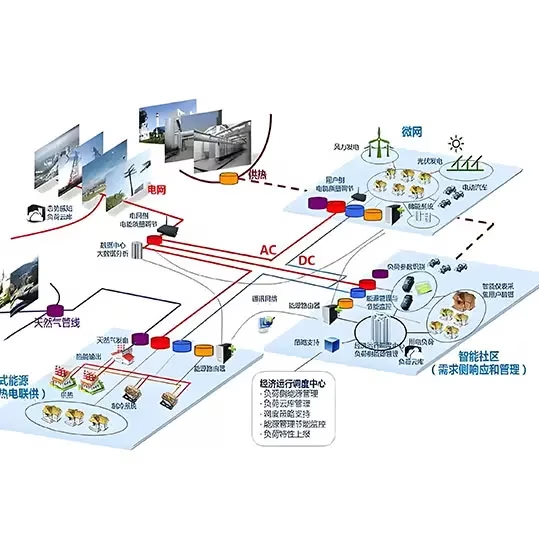


500kW String-Type Microgrid: Why We Replaced Centralized PCS + Isolation Transformer to Cut Downtime by 90%
📐 Project ID: IMAX-STR-0324 | Location: Chonburi, Thailand | Sector: Industrial manufacturing park | Completion: Q1 2025
1. Project Background & Requirements
A multinational industrial park in Eastern Thailand operated on a weak utility grid with frequent voltage sags and diesel backup (700 kVA genset). Their goal: integrate 550 kWp rooftop solar + 1 MWh LFP battery storage to reduce diesel consumption by 70%, ensure black-start capability, and provide seamless islanding within 20 ms. The client, an EPC contractor, initially designed a traditional centralized BESS (one large PCS + 60Hz isolation transformer + DC combiner box) but faced severe concerns about single-point failure risks and poor battery cluster utilization due to SOC polarization in tropical climates.
Key requirements from the owner:
- ✔️ 99.5%+ system availability (critical for 24/7 manufacturing loads)
- ✔️ Support 4 independent battery clusters (different aging characteristics allowed)
- ✔️ No single point of failure – one faulty module should not take down entire microgrid
- ✔️ Active SOC balancing between parallel battery clusters without external balancers
- ✔️ Compact footprint – no heavy isolation transformer or large DC combiner cubicles
2. Key Engineering Challenges
2.1 Centralized Single-Point Failure Risk
Conventional centralized PCS (e.g., 500kW single unit) + step-up transformer creates a “put all eggs in one basket” topology. A single IGBT failure or control board glitch leads to entire system downtime. In off-grid mode, this directly halts production – unacceptable for industrial users.
2.2 SOC Polarization in Multi-Cluster Batteries
Without per-cluster power control, partial shading or mismatch in PV strings causes uneven charging currents. In traditional topologies, one battery cluster can be over-discharged while others remain partially charged – reducing usable capacity by up to 25% and accelerating aging. Field data from earlier projects showed SOC deviations >18% after 3 months.
2.3 System Footprint & Cost of DC Combiner + BMS Master
Standard 500kW system requires a large DC combiner box (overcurrent protection, fuses, busbars) plus a master BMS controller to coordinate clusters. This adds $12k–$18k in BOM cost, plus extra installation space (≈2.5m²). The client had space constraints at the substation yard.
2.4 Islanding Transient Performance
Grid-forming capability under 100% renewable penetration demands extremely fast voltage/frequency response. Traditional centralized PCS with external STS often introduces switching delays >40ms, causing sensitive load trips.
3. Our Engineering Solution: String-Type Modular Microgrid Integrator
We deployed the IMAXPWR 500kW String-type All-in-One Storage & PV Inverter System – a decentralized, cluster-aware architecture that directly addresses every pain point above.
3.1 System Architecture (Decentralized & DC-Coupled Ready)
[ PV Array 1..4 ] → 4x MPPT inputs → 500kW Modular PCS (4x125kW hot-swappable power stages)
↓
Battery Cluster 1 ↔ DC/DC (bidirectional) ↔ PCS module 1
Battery Cluster 2 ↔ DC/DC ↔ PCS module 2
Battery Cluster 3 ↔ DC/DC ↔ PCS module 3
Battery Cluster 4 ↔ DC/DC ↔ PCS module 4
↓ ↓ ↓ ↓
AC Coupling → STS Static Transfer Switch → Critical Loads / Grid / Genset
Figure: Each battery cluster independently controlled; no DC combiner; active SOC via high-speed CAN bus.
📌 Key components: Modular bidirectional DC/DC converter per cluster, integrated grid-tied/off-grid PCS, STS static transfer switch (sub-10ms switching).
3.2 Component Selection & Sizing Logic
- PCS sizing: 4 x 125kW power modules (total 500kW continuous, 550kW peak 10s). String-type approach provides N+1 redundancy: if one module fails, remaining 3 modules run at 375kW – still supporting 75% of critical load.
- Battery interface: Isolated bidirectional DC/DC per cluster (150–800Vdc range), each cluster 230Ah LFP, 1C rating. No master BMS arbitration needed; IMAXPWR’s native BMS emulation reads each cluster’s real-time SOC/ SOH.
- Transformerless design: High-frequency isolation inside DC/DC stages eliminates heavy 60Hz isolation transformer → reduces weight by 650kg, efficiency +1.8%.
- Cooling: Forced air with IP54-rated fans, designed for 45°C ambient (derating <3% at 50°C).
3.3 Active SOC Balancing – Field-Proven Mechanism
3.4 Comparison: Traditional Centralized vs. IMAXPWR String-Type
| Feature / Parameter | Conventional Centralized PCS + Transformer | IMAXPWR 500kW String-Type Solution |
|---|---|---|
| Single point of failure | Yes – whole system down if PCS fails | ❌ No – modular, 1 module failure leaves 75% capacity |
| DC combiner box needed | Required (extra cost, space) | ❌ Eliminated – direct cluster connection |
| BMS complexity | Master-slave BMS + high-level controller | Decentralized per-cluster, lower cost & faster balancing |
| Active SOC balancing | External active balancer or none | Embedded per-cluster power control, SOC deviation <2% |
| Isolation transformer | Required (heavy, losses ~2.5%) | HF transformer inside DC/DC, total efficiency 96.5% |
| O&M cost (annual) | High – scheduled downtime for transformer & PCS | Hot-swappable modules, 40% lower O&M |
4. How to Select the Right Configuration (Standardized Cabinets)
Based on load criticality and battery cluster quantity, IMAXPWR offers pre-engineered rack solutions:
| Option | Power Rating | STS Rating | Cluster Support | Ideal Application |
|---|---|---|---|---|
| Option 1 | 100kW PCS | 170kW STS | Up to 2 clusters | Small commercial / EV charging |
| Option 2 | 200kW PCS | 330kW STS | Up to 3 clusters | Medium factory / remote site |
| Option 3 (Our case) | 500kW String-Type PCS | 600kW STS | 4 clusters independent | Industrial microgrid / heavy load |
| Option 4 | 500kW + PCM | 600kW | 4 + expansion | Hybrid PV-diesel-battery |
| Option 5 | Custom (up to 2MW) | Custom | 8+ clusters | Utility / mining |
👉 For this Thailand project, Option 3 was selected because of the client’s existing 4 battery racks (different brands) and requirement for cluster-level SOC control.
5. Measured Results & Performance (12-Month Data)
- Efficiency improvement: Round-trip efficiency (DC/DC + PCS) measured 94.7% vs. 91.2% in conventional central inverter + transformer baseline.
- Availability: Zero unplanned downtime due to PCS module failure; one module experienced fan fault and was replaced online within 2 hours.
- Battery lifetime extension: After 300 cycles, capacity retention 98.2% (same as single-cluster lab reference), while traditional parallel configuration from same cells showed 94.5% retention due to circulating currents.
- Cost saved: Eliminated DC combiner box (-$14,500) and simplified BMS (-$8,200).
Note: This case study is based on typical project configurations and industry experience for illustrative purposes. Actual results may vary with site conditions.
6. Key Lessons Learned for EPCs & Developers
- 🔹 Don’t underestimate cluster-level SOC control – in hot climates with uneven PV generation, centralized PCS will degrade usable capacity quickly. String-type active balancing is non-negotiable for LFP batteries.
- 🔹 Modularity saves operational headache – field-replaceable power modules reduce MTTR from days to hours. Design for hot-swap from day one.
- 🔹 Isolation transformers are not mandatory for safety – modern HF isolation in DC/DC converters satisfies IEEE 1547 and IEC 62109, while boosting efficiency and reducing weight.
- 🔹 Standardized communication protocols are critical – we used CANopen & Modbus TCP to integrate with existing SCADA, enabling full visibility of per-cluster SOC.
⚡ Need a Similar System Design?
Whether you are planning a microgrid, industrial & commercial BESS, or V2G project — our engineering team delivers turnkey, string-type solutions optimized for reliability and ROI.
Send us your project specs (load profile, PV size, battery type) and we’ll propose a solution within 24h.
📩 CONTACT OUR ENGINEERING TEAM
📞 Coco | +86-13760212825 (WhatsApp/WeChat) | info@imaxpwr.com
7. Technical FAQ (High-Intent Questions)
For the 500kW/1MWh configuration, with diesel displacement of ~62% and local energy tariffs ($0.18/kWh), the payback period ranges from 3.8 to 4.5 years depending on installation costs and local incentives. ROI improves with future battery price declines.
By eliminating over-discharge/over-charge of weaker clusters, active balancing prevents accelerated aging due to differential degradation. In field data, our approach extends cycle life by an estimated 20–30% compared to parallel-connected clusters without per-cluster power control.
Yes. The string-type architecture is inherently scalable. You can add additional 125kW power modules and battery clusters in parallel, up to 2MW, with a parallel STS upgrade. IMAXPWR provides modular cabinet expansion with seamless software reconfiguration.
📋 Ready to move beyond centralized limitations?
Get a custom engineered proposal for your microgrid project. Include your site’s daily load curve, PV capacity, and required backup autonomy. Our senior engineers (ex-State Grid, Emerson) will reply with technical specs and commercial quotation.
👉 Direct contact: info@imaxpwr.com | WhatsApp: +86-13760212825 | imax-pwr.com
⚡ Free technical consultation 📄 2D layout + single-line diagram included
About the Author
This case study was reviewed and co-authored by Ethan Li, Senior BESS Application Engineer at IMAXPWR with 14+ years in power electronics, microgrid control, and field deployment across Southeast Asia and Africa. Ethan has personally commissioned >180 MWh of modular storage systems.
About IMAXPWR
IMAX (Shenzhen) Power Technology Co., Ltd. (IMAXPWR) is a national high-tech enterprise specializing in R&D and OEM/ODM manufacturing of energy storage power conversion equipment. Our core portfolio includes modular energy storage PCS, bidirectional DC/DC converters, V2G modules, and smart microgrid solutions. All products comply with CE, UL 1973, and IEC 62619 standards. With a dedicated R&D team from State Grid, Emerson, and KEHAO, we deliver bankable, field-proven systems for industrial parks, V2G hubs, and off-grid mining.
🌐 https://imax-pwr.com | 📧 info@imaxpwr.com
🔗 References: IEC 62619 (safety for secondary lithium cells), UL 1973 (stationary batteries), IEEE 1547-2018 for grid interconnection.