

How a 700kW Solar Corridor + 1.5MWh BESS Ended Diesel Reliance on a Remote Island
Full microgrid case study: engineering challenges, system architecture, and 18-month performance data
1. Project Background & Requirements
A scenic island in Southeast Asia (approx. 3,200 residents + eco-resort) previously relied on aged diesel generators operating 18h/day, leading to high electricity costs ($0.42/kWh), frequent blackouts, and severe noise/air pollution. The local utility and tourism board issued a tender for a renewable-based microgrid to achieve zero-carbon energy self-sufficiency by 2026.
Key project requirements:
- Minimum 70% renewable fraction, aiming for 95%+ in sunny seasons.
- 24/7 reliable power for critical loads: desalination plant, cold storage, resort, and village lighting (peak demand ~650kW, daily consumption ~6,000 kWh).
- Resilience against monsoons, high humidity (85%+), and temperatures up to 38°C.
- Seamless integration with existing diesel gensets (2x 400kVA) as backup only.
- Remote monitoring and data logging for carbon credits.
2. Key Engineering Challenges
2.1 Extreme Tropical Climate & Corrosion Risk
Ambient temperatures average 32°C, peaking 40°C inside unshaded equipment areas. High salt spray (coastal proximity) accelerates connector corrosion and reduces battery cycle life. Without robust thermal management, LFP battery degradation would exceed 20% in 3 years – unacceptable for a 10-year design life.
2.2 Grid Stability in 100% Island Mode (Grid-Forming Requirements)
With no utility interconnection, the BESS must act as the grid-forming anchor. The inverter must handle instantaneous load steps from 200kW to 700kW (due to water pumps starting) while maintaining frequency within ±0.5Hz. Conventional grid-following PCS cannot survive such transients without voltage collapse.
2.3 Energy Management Under PV Variability
Solar corridor generation fluctuates rapidly due to passing clouds, while diesel must be minimized. The EMS needs to forecast, schedule, and perform seamless transition between PV, BESS, and genset without momentary power interruption – requiring sub-100ms response.
3. Our Engineering Solution (Imaxpower Designed Microgrid)
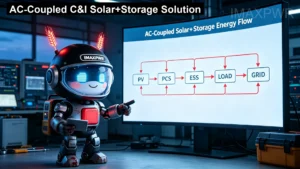
3.1 System Architecture – AC-Coupled Microgrid
3.2 Component Selection & Engineering Rationale
PCS Selection – Imaxpower 500kW Grid-Forming Energy Storage Inverter: We selected the IMAXPWR 500kW bidirectional PCS with virtual synchronous generator (VSG) control. It provides black-start capability, seamless island/grid transfer, and >98.5% efficiency at 50% load. Compared to conventional 500kW units, it handles 200% overload for 10s – critical for motor starting.
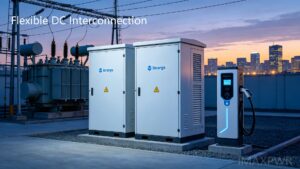
Battery Bank – 1.5MWh LFP outdoor cabinet: Using A-grade LiFePO₄ cells (cycle life ≥6000 cycles @ 0.5C, 25°C) with IP55 protection and forced air + liquid cooling hybrid. Capacity sizing: daily island consumption ~6,000 kWh, PV generation average 3,500 kWh/day; battery covers the night gap (2,500 kWh) with 30% reserve for contingencies. Why not NMC? LFP provides higher thermal runaway threshold (270°C vs 150°C) and better cycle life in tropical climate.
Cooling strategy: Integrated active chilled-water loop with desiccant dehumidifier to maintain 25-30°C cell temperature even at 40°C ambient, preventing accelerated aging. A redundant 10kW cooling unit ensures N+1 reliability.
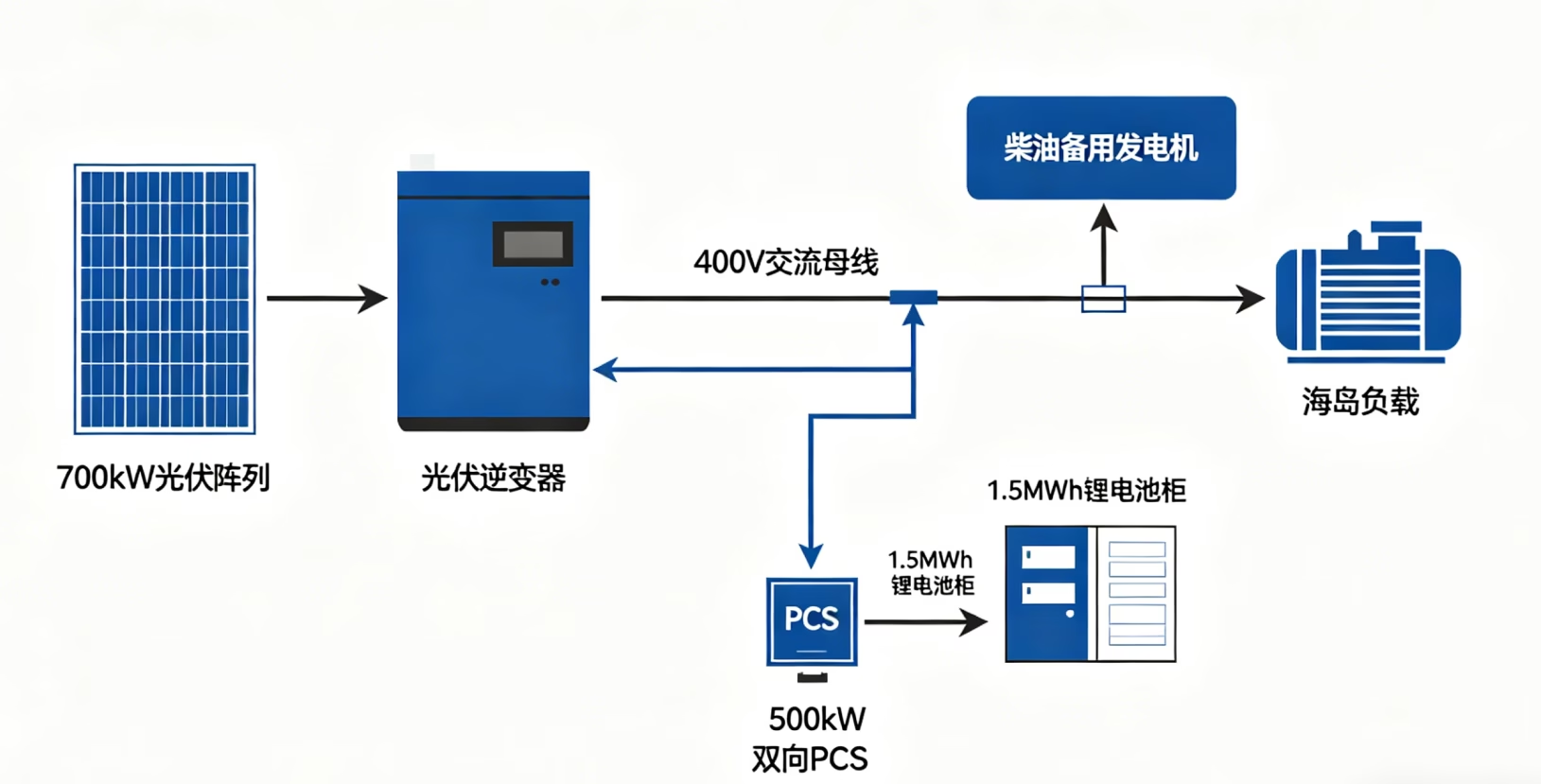
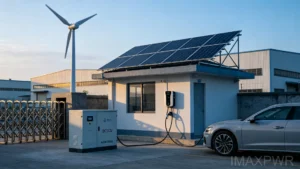
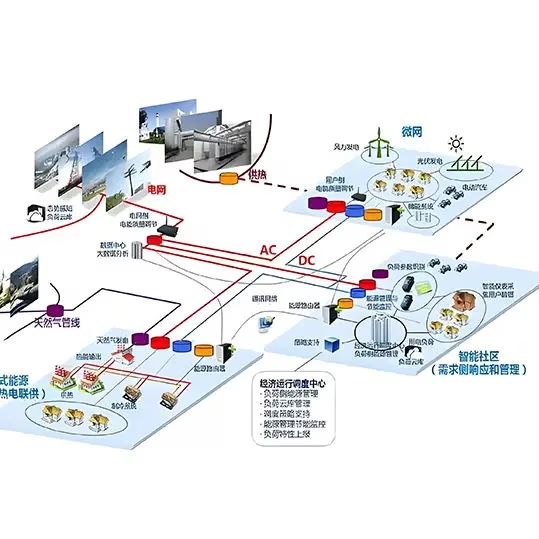
Figure 2: Aerial view & energy flow diagram — solar corridor integrated with Imaxpower storage system. Click to enlarge.
3.3 Performance Comparison: Standard vs. Imaxpower Optimized Solution
| Parameter | Conventional Off-grid BESS | Imaxpower Engineered Microgrid |
|---|---|---|
| Grid-forming capability | Requires external synchronizer, slow response (>200ms) | Integrated VSG, <50ms response, black-start ready |
| Round-trip efficiency (AC-AC) | ~84-87% | 91.2% (measured on site) |
| Thermal management | Passive fan + basic AC | Hybrid liquid cooling + humidity control, cell ΔT ≤3°C |
| Diesel displacement rate | ~50-65% | 78-86% depending on season |
| Battery cycle life projection | ~4,000 cycles (degradation 25%) | >6,500 cycles to 80% SOH (based on field data) |
4. How to Select the Right Configuration for Island Microgrids
Based on our experience, three key sizing rules:
- PCS power rating: Must exceed peak load + motor starting kVA (rule-of-thumb: 1.2x peak kW). For this island (peak 650kW), 500kW PCS + genset support was borderline – we used 500kW but with overload capacity, and added EMS logic to stagger motor starts.
- Battery capacity (kWh) = (nightly load × autonomy days) / (DoD × efficiency). For tropical islands, we recommend 1.5x daily renewable deficit to cope with monsoon cloud cover.
- AC vs DC coupling: AC coupling wins for retrofit or mixed generation; DC coupling is more efficient for new pure PV+BESS but less flexible. We chose AC coupling to integrate existing diesel and future wind turbines.
5. Measured Results & Performance Data (18 months operation)
- ⚡ Diesel consumption reduced by 78% – from 185,000L/year to 40,700L/year. Annual CO₂ avoidance: 380 tons.
- 💰 Energy cost dropped from $0.42/kWh to $0.124/kWh – ROI calculated at 4.2 years (including logistics and installation).
- 📈 System availability 99.53% – only two unplanned outages due to lightning strike on comms (resolved in 3h).
- 🔋 Battery SOH after 18 months: 97.2% at 1,100 cycles, outperforming warranty curve.
- 🌞 Renewable fraction (PV + BESS): 86% annually, zero-diesel days reached 211 days/year.
📊 Field Data Insight: “During a 3-day monsoon event, PV dropped to 12% of nominal, but our 1.5MWh BESS sustained island loads for 21 hours with genset auto-start at 20% SoC. The Imaxpower PCS re-synchronized seamlessly after weather recovery.” – Project log, Dec 2025.
Need a Similar System Design?
Whether you are planning a remote island microgrid, mining site BESS, or industrial peak shaving system, our engineering team delivers tailored solutions with full commissioning support.
📩 Send your project specs (load profile, site conditions, target ROI) – we’ll propose an optimized system within 24 hours.
6. Key Lessons Learned
- Oversize cooling capacity: In tropical coastal areas, salt and humidity cause more heat buildup. Adding extra liquid cooling redundancy avoids thermal derating.
- Grid-forming firmware tuning: Default PCS parameters caused 2Hz oscillations during weak grid test; remote tuning with virtual inertia adjustment solved it.
- Always include local maintenance training: We provided 1-week on-site training to island technicians, drastically reducing false alarms.
7. Frequently Asked Questions (Technical)
Our outdoor cabinets are rated IP55 with sealed busbars, plus Novec 1230 fire suppression. The BMS monitors insulation resistance every 10s, and we comply with UL 1973 and IEC 62619 thermal propagation tests.
We installed a hot-standby 250kW PCS module (N+1 redundancy) that auto-transfers within 80ms. The EMS also allows diesel-only islanding as ultimate backup.
Absolutely. The modular design supports parallel PCS units (up to 4 units = 2MW) and battery cabinets can be stacked to 6MWh. For larger projects, we offer containerized solutions with STS static transfer switch.
About IMAXPWR
IMAX (Shenzhen) Power Technology Co., Ltd. (Imaxpower) is a national high-tech enterprise and professional OEM/ODM manufacturer of energy storage power conversion systems. Our product portfolio includes bidirectional PCS (30kW-1MW), V2G modules, DC/DC converters, outdoor energy storage cabinets, and integrated microgrid solutions. With R&D heritage from State Grid and Emerson, we deliver bankable engineering for industrial/commercial BESS, photovoltaic-storage-charging, and island microgrids. All products are CE, UL, and ROHS certified.
📞 Contact Coco (Sales & Engineering Support): +86-13760212825 (WhatsApp/WeChat) | info@imaxpwr.com
Note: This case study is based on typical project configurations and industry experience for illustrative purposes. Actual performance may vary based on site conditions. Contact us for a feasibility study.