

6 Key Flow Battery Innovations Reshaping Long-Duration Energy Storage in 2026
As the global energy transition accelerates, the demand for reliable long-duration energy storage (LDES) continues to grow. While lithium-ion batteries have dominated the short-duration storage market, flow batteries are emerging as the game-changing solution for 8+ hour discharge applications that are critical for renewable energy integration. In 2026, several key innovations are pushing flow battery technology beyond traditional limitations, making it more cost-competitive, efficient, and scalable than ever before.
Grid operators, renewable energy developers, and independent power producers are all turning their attention to flow batteries for their unique advantages: longer cycle life, deeper discharge capability, and better safety profiles compared to conventional lithium-ion. Let’s explore the six most impactful innovations that are driving the flow battery revolution this year.
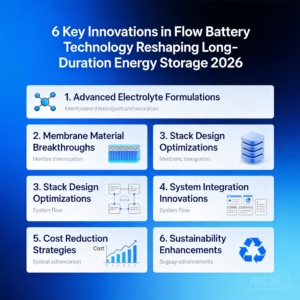
1. Advanced Organic Electrolytes Reducing Material Costs by 40%
One of the most significant breakthroughs in flow battery technology comes from organic electrolyte development. Traditional vanadium-based flow batteries have been limited by the high and volatile cost of vanadium, which can account for up to 60% of total system cost. In 2026, new aqueous organic flow batteries using quinone and other organic molecules have cut material costs by more than 40% while maintaining comparable performance.
These organic electrolytes are derived from abundant organic compounds that can be synthesized at scale, eliminating reliance on mining supply chains. The latest generation of organic flow batteries developed by leading researchers achieves energy efficiencies above 85% and demonstrates excellent stability over 10,000+ cycles with minimal capacity fade. This innovation is making long-duration energy storage economically viable for a much wider range of projects.
2. Membrane-less Designs Lowering Capital Expenditure
The ion-exchange membrane has long been one of the most expensive and failure-prone components of flow batteries. Traditional membranes account for 20-30% of total system cost and can degrade over time, affecting performance and increasing maintenance requirements.
2026 sees the commercialization of membrane-less flow battery designs that use laminar flow separation to keep positive and negative electrolytes from mixing. This innovation not only removes the most expensive single component but also simplifies system design and reduces maintenance. Early deployments of membrane-less flow batteries have shown capital expenditure reductions of 25-35% compared to conventional designs, while maintaining coulombic efficiencies above 90%.
For remote renewable energy projects that need to minimize upfront costs and maintenance, this innovation is particularly valuable. It complements well with hybrid microgrid designs where storage cost is a critical factor in project economics.
3. Reversible Redox Chemistry Extending Cycle Life Beyond 20,000 Cycles
Flow batteries are already known for longer cycle life compared to lithium-ion, but 2026 innovations are pushing this advantage even further. New reversible redox chemistry developments have enabled flow batteries to operate beyond 20,000 full charge-discharge cycles with less than 10% total capacity fade.
This extraordinary cycle life translates to over 30 years of operation for daily cycling applications – far exceeding the 10-15 year lifespan of typical lithium-ion systems. For grid-scale applications where asset owners expect 25+ year project lifetimes, this means the flow battery system won’t need replacement during the project’s lifetime, dramatically improving levelized cost of storage (LCOS).
The key innovation lies in stabilizing the redox active materials through molecular engineering, preventing side reactions and material degradation that occur over repeated cycling. This development comes from extensive collaboration between academic researchers and industry partners, who have successfully translated lab results into commercial-scale systems.
4. High Power Density Designs Enable Compact Footprints
A traditional criticism of flow batteries has been their larger footprint compared to lithium-ion batteries of the same power rating. However, 2026 innovations in high power density cell design have addressed this issue, increasing power density by 2-3 times compared to designs from just five years ago.
New electrode materials with advanced porous structures and improved surface area enable faster redox reactions, allowing higher current densities without increasing overpotential. This means that a flow battery system with the same power rating can now fit into a 50% smaller footprint, making it much more practical for utility-scale installations where land costs can be significant.
The improved power density doesn’t come at the expense of energy capacity – one of flow batteries’ key advantages remains the independent scaling of power and energy. Developers can still size energy capacity independently from power to match project requirements, whether that’s 8 hours, 12 hours, or multiple days of storage.
5. AI-optimized Energy Management Systems
Artificial intelligence is transforming flow battery operation in 2026. Advanced AI-powered energy management systems (EMS) optimize charge-discharge cycles in real-time based on market prices, weather forecasts, and system health data. These AI systems can extend battery life by 15-20% through intelligent operation that avoids stressful operating conditions.
The AI EMS continuously monitors electrolyte concentration, temperature, and system efficiency, automatically adjusting operating parameters to maintain optimal performance. Predictive maintenance algorithms identify potential issues before they become problems, reducing unplanned outages and maintenance costs.
For merchant storage projects participating in wholesale electricity markets, the AI optimization can increase revenue by 10-15% through improved arbitrage and ancillary service participation. This software innovation adds significant value on top of the hardware improvements, making flow batteries more profitable than ever for project owners.
6. Integrated Refrigerant-Free Thermal Management
Thermal management is crucial for maintaining flow battery performance and lifespan, but traditional cooling systems add cost, complexity, and energy consumption. The latest innovation in 2026 is integrated refrigerant-free thermal management that uses the electrolyte itself as a heat transfer fluid.
This design leverages the fact that flow batteries already circulate electrolyte through the system – the same circulation can pass through a simple heat exchanger to maintain optimal operating temperature without needing separate refrigerant-based cooling. This innovation reduces system complexity, eliminates refrigerant (an environmental benefit), and cuts parasitic losses by 2-3%, improving overall round-trip efficiency.
The integrated thermal management system also helps flow batteries perform better in extreme temperature environments, from very cold to very hot climates. This makes the technology more suitable for a wider range of geographic locations, including desert regions where solar irradiance is high but temperatures can be extreme.
Market Implications: Flow Batteries Are Ready for Prime Time
The combination of these six innovations has dramatically improved the economics of flow batteries for long-duration energy storage applications. In 2026, we’re seeing:
- Capital costs below $200/kWh for 10-hour systems
- Levelized cost of storage (LCOS) competitive with other peaking generation options
- Project lifespans exceeding 30 years with minimal maintenance
- Scalable manufacturing ramping up to meet growing demand
Major markets are already responding. The U.S. Department of Energy’s Long-Duration Storage Shot has accelerated innovation, and recent IRA tax credits have made flow battery projects even more attractive. In Europe, renewable energy auction programs are increasingly selecting flow battery projects alongside wind and solar farms to provide guaranteed capacity.
For renewable energy projects that need 4+ hours of storage, flow batteries are now often the most economical choice when total lifecycle costs are considered. Their excellent safety profile and non-toxic materials also make them more suitable for installations near population centers compared to some other storage technologies.
Conclusion: The Future of Long-Duration Storage Is Here
Flow battery technology has come a long way from the early laboratory prototypes. The six innovations we’ve explored in this article – advanced organic electrolytes, membrane-less designs, reversible redox chemistry, high power density, AI optimization, and integrated thermal management – have transformed the technology into a commercially competitive solution for long-duration energy storage.
As the world continues to increase renewable energy penetration, the need for long-duration storage will only grow. Flow batteries are well-positioned to meet this demand, complementing rather than competing with lithium-ion batteries which remain optimal for short-duration and high-power applications.
At Imaxpower, we’re closely following these technology developments and integrating the latest innovations into our energy storage project designs. Whether you’re developing a utility-scale renewable energy park, a remote microgrid, or an industrial energy storage project, our engineering team can help you evaluate whether flow battery technology makes sense for your specific requirements.
Contact Coco today to discuss your long-duration energy storage project:
Phone: +86-13760212825
Email: info@imaxpwr.com
Our team of experienced energy storage engineers is ready to help you design a customized solution that maximizes project economics and reliability. Get in touch today to schedule a consultation.