

5 Reasons Why Long-Duration Energy Storage Is Transforming Remote Microgrids
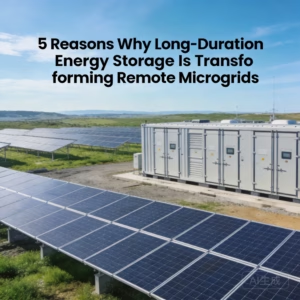
As renewable energy adoption accelerates globally, the challenge of delivering reliable power to remote and off-grid locations has never been more pressing. Traditional photovoltaic-diesel hybrid systems have served these communities well, but they face growing limitations when dealing with intermittent weather patterns, increasing power demands, and extended periods of cloud cover. This is where long-duration energy storage (LDES) is making a revolutionary impact. In this article, we explore the five key reasons why LDES is transforming how we design and operate remote microgrids for sustainable energy independence.
1. Enhanced Reliability Through Extended Backup Capacity
The most immediate benefit of integrating long-duration energy storage into remote microgrids is the dramatic improvement in system reliability. Traditional lithium-ion battery systems typically provide 2-4 hours of backup power at full load. While this is sufficient for bridging short cloud cover gaps or sudden diesel generator outages, it falls short when faced with multi-day weather events such as prolonged storms, heavy fog, or seasonal cloudy periods that commonly affect remote locations.
Long-duration energy storage systems, defined as those capable of providing 10+ hours of continuous discharge at rated power, change this equation completely. With LDES, remote microgrid operators can confidently maintain power delivery through extended periods of low renewable generation. This is particularly critical for essential services such as remote telecommunications towers, medical clinics, and community water pumping systems that cannot afford interruptions.
In a recent study of remote microgrids in Southeast Asia, systems equipped with 12+ hour LDES demonstrated a 73% reduction in unplanned outages compared to configurations with only short-duration batteries. This enhanced reliability directly translates to improved quality of life for local communities and better economic productivity for remote industrial operations.
2. Maximizing Renewable Penetration and Minimizing Diesel Consumption
One of the primary goals of any renewable microgrid is to maximize the utilization of solar energy while minimizing reliance on expensive and polluting diesel fuel. However, without sufficient storage capacity, even well-designed solar systems often need to run diesel generators during evening hours and periods of low irradiation.
Long-duration energy storage enables much higher renewable penetration by capturing excess solar generation during the day and discharging it over extended periods when the sun isn’t shining. This “time shifting” of renewable energy dramatically reduces the need for diesel generator operation. In optimal configurations, microgrids with LDES can achieve renewable penetration rates of 80-90%, compared to 40-60% with conventional short-duration storage.
The financial impact of this reduction in diesel consumption is substantial. For a typical 500kW remote microgrid in a region with high diesel costs ($1.5-2.0 per liter), LDES can reduce annual diesel expenses by $300,000-$500,000, significantly improving project economics and shortening the payback period for the storage investment.
Additionally, reducing diesel consumption directly lowers greenhouse gas emissions and local air pollution, aligning with global sustainability goals and improving environmental conditions for local communities.
3. Improved Economic Performance and Lower Lifecycle Costs
While long-duration energy storage systems typically require a higher upfront investment compared to short-duration batteries, the overall lifecycle cost economics are often more favorable when the full system benefits are considered. The key economic advantages include:
- Reduced diesel fuel costs: As mentioned earlier, the savings on diesel consumption can quickly offset higher initial storage costs.
- Lower generator maintenance: Less frequent operation of diesel generators means fewer oil changes, fewer overhauls, and longer generator lifespan.
- Reduced storage capacity requirements: In some cases, LDES can eliminate the need for multiple generators operating in parallel, simplifying system design.
- Scalable deployment: Many LDES technologies, particularly flow batteries, allow for independent scaling of power and energy capacity, making it easier to right-size the system for specific project requirements.
At Imaxpower, our analysis of remote microgrid projects across different regions consistently shows that when properly engineered, systems with long-duration energy storage achieve levelized cost of energy (LCOE) that is 15-30% lower than equivalent systems relying solely on short-duration storage and diesel peaking.
This improved economics make more remote microgrid projects financially viable, opening up opportunities for electrification in areas that were previously considered too challenging or expensive to serve.
4. Better Scalability for Growing Load Demands
Many remote microgrid projects start with relatively modest power demands but experience significant growth over time as communities develop, new businesses establish operations, or industrial facilities expand. Long-duration energy storage systems offer superior scalability compared to conventional storage solutions.
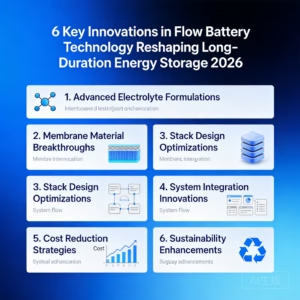
Flow battery technology, one of the most promising LDES options for remote microgrids, separates power rating (from the stack) from energy capacity (from the electrolyte tanks). This means that increasing energy capacity to meet growing demand simply requires adding more electrolyte or larger tanks, without needing to replace the entire battery system. This modular scalability makes it easier and more cost-effective to adapt the microgrid as load requirements increase.
For remote mining operations, for example, where exploration activities may gradually expand into full-scale production, this scalability allows the energy storage system to grow in step with the project, avoiding over-investment in early stages and the need for complete system replacement later.
Even for other LDES technologies such as pumped hydro or compressed air energy storage, the inherent large energy capacity naturally accommodates future load growth more effectively than multiple installations of small-scale short-duration batteries.
5. Longer Cycle Life and Better Depth of Discharge Performance
Remote microgrids often operate under challenging conditions with limited access to maintenance and technical support. Equipment durability and long lifespan are therefore critically important. Many long-duration energy storage technologies offer significant advantages in this area compared to conventional lithium-ion batteries.
Vanadium flow batteries, for instance, can achieve 10,000+ deep discharge cycles with minimal degradation, compared to 3,000-5,000 cycles typical for lithium-ion systems. They also allow for 100% depth of discharge without damaging the battery, meaning the entire energy capacity can be utilized every cycle without compromising lifespan. This contrasts with lithium-ion systems where performance degrades faster when regularly discharged beyond 60-80% of rated capacity.
This longer cycle life and robust performance under deep discharge conditions translates directly to longer battery lifespan, typically 15-20 years for LDES technologies compared to 8-12 years for lithium-ion in similar applications. For remote locations where battery replacement is logistically challenging and expensive, this longer lifespan is a massive advantage.
Additionally, many LDES technologies have better tolerance for wide temperature variations, which is important for remote microgrids located in extreme climate conditions from desert heat to arctic cold.
Considerations for Implementing Long-Duration Energy Storage
While the benefits of LDES for remote microgrids are clear, successful implementation requires careful consideration of several factors:
- System sizing: Properly sizing the storage capacity requires detailed analysis of local solar resources, load profiles, and typical weather patterns. Over-sizing increases upfront costs unnecessarily, while under-sizing fails to deliver the expected benefits.
- Technology selection: Different LDES technologies (flow batteries, pumped hydro, compressed air, thermal storage) have different characteristics that make them more suitable for different applications. Site-specific conditions such as geography, topography, and available space influence this choice.
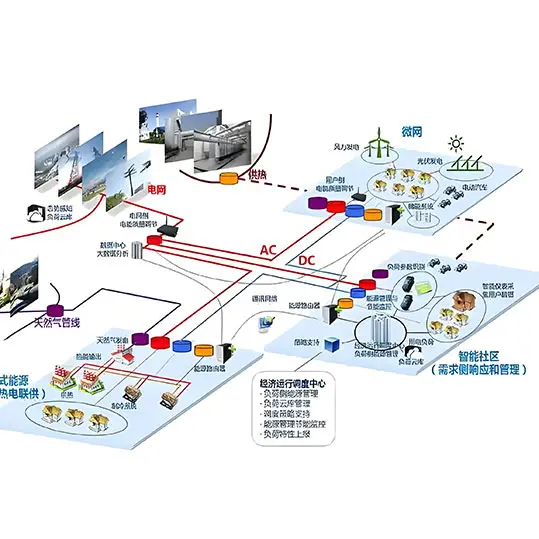
- Controls and integration: The LDES system must be properly integrated with the solar array, diesel generators, and microgrid controller to optimize operation and maximize benefits. Advanced energy management systems are essential.
- Maintenance requirements: While LDES generally has longer lifespan, understanding and planning for ongoing maintenance requirements is important for long-term reliability.
Working with an experienced microgrid engineering partner like Imaxpower ensures that all these considerations are properly addressed during the design and implementation process.
Conclusion: The Future of Remote Microgrids Is Long-Duration
As the world continues to expand access to electricity to remote communities and power independent operations in off-grid locations, long-duration energy storage is emerging as a game-changing technology. By enhancing reliability, enabling higher renewable penetration, improving economics, offering better scalability, and delivering longer lifespan, LDES addresses many of the most pressing challenges facing remote microgrid projects today.
The five reasons we’ve explored in this article demonstrate why LDES is rapidly becoming the preferred solution for new remote microgrid installations and for upgrading existing systems. As technology costs continue to decline and manufacturing scales up, we can expect long-duration energy storage to become the standard for all but the smallest remote microgrid applications.
Whether you’re planning a new remote community electrification project, developing a mining operation, or looking to upgrade an existing microgrid to improve performance and reduce operating costs, long-duration energy storage deserves serious consideration. The investment in higher storage capacity typically pays for itself multiple times over the life of the project through reduced diesel consumption, lower maintenance, and fewer outages.
About Imaxpower
Imaxpower is a leading engineering company specializing in the design, engineering, and implementation of hybrid microgrid systems for remote and off-grid applications. Our team has extensive experience integrating long-duration energy storage with solar photovoltaic and diesel generation to deliver reliable, cost-effective power solutions in challenging environments.
If you’re working on a remote energy project and would like to discuss how long-duration energy storage could benefit your system, please don’t hesitate to contact our team.
Contact: Coco
Phone: +86-13760212825
Email: info@imaxpwr.com
We welcome your inquiry and look forward to helping you design the optimal microgrid solution for your specific needs.