

5 Key Challenges Deploying Hybrid Microgrids in African Off-Grid Commercial Hubs — And How to Solve Them
Across sub-Saharan Africa, the lack of reliable grid electricity remains one of the most significant barriers to economic growth. According to recent reports, less than 50% of the population has access to steady power, and for small and medium enterprises (SMEs) in peri-urban and rural areas, the situation is even worse. For decades, these businesses have relied on expensive, polluting petrol generators that eat up to half of their monthly revenue while emitting dangerous levels of pollutants.
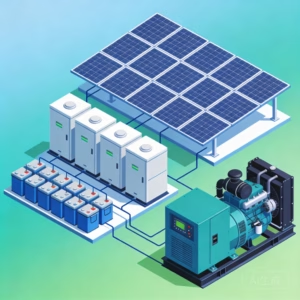
Today, photovoltaic-storage-diesel hybrid microgrids are emerging as the definitive solution to this crisis. By combining solar PV, battery energy storage, and backup diesel generation, these systems deliver reliable, clean electricity at a fraction of the running cost of traditional generators. However, deploying successful hybrid microgrids in African commercial hubs comes with unique challenges that many engineering teams overlook.
In this article, we break down the 5 most critical challenges and share proven engineering solutions drawn from real-world project experience. Whether you are a developer, investor, or local business owner, understanding these challenges upfront will make the difference between a project that delivers years of reliable service and one that becomes a costly headache.
1. Unpredictable Load Profiles & High Peak Demand Variability
One of the first challenges engineering teams face when designing a hybrid microgrid for African commercial hubs is the highly unpredictable nature of load demand. Unlike industrial facilities or residential communities, commercial clusters like marketplaces, shopping plazas, and small business parks have extremely variable demand patterns. Multiple independent businesses connect and disconnect power at will, with peaks often driven by seasonal trading patterns, unexpected events, and even weather changes.
For example, in a typical Nigerian commercial plaza studied recently, peak afternoon demand could be 3-4 times higher than early morning demand on regular business days. During harvest seasons or holiday trading periods, that peak can jump an additional 30-50% as businesses extend hours and add more equipment. If a hybrid microgrid is designed based on average demand rather than properly accounting for this variability, it will either fail to meet peak load or be oversized, driving up unnecessary capital costs.
The Solution: Dynamic Sizing with Smart Load Forecasting
The answer to unpredictable load profiles is not oversizing the system – it’s dynamic sizing that combines data-driven forecasting with flexible battery management. At Imaxpower, we recommend conducting at least 1-2 weeks of on-site load monitoring before finalizing design. This data helps identify not just average and peak demand, but also the frequency and duration of peak events.
By integrating this data into our simulation models, we can right-size both the solar array and battery storage capacity. The photovoltaic-storage-diesel hybrid microgrid design should allow the battery system to handle short duration peak spikes, with the diesel generator only kicking in for extended high-demand periods or during prolonged periods of bad weather. This approach balances capital cost with reliability, ensuring you don’t pay for more capacity than you actually need while still meeting business requirements.
Related reading: 4 Core Design Principles That Make or Break Your PV-Storage Microgrid Project
2. Harsh Climate Conditions & Environmental Stress
Most of the best opportunities for off-grid hybrid microgrids in Africa are located in hot, humid, dusty climates that put significant stress on electrical equipment. High ambient temperatures reduce the efficiency of both solar panels and battery storage, while dust and humidity can accelerate corrosion and equipment degradation if proper precautions are not taken from the start.
Solar panel efficiency drops significantly as temperature increases – for every 1°C above 25°C, crystalline silicon panel efficiency typically drops by around 0.3-0.5%. In many parts of West Africa, ambient temperatures regularly exceed 40°C during hot seasons, which can reduce output by 5-8% compared to standard test conditions. For batteries, high temperatures dramatically accelerate degradation, cutting cycle life in half or worse if they are not properly cooled.
Dust is another hidden challenge. Heavy Harmattan winds in West Africa can deposit centimeters of dust on solar panels in just a few weeks, drastically reducing output until cleaning. And high humidity creates favorable conditions for corrosion on exposed electrical connections, which can lead to intermittent faults and equipment failure over time.
The Solution: Climate-Hardened Design & Proper Maintenance Planning
Working in harsh climates doesn’t mean you have to drastically overspend – it means you need to climate-harden your design from day one. For solar arrays, this means:
- Specifying panels with better temperature co-efficients and rugged construction
- Designing mounting structures with adequate air gap behind panels to facilitate cooling
- Including budget for regular cleaning schedules (typically every 2-4 weeks depending on location)
- Using corrosion-resistant materials for all mounting hardware and electrical connections
For battery energy storage, the most important factor is proper climate control. Even “high-temperature” lithium batteries benefit from passive or active cooling in extreme climates. Containerized battery systems with integrated HVAC might add some upfront cost, but they more than pay for themselves by extending battery life from 5-6 years to 10+ years in hot climates.
3. Limited Local Technical Capacity & Maintenance Access
Even the most well-designed hybrid microgrid will fail without qualified local personnel to operate and maintain it. One of the biggest challenges facing many microgrid projects in Africa is the lack of local technical capacity. Many regions simply don’t have experienced technicians who understand the complex interaction between solar, storage, and diesel generation in a hybrid system.
When something goes wrong – whether it’s a minor inverter fault or a battery management system alert – the project owner often has to wait days or weeks for a foreign expert to fly in, leaving businesses without power during that time. These extended outages erode trust in the microgrid model and can sink the financial viability of even the best-planned projects.
The Solution: Proactive Capacity Building & Remote Monitoring
The key to addressing this challenge is investing in local training from the project planning stage, not as an afterthought. Successful developers like ICE Commercial Power, profiled recently by the World Economic Forum, partner with local universities to train young people as solar installers and data analysts, creating a local workforce that can support ongoing operations.
Modern technology also helps bridge the gap. Every Imaxpower hybrid microgrid comes with cloud-based remote monitoring that allows our engineering team to detect and diagnose many issues without needing to be on-site. We can often fix software or configuration problems remotely, and if a physical part replacement is needed, we can guide a local technician through the process step-by-step.
This combination of proactive training and remote monitoring dramatically reduces downtime and ensures that local businesses can count on their power 24/7. It also creates local jobs and builds support for the project within the community.
4. Difficult Financing & High Upfront Capital Costs
While the levelized cost of electricity from a hybrid microgrid is almost always lower than running diesel generators, the upfront capital cost of purchasing and installing solar panels and batteries is significantly higher. For many local project developers and business owners, accessing affordable financing remains one of the biggest barriers to getting projects off the ground.
International investors often perceive microgrid projects in emerging markets as high-risk, and local banks frequently offer loans with interest rates that make projects uneconomical. This financing gap means that many viable projects never get built, leaving businesses stuck with expensive generator power.
The good news is that this situation is improving. Development finance institutions and impact investors are increasingly recognizing the tremendous social and economic impact of microgrid projects in Africa, and more flexible financing options are becoming available. The US African Development Foundation and other organizations are already supporting promising projects like ICE’s work in Nigeria, helping to de-risk investment and unlock additional capital.
The Solution: Modular Design & Pay-As-You-Go Models
From an engineering perspective, the best way to address financing challenges is to design projects for modular expansion. Instead of installing the full projected capacity upfront, design the system so you can add additional solar panels and batteries incrementally as demand grows and revenue comes in. This reduces the upfront capital requirement and matches investments to revenue streams.
The pay-as-you-go model, successfully used by ICE and others, has also proven effective for expanding access. With no upfront costs for customers, businesses can connect to clean energy on a pay-as-you-go basis through a mobile app, making the solution immediately accessible even for smaller businesses with limited capital.
For developers, this model requires careful system design with smart meters and remote disconnect capabilities, but it dramatically expands the addressable market and helps projects achieve financial sustainability more quickly.
Related reading: 7 Key Design Factors That Determine the Success of Your PV-Storage-Diesel Hybrid Microgrid
5. Grid Interconnection Uncertainty & Long-Term Evolution
In many emerging market regions, the main utility grid is gradually expanding into underserved areas. This creates a dilemma for microgrid developers: what happens when the main grid eventually reaches the project area? Will the microgrid become stranded, or can it continue to provide value?
This uncertainty makes some investors hesitant to commit to microgrid projects. However, experience shows that even when the main grid does arrive, hybrid microgrids continue to provide significant value by providing backup power during frequent grid outages, which remain common in many African countries. The key is designing the system with this long-term evolution in mind.
The Solution: Design for Multi-Mode Operation from Day One
The solution to long-term uncertainty is to design the hybrid microgrid for both off-grid operation and seamless grid interconnection. Modern hybrid inverters and microgrid controllers allow the system to operate in multiple modes:
- Off-grid mode: Full island operation serving the load independently
- Grid-tied mode: Connected to the main grid, providing peak shaving and backup power
- Emergency backup mode: Automatically islanding from the grid during outages
By designing for multi-mode operation upfront, you ensure that the microgrid will continue to deliver value regardless of when – or if – the main grid arrives. The investment in solar panels and batteries remains productive, providing lower energy costs and improved reliability even after main grid arrival. This flexibility makes the project more bankable today and protects the investor’s capital over the long term.
Conclusion: Hybrid Microgrids Are the Path Forward
Deploying hybrid photovoltaic-storage-diesel microgrids in African off-grid commercial hubs comes with real challenges, but none of them are insurmountable. By addressing these 5 key challenges upfront with proven engineering solutions, developers can deliver projects that provide reliable, affordable clean electricity to businesses that need it most while achieving solid financial returns.
The opportunity is enormous. According to the International Energy Agency, off-grid solutions like hybrid microgrids will play a critical role in increasing electricity access across Nigeria and other sub-Saharan African countries. Companies like ICE Commercial Power are already demonstrating that the model works, connecting hundreds of businesses and saving them up to 35% on energy costs while creating local jobs and reducing carbon emissions.
With the right design approach, local capacity building, and flexible financing, we can scale this model across the continent, unlocking economic growth in communities that need it most. The combination of falling solar and battery costs with improved engineering know-how makes this the perfect time to invest in hybrid microgrids for African commercial hubs.
About Imaxpower
Imaxpower is a leading engineering provider of customized photovoltaic-storage-diesel hybrid microgrid solutions for remote and off-grid projects around the world. With years of experience designing and deploying systems in challenging environments across emerging markets, we help developers and investors navigate the unique challenges of these projects to ensure long-term success.
Whether you are planning a small commercial microgrid or a large off-grid mining project, our engineering team can help you optimize your design for reliability, cost, and climate resilience.
Contact Coco today to discuss your project:
Phone: +86-13760212825
Email: info@imaxpwr.com
Send us your project requirements, and our engineering team will provide you with a customized design and quotation.